It’s a bit odd in its way that a fair fraction of the more or less British theatre we watch comes to us via National Theatre Live or one of its subsidiaries. A few years ago – in 2018 – you might have seen Sophie Okonedo play Cleopatra to the Antony of Ralph Fiennes. Before that, there was a resoundingly grand production of Shaw’s Man and Superman where Ralph’s Jack Tanner was partnered with Indira Varma and the text was wonderfully uncut and included the dazzling dialogue of the ‘Don Juan in Hell’ section, which had been recorded by itself in the 1940s with Charles Boyer, Agnes Moorehead and Charles Laughton among others. Decades later, in 1993, Norman Mailer directed a benefit reading with Gay Talese as Don Juan, Susan Sontag as Doña Ana and Gore Vidal as The Devil. Man and Superman is arguably Shaw’s greatest work, and it’s to the credit of NT Live – and their distributor here, Sharmill Films – that they can do this sort of thing and make it available to an audience of millions, potentially. You might not have warmed to, say, Benedict Cumberbatch’s 2015 Hamlet (with Ciarán Hinds as the King), but it’s good to have got a glimpse of it.
What else stays in the mind? Well, there was a dazzling production of The Crucible by the South African director Yaël Farber in 2014, and there was a startlingly fine production of Lorca’s Yerma with Billie Piper conquering every obstacle in sight in Simon Stone’s production. Then there was Ruth Wilson in Ivo van Hove’s production of Hedda Gabler – almost as far as possible from the famous 1960s version with Ingrid Bergman in the title role, Ralph Richardson as Judge Brack and Michael Redgrave as Tesman. Wilson’s Hedda was jagged and visceral. Did it have something in common with Helen Morse’s Sylvia Plath-like Hedda for the Melbourne Theatre Company?
When people shuffle the cards of memory, they will come up with favourites like Alan Bennett’s The Habit of Art about Auden (Richard Griffiths) and Benjamin Britten (Alex Jennings).
The very first NT Live production we saw – which is still on their site – was Phèdre with Helen Mirren as the fated Queen and Dominic Cooper (remember him in The History Boys?) as her bewildered love object; the translator of Racine’s almost icy tragedy is Robert Lowell and it is full of colour and confusion. It has an exceptional cast with Margaret Tyzack as the retainer and the Irish actress Ruth Negga as Aricia is magnificent in the way she articulates her anguish and the whole production (directed by Nicholas Hytner and Robin Lough) has a sense of bright impending doom in the manner of those mannerists of madness and mayhem, the Jacobeans. Mirren captures the horror of an older woman who is willing to shatter the bonds of familial chastity as she yearns for her surrogate son. And although it’s Mirren’s show the rest of the cast hold her up with a sort of collective grandeur.
Ruth Negga has since played Lady Macbeth to Daniel Craig’s Thane. She’s Irish with a magnificent lilt to her voice, and given her Ethiopian background, it was fascinating to see that she was playing Pegeen Mike in a production of Synge’s The Playboy of the Western World.
Remember the moment in James Joyce’s Ulysses when Mulligan says, ‘Shakespeare, I seem to recall the name.… Ah, to be sure, the fellow who writes like Synge.’ John Millington Synge was one of the central figures in the Celtic revival. He truly had gifts comparable to Shakespeare’s. His Riders to the Sea is a 30-minute one-act tragedy performed by Dame Sybil Thorndike (with the young Sean Connery as one of her sons), and it packs astonishing dramatic power into a short space. Synge became the primary Irish playwright of the Abbey Theatre Dublin, and his influence continues today when he is patently the model for Martin McDonagh’s trilogy The Beauty Queen of Leenane, which employs Synge’s tragicomic moodiness and brilliance and, in fact, extends further on film with The Banshees of Inisherin, which has an Aran Islands setting as well as a tragic shading.
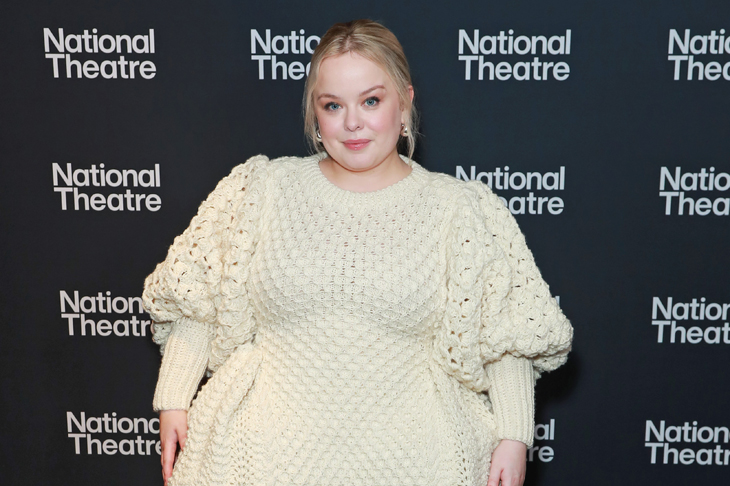
Now we have a stage production of Synge’s most famous play, the shimmeringly brilliant The Playboy of the Western World, which uses two stars from Derry Girls – Nicola Coughlan in the Siobhán McKenna role of Pegeen Mike and Siobhán McSweeney as Widow Quin.
Playboy is an extraordinary combination of lyricism and grotesquerie, and you can actually make the case that Synge, who died tragically young, is the greatest playwright anywhere since the heyday of Racine and Molière. His gift is extraordinary. He is the great Irish playwright in the sense that Yeats is the great Irish poet, and Joyce is the great prose writer. And this is despite Beckett’s proximity, who is also a great dramatic playwright, though a strong one, not a flamboyant one.
The Derry Girls have a very spirited command of Synge’s music and also of his breathtaking artfulness with plot: Christy Mahon appears in this County Mayo village, revealing that he has killed his father, and becomes a figure of immense prestige and glamour as a consequence. He is saluted; he is salaamed. The set combines a table and chairs as well as an epic glimpse of a wild and seductive oceanic background.
It’s very easy on the eye, and the blarney and grandness of the voices carry an endowed conviction as the storyline becomes wilder and wilder. The Playboy of the Western World is a magnificent house of cards full of bejewelled and boisterous language. The imagery of Catholicism and the violence of a Hibernian community is a hoot, and everyone should see this heroic rant for a group of beautiful voices, even if it could have a touch more light and shade.
It is as if Synge has appropriated the Derry Girls and given them the irresistible quality of his great mouthful of air. The supporting cast is grand, and there are names like Cusack and Rea that remind us of how strong the Irish tradition is and the beauty and barbarity it draws from its drama.
Synge caused riots when Playboy opened at the Abbey. It’s as if this comic glory of a play held up a mirror of surpassing ugliness to its first audience. Still, we surrender to the verbal music, which is really Shakespearean in the loftiness of its command of rhetoric.
Got something to add? Join the discussion and comment below.
You might disagree with half of it, but you’ll enjoy reading all of it. Try your first month for free, then just $2 a week for the remainder of your first year.