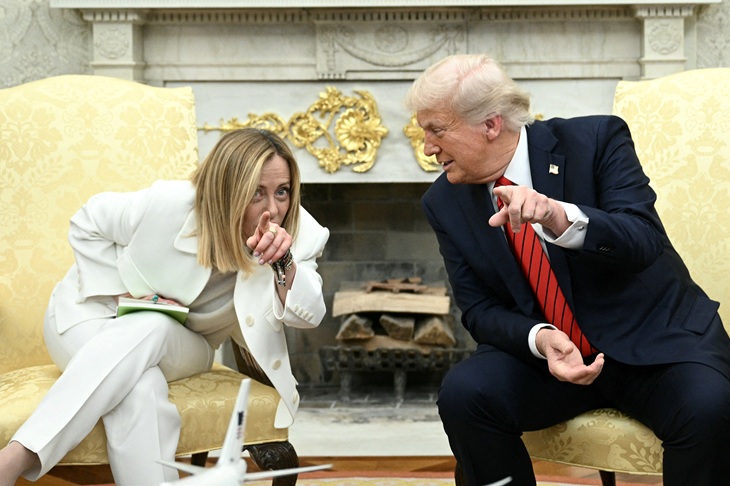
Amidst the extremely serious geopolitics of Europe and the Middle East – where politicians are navigating active war fronts – a fresh battle has broken out in the world’s headlines.
The initially amicable relationship between Italian Prime Minister Giorgia Meloni and US President Donald Trump has deteriorated over a photograph.
When asked about a picture taken of Meloni and Trump at the G7 Summit, Trump replied (according to a translation from La7 TV):
‘She’s probably happy I talked to her. I didn’t have to talk to her. She begged me to take a picture with her. She wanted a picture with me so badly. I wouldn’t have taken it, but I felt sorry for her.’
Keep in mind, these reports are being sourced from dubbed audio. Still, there has been very real political fallout lending authenticity to the incident.
Meloni put up a social media response shortly after, insisting: ‘Neither I, nor Italy, ever beg.’
Io e l’Italia non imploriamo mai. pic.twitter.com/sTpKlqWB67
— Giorgia Meloni (@GiorgiaMeloni) June 19, 2026
According to reported translations, Meloni said:
‘Donald Trump’s statements are completely made up. I am frankly astonished.
‘I don’t know why the President of the United States behaves like this towards his allies: it is not the first time, moreover.
‘I can only say it is disappointing that he does not show the same determination with the enemies of the West and of the United States, whose leaders he instead treats with far greater indulgence.
‘There is one thing he should remember: neither I, nor Italy, ever beg.’
Watching the global right argue over photo ops at the G7 is not high on the list of priorities for voters who are deeply concerned about mass migration, war, Islamic terror, and collapsing economies. Many would have preferred these two to eye-roll it and move on.
That is not what happened.
Italy is treating the incident as a Zelenskyy suit-level slight.
Just as the White House meeting had nothing to do with the Ukrainian President’s clothes, it is similarly unlikely that this incident is about a photo.
In the aftermath, Italy’s Foreign Minister, Antonio Tajani, has cancelled his visit to the United States set for early next week. Not a coincidence. He pinned the move directly on Trump’s comments.
‘The grave and offensive words of President Trump … offend the whole of Italy.’
Not really, although it is convenient for the Italian leadership to take that line. After all, when Ambassador Rudd and Prime Minister Albanese were chewed over by Washington, the average Aussie did not take it personally. Some even raised their beer in approval.
Having been one of Meloni’s most powerful supporters during her difficult rise to power, their dialogue has been on the rough side since war in Iran broke out. Italy also copped some of the blame for Pope Leo’s overt opposition to Trump’s actions against the Iranian regime. Meloni obviously has to walk an extremely fine line between the Pope, domestic politics, and the world’s most powerful leader.
She has all the demographic problems that mass migration brings, complicated by an increasingly spiritual conflict between Catholicism, Islam, and the Jewish leadership in Israel.
When Italy refused to allow US planes to land on an air base, Trump snapped saying he was ‘shocked by her’.
‘She doesn’t care if Iran has a nuclear weapon and would let it blow Italy to smithereens in two minutes if it could.’
Italy’s take on the situation is different, although not particularly convincing. Insisting that no activity would occur outside existing international agreements that have been in place since the 1950s, a cynic might suspect they would have bent those rules if Italy had wanted US support. All of these sorts of military rules are more like guidelines that are ignored when advantageous and insisted upon as an excuse.
This is especially likely based on Meloni’s words: ‘We are not at war, and we do not want to enter a war.’
Others could argue that Iran’s sponsorship of global terror and hand in the mass migration of radical Islam into nations such as Italy could constitute an act of war, albeit it disguisable.
While discussing Italy’s lack of enthusiasm for ensuring Iran remains without nuclear capability, Trump said, ‘She’s very different from what I thought.’
In many ways, that comment is far more severe than this trivial nonsense over photographs.
While we obviously cannot know what might have led to this exchange taking place, we have seen similar snaps from President Trump in retaliation for serious political tensions or disappointments. Ukrainian President Volodymyr Zelenskyy is easily one of the most notable examples where he was made to suffer a ritual, globally-broadcast, humiliation before Trump agreed to offer further assistance. He is far from alone, with choice comments directed at members of Nato, the European Union, and Keir Starmer. And yes, often those individuals deserved it. In this, Trump is hardly making history. The difference is that in the era of social media and online publications, off-hand remarks are amplified beyond what would have gone unnoticed in previous centuries. You can still find plenty of them if you read history books containing recollections from contemporary staffers.
For Meloni, the scuffle with the man the world loves to hate is playing well domestically.
Trump’s withering remarks have been pushing similarly wounded European nations closer together in opposition to the US, even though those nations rely on the US to keep them safe from war. It is this parasitic relationship, which offers the US very little except nauseating trade arrangements, that set Trump out of sorts in the first place. And so the whole thing goes around endlessly. Europe, after all, does not want to pay for itself. They essentially want a different US President who gives them money without strings and they might just get it if US citizens backtrack. Well, for five minutes until the US goes broke trying to be the world’s sugar daddy. Then Europe will find itself dealing with China and Russia.
The truth of global politics of Donald Trump is far more complex than articles on ‘slights’ and ‘offence’ make out.
Donald Trump has been elected to govern over a world at the edge of crisis with archaic institutions, such as the UN, EU, and Nato, so bloated and corrupted that they no longer function except as shells protected by US money and the threat of US military interference. We saw a perfect example of media delusion over this at last week’s National Press Club when Pauline Hanson was challenged over her desire to withdraw from the UN. What will Australia do with freedom of shipping? The same thing it has always done, because the UN does not police freedom of navigation … the US does. Failing to understand the difference between paper treaties and political reality is a structural disease eroding the current political conversation.
The organisations of global bureaucracy are inconceivably broken.
When Trump tried to fix this by withdrawing support and funding in a way designed to force Europe to stand up and support itself, even populist leaders began to revolt, presumably because they are broke just like every other nation in Europe. In the end, there is a depressing consistency between populists, socialists, and dying old parties. They are all more frightened of their voters than foreign aggression.
While Argentina’s Javier Milei is taking the necessary steps to salvage the economy so the nation can eventually regain its full independence, Europe is leaning heavily back on its bureaucratic structures like a child gravitates to their comfort toy.
These leaders are torn between taking the necessary steps toward survival, and pandering to fragile domestic politics where their socialist rivals are waiting to tear them down with the promise of exacting economic revenge on the so-called rich. Those who shout fascism the loudest are the fascists in waiting, and yet voters are so upset by their living conditions that they simply do not care.
European leaders are doing a remarkably poor job of selling the narrative of change and self-reliance to the people, preferring to take the easy ‘victimhood’ polling boost by pretending Trump’s frustration is aimed at the people, not the leaders and their parties. It is a story of weakness, political expediency, and an inevitable fate that will make European leaders long for day when Trump was a bit mean to them in an interview.
Whatever patience Trump had for Europeans has evaporated when his military assets were turned away.
Replying to Meloni’s comments, Trump said:
‘Italian Prime Minister Giorgia Meloni asked, over and over, for a picture with me during the G7 meeting in France.
‘She is doing poorly in Italy with her level of popularity, possibly because she turned down the United States of America, a country that truly loves and protects Italy, when it came to denying Iran from obtaining or developing a nuclear weapon (but so did Nato, for that matter!).
‘She wouldn’t even let us use Italy’s landing strips or runways, a great logistical inconvenience, and this despite the fact the US contributes hundreds of billions of dollars a year to protect Italy and other so-called Nato allies.
‘Now, after the United States defeated Iran militarily, she wants to be friends again in order to get her numbers up. No thanks!!!’
This is not going to end well.
Flat White is written by Alexandra Marshall. If you would like to support her work, shout her a coffee over at donor-box.