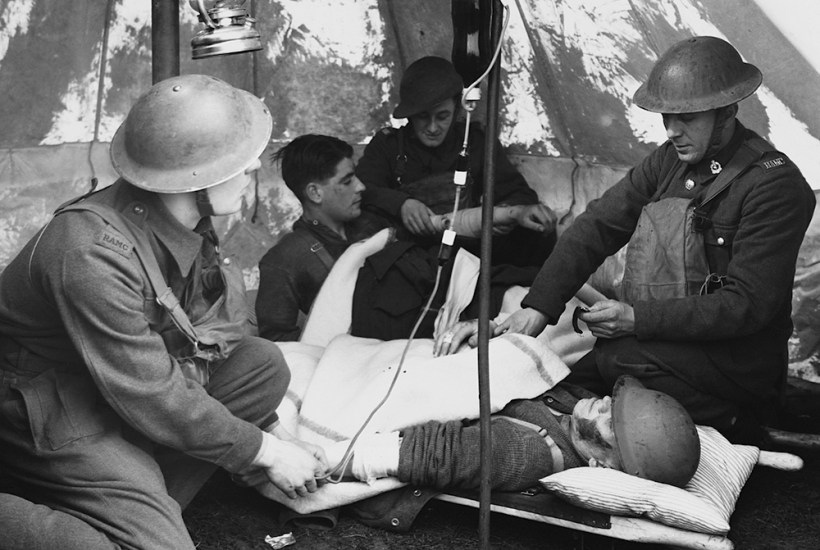
Most conventional second world war military histories focus on weapons, materiel and even the manpower needed for a decisive victory over Hitler and the Axis powers. Little has been written about blood as a strategic resource. However, a pioneering service of specially trained medics who worked dangerously close to the front lines, pumping blood into the veins of battle casualties, saved not only lives but contributed significantly to winning the war. They did this by returning men to the front line and boosting morale by persuading them that, if wounded, they had the maximum chance of life.
The field transfusion units, FTUs, were not replacements for surgical units – in many cases they prepared the wounded for surgery which might otherwise not have been possible – nor for the new drugs, especially penicillin, which became available towards the end of the war. But according to postwar estimates, one in ten wounded British soldiers who survived had been transfused.
One of the most surprising aspects of this story, compellingly told by the official SOE historian Roderick Bailey, is why other countries, including allies such as the US, were, to their serious disadvantage, lagging behind the British in this experiment. Admittedly, transfusion itself was a novelty at the beginning of the century and there was little understanding of different blood types or the role of coagulants. But mostly the British success resulted from the drive of unconventional individuals who set up expert teams in 1939, were prepared to take risks and then hand-picked others like them. These included prewar GPs, conscientious objectors (many of whom were Friends) and a communist doctor and veteran of the Spanish Civil War. There were also doctors in their twenties, such as Gordon Wolstenholme, who, like many others, had trained at the Middlesex Hospital. They became one of the smallest and tightest-knit units in the British army.
At their head was the brilliant Dr Lionel Whitby MC, a research scientist and colonel in the Territorial Army, whose own life had been saved after the Somme, thanks to a transfusion following haemorrhaging from the femoral artery and a leg amputation. His second-in-command, the 41-year-old Gladwin Buttle, a biochemist and charismatic wartime leader based in Cairo, was described as ‘not so much a man as a force of nature’.
The FTUs needed vast quantities of donated blood, and this part of the operation, based in Bristol but using village halls across the country, depended heavily on women, including Whitby’s wife Ethel, also a doctor, and Auxiliary Territorial Service (ATS) drivers who ferried thousands of bottles for shipment abroad. Then there were those constantly packing and dispatching, struggling to keep up with increasing demand.
By the end of the war, Bristol’s collecting teams had drawn three quarters of a million donations of blood, with production increasing from ten pints a day in September 1939 to 1,200 by 1945. Although the Canadians sent large quantities of plasma and serum, most of the fluid and dried blood came from the Bristol production lines. Once the Americans joined in the war the donations increased, as US soldiers were each paid $10 to contribute. But this caused additional difficulties, since the British believed that payment encouraged those with contaminated blood, possibly from syphilis, to volunteer without declaring their concerns.
Although the FTUs were prepared to help anyone whose life was in danger, including the enemy, blood purity was an issue for some Germans, who didn’t even want English, let alone possibly Jewish, blood. The Nazi attitude towards blood transfusion was that it was fairly pointless – ‘a stupid waste of time, like beating a horse,’ according to one SS surgeon.
The Nazi attitude towards blood transfusion was that it was ‘a stupid waste of time, like beating a horse’
Bailey, who is also a British army reservist, brings this story alive by focusing on the many strong characters in the FTUs who were not typical military types and whose reliance on unorthodox methods was necessary to ensure the project succeeded. Beer, gin, whisky and wine bottles were salvaged and sterilised, as were repurposed refrigerators which may have once carried fruit and vegetables. At Anzio, the former GP Frank Pitt-Payne requisitioned Italian ice cream refrigerators; in France, a chocolate factory became a FTU headquarters.
The ferocity of the D-Day landings and subsequent battle of Caen is well known. But Bailey has unearthed personal diaries and letters to bring home the sheer terror of fighting at close quarters, as exposed doctors gave 40 transfusions in the first two-and-a-half days after landing while under fire from snipers just 50 yards away. Tragically, FTUs were themselves targets, and some were forced to work without lights, realising it would give away their positions. Bailey quotes one doctor so frightened that he had a great urge to climb under the stretcher and trestle on which a patient was lying – he resisted – before entering a casualty tent ‘where the smell and sight made me feel physically sick. I had to leave.’ Worst of all for this man was having to transfuse severely wounded civilians, especially children.
This is not a book for the squeamish. In 1943, Lt Robert Marshall, shot in the chest at El Alamein, knew he had to sever the last sinews of his shattered left arm using his own jackknife before he could be given several bottles of blood and saline and was judged fit for evacuation. Another casualty was deemed in such poor condition that various medics could not find a suitable part of his body to receive a lifesaving transfusion; but an FTU orderly stepped forward and ‘with ease’ administered it via the dorsal vein of the man’s penis.
Many of the FTU men were not, it was felt, recognised adequately at the time, especially if they were conscientious objectors. Finally they are, in this riveting book.
Got something to add? Join the discussion and comment below.
You might disagree with half of it, but you’ll enjoy reading all of it. Try your first month for free, then just $2 a week for the remainder of your first year.