There’s one man in Australia who can say with overwhelming scientific authority that Donald Trump is right – the theory of man-made global warming is ‘an expensive hoax’. He’s Australia’s leading geologist of world standing, and a regular columnist in these pages, Professor Ian Plimer.
Even if one accepts the prevailing orthodoxy of man-made climate change in whichever of its many versions is currently fashionable, a stark mathematical reality remains. If the great global emitters – led by China, the United States, and India – do not drastically and permanently curtail their industrial output, the actions of nations like Australia are completely irrelevant. We produce a little over one per cent of global emissions. If we were to completely de-industrialise tomorrow and return to the Stone Age, the impact on global temperatures would be indiscernible.
Despite this undeniable truth, with the exception of One Nation, the Australian political establishment, led enthusiastically by Labor, is obsessed with turning our reliable electricity system into one based on so-called renewables. This is not merely a folly; it is shaping up to be the most foolish and ruinously expensive public policy disaster in our nation’s history.
We are constantly told that wind and solar are cheap. This sleight of hand ignores the astronomical capital required to rebuild an entire national grid from scratch. When you factor in the generation, thousands of kilometres of new ‘poles and wires’, and the colossal pumped hydro and batteries required for ‘firming’, the true cost is staggering – estimated at anywhere between $122 billion and well over $600 billion. Furthermore, this is an ephemeral grid. We are transferring hundreds of billions of dollars to climate cronies and Beijing communists for solar panels and wind turbines that will need to be torn down and sent to landfills in twenty years. We are making electricity exorbitantly expensive, and achieving nothing for the global climate in return.
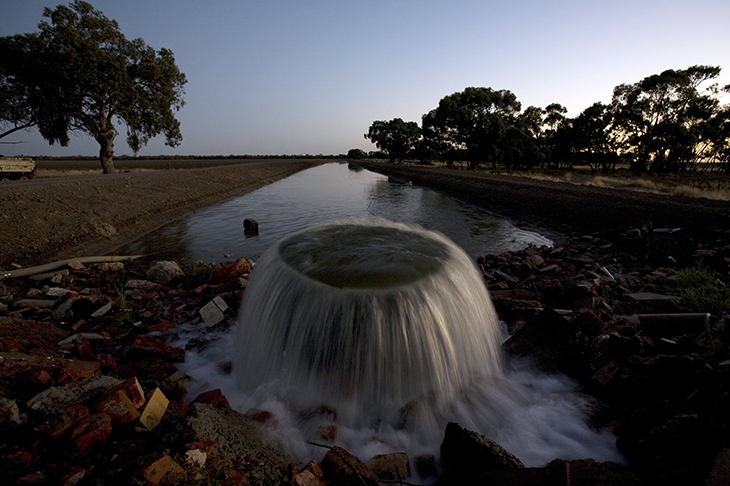
There is a staggering disconnect at the heart of Australian public policy. We are currently committing hundreds of billions of dollars to a ‘net zero’ climate policy that, even on its own terms, will have absolutely zero effect on global temperatures. Yet, while we bankrupt the nation in attempting to change global weather, we are actively dismantling the very infrastructure required to survive it: our water security.
Instead of adapting to our continent by building dams, the prevailing political class has decided that a significant water programme is no longer necessary. This is a profound Labor change, and one that the Coalition has meekly gone along with. They have abandoned the fundamental truth of Australian geography – a reality articulated superbly by Alan Jones in his address to an Australians for Constitutional Monarchy National Conference, now recorded on YouTube: Australia has all the water it needs, it just falls in the wrong places.
The disastrous consequences of this failure are superbly exposed by public-policy writer Patrick Byrne. In his most recent work, Caught in the Current (2026), Byrne details how the Commonwealth’s radical ‘environment-first’ buyback scheme is stripping irrigation from the Murray-Darling, and threatening to turn Australia into a net agricultural importer. This self-inflicted wound in the south is compounded by a total lack of vision in the north. As Alan Jones argued in his presentation to the ACM, the failure to proceed with a modernised Bradfield Scheme – capturing wasted monsoonal floodwaters and diverting them inland – is a failure of national courage.
Let us look at the comparative economic costs. Building a modern Bradfield water infrastructure, alongside a reliable baseload power station (such as high-efficiency low-emissions coal or nuclear) to run the massive pumps, would cost roughly $20 billion to $42 billion. Its recurring operating costs could be a manageable $250 million to $400 million per year, offset by the hydroelectricity the system could also provide. Contrast a maximum capital cost of $42 billion for Bradfield against the $600 billion bottomless black hole of the renewable transition.
Meanwhile, One Nation stands alone as the only political party both with the good sense to offer a strong, unapologetic policy on water, as well as arguing it is essential for Australia to build dams and implement continent-spanning infrastructure to solve Australia’s problems. It would alone abandon money down the drain, climate catastrophism. This modern political indifference to water rights would have horrified our national founders. I am reminded of this sharply because, years ago, Pauline Hanson contacted me directly to discuss the specific constitutional protections regarding water – namely, Section 100 of the Constitution. She recognised then what the major parties still ignore today: water is a sovereign, existential issue.
To understand the gravity of Section 100, you only need look at the 1898 Constitutional Convention debates, where control of the Murray River was one of the most protracted and heated arguments of the entire process.
The compromise that saved Federation was Section 100. It explicitly states that the Commonwealth ‘shall not, by any law or regulation of trade or commerce, abridge the right of a State or of the residents therein to the reasonable use of the waters of rivers for conservation or irrigation’. At Federation, this was treated as a provision of signal importance.
Yet, tragically, an activist High Court has systematically neutralised this vital section, ruling that Section 100 only limits the Commonwealth when it explicitly relies on the ‘trade and commerce’ power. This gives centralist, anti-dam politicians a devastating loophole. Through a never originally intended interpretation of other constitutional powers – especially the notorious ‘external affairs’ and ‘corporations’ powers – the federal government has been able to seize control of the Murray-Darling Basin and strip irrigation rights away from regional communities, completely bypassing the protection the founders believed they had guaranteed in Section 100. An absolute safeguard has been played down to the point of irrelevance by judicial activism.
We are left with a tragic irony. We are spending a trillion dollars to fight for a dubious and unproven global climate theory while using judicial activism to destroy the irrigation systems we rely on to feed ourselves. Until we return to the wisdom of our founders, recognise that water is our most precious developmental asset, and begin building the dams and pipelines this continent demands, our politicians will continue to legislate our own national decline.
Got something to add? Join the discussion and comment below.
You might disagree with half of it, but you’ll enjoy reading all of it. Try your first month for free, then just $2 a week for the remainder of your first year.