When subscription news captions recently blared the words ‘Far-Left Winning Streak’ inside the Democratic party, they were reacting to a localised explosion in America’s urban core. Dramatic primary sweeps across New York City – where progressive and democratic socialist insurgents routinely dismantle moderate incumbents – have laid bare the ideological hyper-velocity of the modern coastal Left.
Yet mistaking these localised urban sweeps for a uniform, nationwide transformation fundamentally misreads the geography of American power. After all, it is within living memory that the Northern Democrats were ensconced in the trade unions like a latter-day Labor Party, while the Southern Dixiecrats were segregationists. Today, that old order is dead. Factional purity wins in deep-blue strongholds. In the competitive suburbs and the heartland, however, it is toxic. The mainstream Democratic leadership knows this, which is why their national survival depends entirely on an elaborate exercise in ideological camouflage: the art of projecting centrist, institutional calm to the media and especially the public, while the underlying policy apparatus moves steadily to the left.
For the Western alliance, centred as it has been for over eight decades on America’s Imperial Presidency, the eventual collision between this sleek progressive vanguard and the rising populist right presents a definitive and worrying contrast.
Leading the charge for the Left is California Governor Gavin Newsom, a figure uniquely blessed with Hollywood-adjacent, Kennedy-esque aesthetics. Newsom uses this visual shield to signal traditional, safe establishment leadership, effortlessly capturing the imagination of a mainly sympathetic media. Yet behind that flawless patina lies a record of poor governance disguised by progressive measures. Just recently, Newsom aligned himself with the populist left by calling for a national ‘billionaires’ tax’ and proposing that the federal government take public equity stakes in artificial intelligence companies.
More damningly, the state he has governed is in a visible mess. California has become a fractured, two-tiered society marked by the nation’s highest real poverty rate when adjusted for the cost of living. Suffocating regulatory red tape and strict environmental zoning have manufactured a crushing housing crisis, while aggressive green-energy mandates have driven utility costs through the roof. The result is an unprecedented demographic shift: for the first time since statehood in 1850, California’s population is actively shrinking as middle-class families and major corporations flee en masse to low-tax states like Florida and Texas.
If Newsom secures the nomination, the smart money of the media establishment will inevitably rush to his side, eager to crown a pristine, modern version of Thomas E. Dewey.
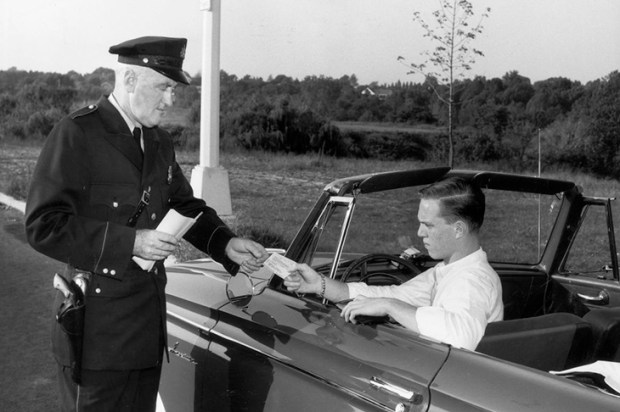
The historical parallel is striking. In 1948, Governor Dewey of New York seemed unstoppable. He possessed the polished, immaculate look of a certain winner, backed by a fawning press corps that treated his victory as a foregone conclusion. But unlike Newsom, Dewey actually boasted a genuine record of superb, clean, highly effective state administration. As a multi-term governor, Dewey balanced budgets, cut state taxes, established New York’s state university system, built the Thruway – the massive, landmark, 570-mile superhighway system and one of the longest toll roads in the United States – and pioneered America’s very first state law banning racial discrimination in employment. On his formidable record, Dewey possessed the baseline competency to be an excellent, stabilising president.
The same cannot possibly be said for Newsom. Given the economic wreckage and social fractures of his California tenure, a Newsom presidency is highly likely to fail administratively. For a Western world dependent on American economic vitality and unwavering global leadership, a president unable to manage his own domestic borders or balance a state ledger would represent an alarming retreat for the leadership of the West.
Yet in 1948, the media landscape was entirely different from today’s. It was far less reflexively left-wing, less hyper-partisan, and deeply invested in the baseline consensus that the United States must remain a robust, powerful global anchor. Even so, that mid-century press corps fell victim to institutional groupthink, culminating in the most celebrated media blunder in political history.
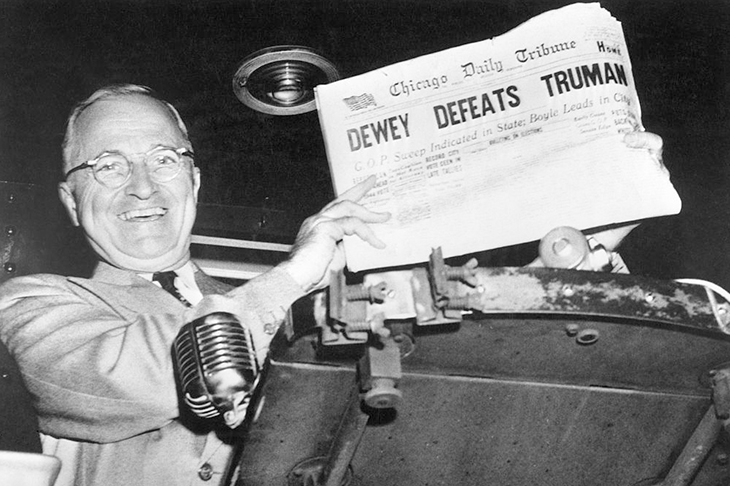
On election night, the famously Republican-leaning Chicago Daily Tribune faced a critical mechanical crisis: its Linotype operators were on strike. Forced to utilise a cumbersome typewriter-to-engraving process, the editors had to lock in their front page hours before the polls closed. Blinded by the universal polling consensus that Dewey’s victory was a mathematical certainty, the paper went to press with the infamous banner headline: ‘DEWEY DEFEATS TRUMAN’. Two days later, a triumphant Harry Truman stood on the rear platform of his train at St. Louis Union Station, grinning as he held aloft that very newspaper – immortalising the moment the elite consensus collapsed under the weight of reality.
Dewey’s fatal error had been to run a cautious, vague campaign, assuming his pristine presentation would carry him across the finish line. He was ultimately undone by Truman – a plain-spoken Midwesterner from humble origins who had famously run a bankrupt haberdashery.
Truman completely lacked Dewey’s manufactured charisma. He was a dapper but severe man whose single daughter, Margaret, famously played the piano in a White House so structurally neglected its floorboards were rotting. Yet Truman possessed a raw, institutional grit. He was a leader of immense decisiveness – a trait later cemented when he courageously fired the legendary and overwhelmingly popular General Douglas MacArthur to preserve the Western principle of civilian control over the military. Truman ignored the elite consensus, took his case directly to the working class on a gruelling whistle-stop tour, and pulled off the greatest upset in political history.
In a future national contest, the Democratic machine will find that the American heartland possesses an equally potent arsenal of counter-strategies, regardless of which wing of the Republican party captures the nomination. Should the ticket be led by a formidable heartland populist like Vice President JD Vance, the race will instantly become a brutal street fight designed to systematically strip away Newsom’s aesthetic shield. Alternatively, should the nomination fall to a dynamic, institutional communicator like Secretary of State Marco Rubio, the contrast changes.
Betting on a candidate with film-star qualities and the backing of much of the media establishment is always the logical position for political speculators. But as the ghost of Thomas Dewey reminds us, when a sleek presentation is assumed to win because of style alone, the American heartland delights in shredding the script.
Got something to add? Join the discussion and comment below.
You might disagree with half of it, but you’ll enjoy reading all of it. Try your first month for free, then just $2 a week for the remainder of your first year.