The best thing about the Soviet Union – arguably the only good thing – was the manner of its going. Though it lost its European empire when the Berlin Wall came down in 1989, almost nobody predicted that the USSR itself would fall apart so quickly. Most historians, Moscow-based journalists and the world’s espionage agencies thought it would limp on for decades, like the Ottoman empire. Yet the world’s second most powerful state withered away, and not in the classical Marxist sense: it just ceased to exist.
As Robert Service shows, the Soviet people destroyed the Soviet Union, not outsiders, and without any significant violence. Now in his 80th year, Service – the biographer of the troika of the USSR’s founders, Lenin, Trotsky and Stalin – has long been our leading historian of Soviet Russia. He is on sparkling form here, armed with plenty of new material. Of the numerous books about the last years of the Soviet era, this is the most definitive.
He identifies the key moment in the story: the coup attempt in August 1991, when a group of diehard Stalinist apparatchiks tried to turn the clock back to ‘re-emphasise the first word in the term dictatorship of the proletariat’, as one of them admitted later.
The ringleader of the plot was Vladimir Kryuchkov, head of the KGB. The six years of Mikhail Gorbachev’s perestroika and glasnost and his hesitant moves towards a freer society, led to economic shambles, the longest bread queues since the second world war and ‘social chaos’, he argued. ‘I have had a stomach-full of democracy,’ he is quoted as saying on 16 August, when he persuaded the Soviet vice president, prime minister, defence minister and various bemedalled generals to join his conspiracy.
They had to act quickly, he insisted. The ‘weak and spineless’ Gorbachev was about to sign a new treaty that would turn the USSR into a looser federation of states that could abandon socialism. The Baltic states had already chosen independence and others would follow, including Ukraine. Gorbachev had to go – preferably by his own ‘choice’, but he must be pushed if necessary. Something also had to be done to silence Boris Yeltsin, the newly elected president of the Russian republic, whose man-of-the people style made him the most popular politician in the country.
The plan was hastily formulated. One group of conspirators, accompanied by KGB troops, went to Gorbachev’s holiday villa in the Crimea to demand he abandon the treaty or resign. The other putschists stayed in Moscow, and if Gorbachev refused to cooperate, were to take over power in a ‘Committee of Emergency’, which would use force if challenged. But the coup was a fiasco from the start. Gorbachev told the plotters: ‘Go to hell, shitfaces.’ At dawn the next morning, Muscovites switched on their radios and TVs to hear that the committee had formed a government. Then the airwaves went dead – except for a continuous loop of Swan Lake. The only thing most Muscovites remembered about the coup was the sound of Tchaikovsky.
The ‘action’ was confined to one small area of Moscow, around the White House, Russia’s parliament. The bungling putschists drew up a list of 50 ‘troublemakers’ to be arrested immediately, with Yeltsin’s name at the top. They failed to apprehend any of them. The central image of the coup was a brave, vigorous Yeltsin climbing on to a tank, defiantly denouncing the plotters. Foolishly, they allowed the stirring scene to be played worldwide on TV, turning him into an international celebrity. Yeltsin retained a phone line, allowing him to drum up support. The army refused to fire on the civilians who surrounded the building, which guaranteed the failure of the plot.
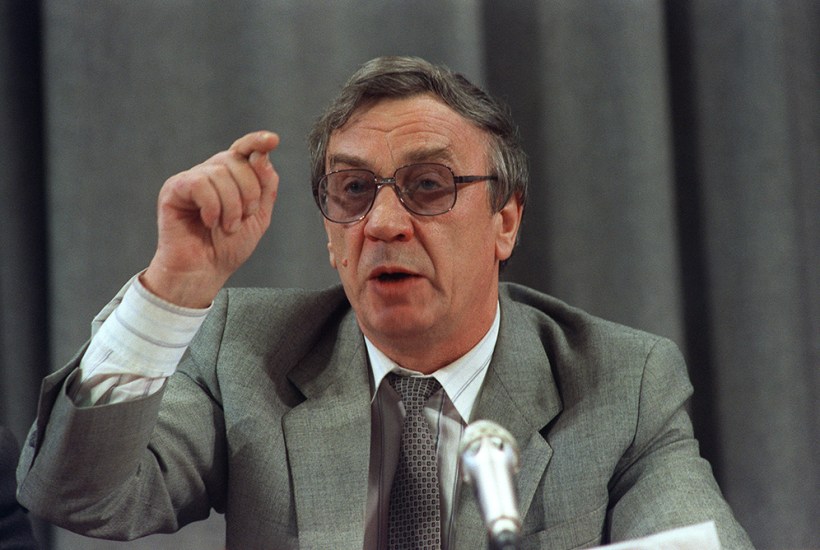
The joke quickly went around Moscow that you knew communism must be finished when the Bolsheviks couldn’t even mount a proper coup. When the nominal head of the Committee, vice president Gennady Yanayev, appeared that evening for the first time, a grey old communist bureaucrat in a shiny suit, he was visibly drunk; as he told the lie that Gorbachev was ill, his hands shook and his hairpiece slipped.
None of the conspirators seemed to consider the law of unintended consequences. Their ill-prepared ‘patriotic action’ brought forward all they feared most: within 48 hours of the coup’s collapse, their beloved Communist party was banned and four months later the USSR disappeared from the map.
Service praises two of the principal figures in the drama, Gorbachev and Yeltsin, despite their many flaws. The two loathed each other. But between them they oversaw the fall of the Soviet Union with little violence, a free and independent Ukraine and genuine hope for a democratic, peaceful future for Russia. These were extraordinary achievements, which a generation on look greater still.
These hopes were quickly dashed, how-ever, and Service gives a good indication why. Vladimir Putin was a middle-ranking KGB officer during the August coup. He resigned shortly afterwards and has repeatedly said since that the fall of the USSR was a ‘geopolitical catastrophe’. Kryuchkov spent two years in prison but was a guest at Putin’s first inauguration in 2000 and took tea with him regularly until his death in 2007.
Got something to add? Join the discussion and comment below.
You might disagree with half of it, but you’ll enjoy reading all of it. Try your first month for free, then just $2 a week for the remainder of your first year.