In interesting news from the fickle world of celebrities, American-Albanian singer Dua Lipa, whose repertoire includes but is not limited to ‘Don’t Start Now’ and ‘Levitating’, and who once declared herself to be non-binary, has opened a library. Sitting under the breathtakingly beautiful neo-Gothic Livraria Lello in Porto, Lipa’s ‘Manifesto Library’ is the new home for banned or censored books. Bravery, these days, can take many forms.
Critics have been quick to point out that a great many of the Manifesto Library’s collection, such as The Second Sex by Simone de Beauvoir, are also on every university syllabus in the US. They have remarked, not unfairly, that it’s almost impossible to go anywhere these days without tripping over a copy of George Orwell’s 1984, now translated into 65 languages. These minor inconsistencies aside, Lipa says that ‘Reading the world brings us closer – but sadly, not everyone is in favour of that.’ Whether Lipa means that some people are opposed to reading per se or world peace, is unclear. Anyway, she continues that, ‘You will find one hundred books that ask questions or have been questioned. Some have been banned by school districts for themes of race or sexuality.’ It is at this juncture that I would like to humbly present Ms Lipa with my own modest contribution, Mindless: How the Education System is Indoctrinating Children and Destroying Our Civilisation (Wyborn Press, 2026). Since its publication in April, it has been banned and censored up and down the country by left-wing political activists currently employed as librarians.
One such ideologue at Sydney’s King’s Cross Library informed a member of the public that Mindless was not a ‘suitable’ topic, adding triumphantly that no single copy could be found in any library on the east coast, including the State Library of NSW. When asked, the Bendigo Library’s collections manager confidently asserted that the title did not meet the library’s current collection guidelines and policies, even though the library’s policies state that the collection will be ‘responsive to community needs and community demands’ and ‘representative of a diverse range of views, subjects and genres’. When the community demands a book that directly undermines the deranged mind-virus that has colonised our institutions, those demands are to be ignored.
So, there you have it. Australian librarians, funded by the public, have taken it upon themselves to decide what the public should and should not read. These self-appointed cultural commissars, and the institutions in which they operate, lost their neutrality decades ago. We can thank, in part, the rise of critical librarianship – also known as critlib, which views traditional collections as structures of power and oppression. Just as teachers are being trained to see themselves as agents of change, the modern librarian is told that she is not just a cataloguer of books and shusher of talkers, but a liberator of oppressed peoples. This indoctrination is taking place at the hands of organisations such as the Australian Library and Information Association (Alia), which sets industry standards and mandates what is taught in universities to aspiring librarians. At Alia’s 2022 National Conference, the program included a presentation entitled ‘Chasing the rainbow: critical librarianship. LGBTQ collections and making a difference’, presented by two librarians from the State Library of NSW.
Then there is the Alia Rainbow, the association’s ‘LGBTQIA+ special-interest group’. Its professional development pathway encourages librarians to ‘check out’ the Australian Queer Archives, which is in the business of ‘preserving and collecting Australia’s very queer histories since 1978’. Some lucky librarians might even attend this year’s Australian Queer Archives Conference in October, where they could well be introduced to such literary classics as Coming to Power, I Once had a Master and Macho Sluts. For $500, meanwhile, Alia members can enrol in a 15-hour online course on ‘Respect and Recognition of Aboriginal and Torres Strait Islander Peoples, Cultures and Country in Australian Libraries’. Participants are introduced to the proposition that ‘Country is an essential concept for all Australian library workers’ and taught to ‘critically examine’ the influence of colonial collecting practices on libraries. This is basically code for: How many books by dead white men can we get rid of before someone notices?
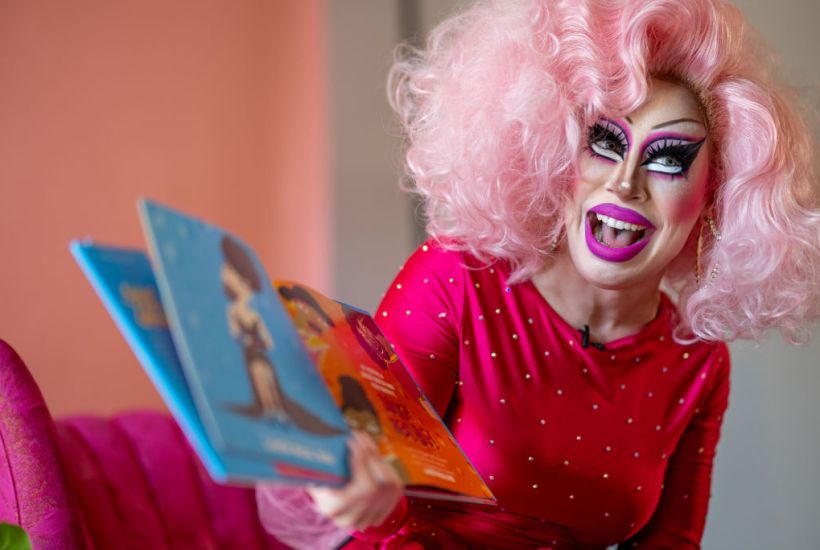
Libraries have long since given up the pretence that they are ‘neutral’ spaces, and Alia has made sure of that. When, in January 2020, Brisbane Square Library invited two drag performers, Johnny Valkyrie, performing as Queeny, and Dwayne Hill, performing as Diamond, to conduct a Drag Queen Story Time for children, Alia enthusiastically defended the practice, declaring its full support for libraries hosting such events. It even encouraged other libraries around Australia to send in photographs of their own Drag Queen Story Times to showcase their commitment to ‘inclusivity’.
Lyle Shelton, who is now in the sixth year of a legal battle arising from his criticism of the event, argued that Drag Queen Story Time was not simply harmless entertainment, but involved introducing very young children to contested ideas about gender fluidity and adult drag culture. The substantive legal dispute arising from his comments remains unresolved after his June 2026 Supreme Court challenge was rejected and the matter returned to the Queensland Civil and Administrative Tribunal.
Here’s the thing: the academic literature surrounding Drag Queen Storytime fully vindicates Shelton’s stance. In the 2020 paper Drag Pedagogy: The Playful Practice of Queer Imagination in Early Childhood, academics Harper Keenan and Lil Miss Hot Mess – also known as Harris Kornstein – argue that drag pedagogy goes beyond merely exposing children to diverse lifestyles. It is, they write, a model for learning ‘not simply about queer lives, but how to live queerly’, involving ‘embodied inquiry into queer/trans ways of being’. It is perhaps no coincidence that queer theorist Lil Miss Hot Mess, is also the author of the children’s book The Hips on the Drag Queen Go Swish, Swish, Swish. While, as I have discovered, Australians searching their public libraries for a copy of Mindless may struggle to find one, nearly 40 public libraries currently hold The Hips on the Drag Queen. Apparently, some books are more ‘suitable’ for the public than others.
Got something to add? Join the discussion and comment below.
You might disagree with half of it, but you’ll enjoy reading all of it. Try your first month for free, then just $2 a week for the remainder of your first year.