Annual contract negotiations between BHP and China’s Mineral Resources Group, which now coordinates purchasing for roughly 80 per cent of China’s steel mills, recently concluded, and word on the street is they are driving an increasingly hard bargain.
For decades, Australia has been China’s dominant supplier of iron ore, helping fuel the industrial expansion that transformed the People’s Republic into an economic superpower. Australia accounts for roughly 65 per cent of China’s iron ore imports, while China buys more than 80 per cent of our iron ore exports.
Over the past two decades, commodities have propped up the Federal Budget. Many a spendthrift Treasurer has had their fiscal position rescued by unexpected spikes in iron ore prices. But it increasingly looks like the decades long boom may be nearing its end.
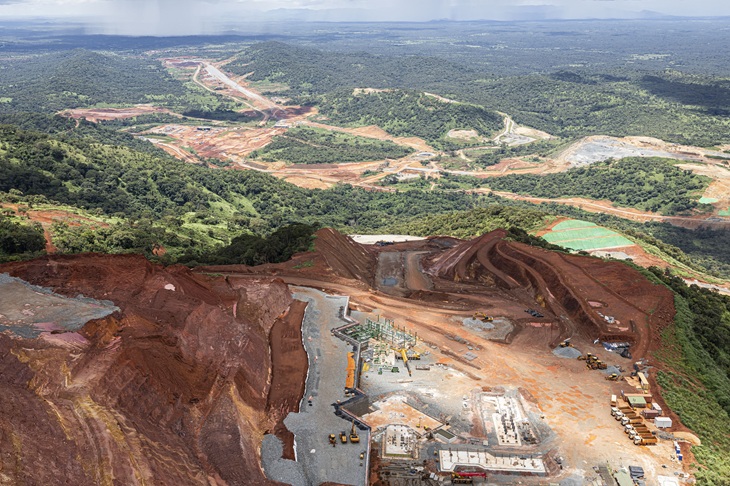
For the past five years, China has been quietly developing its own alternative to Australian iron ore in the jungles of Guinea, known as the ‘Pilbara killer’.
China does not like being strategically dependent on Australia and does not like handing super profits to our mining giants. Its efforts to diversify are finally beginning to bear fruit.
Australia’s big three miners contribute tens of billions to government revenues each year. Iron ore royalties alone underpin much of the Western Australian budget, while company tax receipts from the sector have repeatedly helped Canberra avoid much larger deficits.
That dependence creates leverage.
China does not need to completely replace Australian iron ore to hurt Australia economically. It simply needs to diversify enough supply to weaken our pricing power. Even a modest reduction in Chinese reliance on Australian ore could place sustained downward pressure on prices, with enormous consequences for Australian tax revenues, royalties, superannuation funds, and the dollar.
As the dominant buyer of our commodities, China can use its monopsony power to its advantage. The future battleground may not be whether China stops buying Australian ore altogether, but whether it can force Australian miners to accept permanently lower margins.
So far, Australian mining executives have been able to smooth relations by purchasing heavy mining equipment from China or borrowing from Chinese banks, but these sweeteners appear to be losing their shine.
The Albanese government quietly slapping tariffs on Chinese steel will hardly improve diplomatic relations either. Beijing has repeatedly threatened restrictions on Australian iron ore in the past.
Mining bosses have also expressed frustration that Labor’s industrial relations regime further undermines Australia’s cost competitiveness at precisely the wrong moment.
And it is not just iron ore we should be worried about.
Australia currently represents roughly half of global lithium supply, but China is moving aggressively there too.
China already owns a substantial stake in Australia’s lithium production, while more than half of the world’s lithium reserves sit in South America’s so-called ‘lithium triangle’.
Recent analysis suggests Chinese companies could control as much as 40 per cent of global lithium extraction by 2030, while Australia’s share declines as Beijing aggressively acquires projects across Africa and South America.
China already dominates global rare earth processing and has repeatedly been accused of suppressing prices to drive Western competitors out of the market.
The Simandou mine in Guinea is expected to add around 120 million tonnes of iron ore supply into global markets. Earlier this year, its first shipment departed for China. For Australia, it is difficult to see this development as anything other than bad news.
The $23 billion project, heavily backed by Chinese capital, is expected to become one of the world’s largest iron ore exporters before the decade is out as part of Beijing’s explicit strategy to reduce dependence on Australian supply.
Some economists have described Simandou as a ‘dagger to the heart’ of Australia’s economic model because of its potential to materially weaken global iron ore prices, which have already fallen sharply from their pandemic highs.
Critically, Simandou does not need to replace the Pilbara to reshape the market. Before Simandou, Australia was effectively irreplaceable. After Simandou, Australia becomes merely dominant. That alone changes the balance of power.
Currently, too much of Australia’s national security debate focuses on critical minerals purely through the lens of military capability and sovereign manufacturing. Far less attention is given to the minerals that actually made Australia wealthy in the first place.
The issue is not simply one of national security. It is one of national solvency.
China building alternative supply chains is not merely a strategic threat. It is a threat to Australia’s economic model and tax base. We cannot simply ‘onshore’ our way out of this problem.
So far, industry officials have dismissed concerns that Simandou will materially affect Western Australia’s cash cow. Perhaps they are right.
But if the Golden Goose is eventually cooked, it will take far more than a ‘Made in Australia’ campaign to save us.
Gas may become the next logical cash cow. But even that industry faces growing political hostility at home and intensifying competition abroad.
For years, Australian governments have expanded spending programs on the assumption that commodity revenues would continue indefinitely.
Yet remarkably little serious discussion has occurred about what Australia’s economic model looks like when the rivers of iron ore finally begin to run dry.