It is ironic that although Winston Churchill revered the concept of monarchy – his wife Clementine joked that he was the last believer in the Divine Right of Kings – half of the six monarchs under whom he served had anything but reverence for him.
He never met Queen Victoria, who signed his officer’s commission but died when Churchill was 26. He had a complicated relationship with Edward VII. As Prince of Wales, in 1876 Edward had been blackmailed by Winston’s father Lord Randolph Churchill, and had later slept with Winston’s mother, Jennie Jerome, after Lord Randolph’s death. Edward was impressed when Churchill escaped from the Boer prisoner of war camp in Pretoria in December 1899, but he disapproved of him leaving the Conservative party to join the Liberals five years later.
It was said that Jennie had one of the earliest lifts in London installed in her house off Marble Arch to accommodate ‘King Tum-Tum’, so that he didn’t have to climb the stairs to her bedroom; but Ted Powell sensibly ignores such gossip in this well-researched and well-written book. Considering how many works there are on every minute aspect of Churchill’s life, Powell is to be congratulated on having found an interesting subject that has not been written about before, and to have summed it up admirably in only 211 pages.
George V inherited his father’s doubts about Churchill and amplified them, even though Churchill successfully oversaw the trial for criminal libel of Edward Mylius, who claimed that George had contracted a secret marriage in Malta in 1890 while serving there with the Mediterranean fleet. When Churchill observed that ‘there are idlers and wastrels at both ends of the social scale’, George thought such views ‘very socialistic’; but Churchill stood by the offending phrase and objected to receiving ‘a formal notification of the King’s displeasure’.
After Churchill moved to the Admiralty in 1911, relations deteriorated further when he suggested naming a ship HMS Oliver Cromwell. The King had strong views on ships’ names, and unsurprisingly took exception to his government honouring a regicide. ‘I have always endeavoured to profit from any guidance His Majesty has been gracious and pleased to give me,’ Churchill wrote to him rather stiffly and entirely unconvincingly.
In 1913, there was a further royal objection to Churchill’s proposal to withdraw battleships from the Mediterranean to safeguard British waters. ‘The King talked more stupidly about the navy than I have ever heard him before,’ Churchill exploded to Clementine. ‘Really it is disheartening to hear this cheap and silly drivel with which he lets himself be filled up.’ Churchill’s downfall over the Dardanelles disaster in 1915 was greeted with scarcely concealed relief at Buckingham Palace. ‘It is,’ Queen Alexandra informed her son, ‘all that stupid, young foolhardy Winston C’s fault which has upset everybody.’ The King agreed, calling him ‘impossible’ and ‘a real danger’.
In this, if in little else, George V saw eye to eye with his eldest son, the future Edward VIII. ‘It is a great relief to know that Winston is leaving the Admiralty,’ the then Prince of Wales wrote to his father in May 1915, describing him as an ‘interfering politician’ and ‘intriguing swine’ who was ‘nothing short of a national danger’. When Churchill was appointed minister of munitions in 1917, the Prince wrote: ‘I suppose he has silently wormed his way in again.’ He acknowledged that it was nonetheless ‘safer to give him a job than to have him hanging around unemployed’.
Churchill came very late to the recognition that Edward VIII’s feelings for Wallis Simpson might lead to the first abdication of a monarch since the Middle Ages. He took a modern view of royal mistresses, since his mother had been one. He was not consulted by the King until December 1936, where-upon his support of the beleaguered monarch, begging for him to be given more time, saw him shouted down by members of both parties in the House of Commons. Churchill stormed out of the chamber, and his far more important warnings about German rearmament were momentarily sidelined. At George VI’s coronation, once Edward’s pro-Nazi attitudes had become apparent, Churchill acknowledged to Clementine: ‘I now realise that the other one wouldn’t have done.’
Churchill and George VI could hardly have been more different, the latter being a modest, shy, retiring man, who had been propelled, reluctantly and unexpectedly, on to the throne. He supported appeasement, felt comfortable with Neville Chamberlain as his prime minister, and told William Mackenzie King, the Canadian prime minister, that he would ‘never wish to appoint Churchill to any office unless it was absolutely necessary in time of war’.
His doubts about Churchill’s judgment were informed by his mother, father, elder brother and the Abdication Crisis. But, as the historian John Wheeler-Bennett has suggested, the King may also have felt ‘somewhat overwhelmed by the very magnitude of Churchill’s personality’. After Churchill entered the cabinet on the outbreak of war, the King said: ‘Winston is difficult to talk to, but in time I shall get the right technique I hope.’
When Chamberlain fell in May 1940, George preferred his friend Lord Halifax to Churchill as the new prime minister. ‘It took me a long time to get the King and Queen to look on the new prime minister with favour,’ Sir Alec Hardinge, George’s private secretary, recalled, ‘but in the end the King at any rate made great friends with him.’ Shared wartime dangers and responsibilities and Churchill’s weekly audiences were the perfect conditions to foster deep mutual admiration and affection between monarch and premier. By February 1941, the King could write: ‘I could not have a better prime minister.’ Churchill became the only one of George VI’s four premiers whom he addressed by his Christian name. Powell is excellent on the way their friendship blossomed – and survived Churchill’s extreme irritation when the King (obviously correctly) refused to allow him to watch the Normandy landings from HMS Belfast in the English Channel.
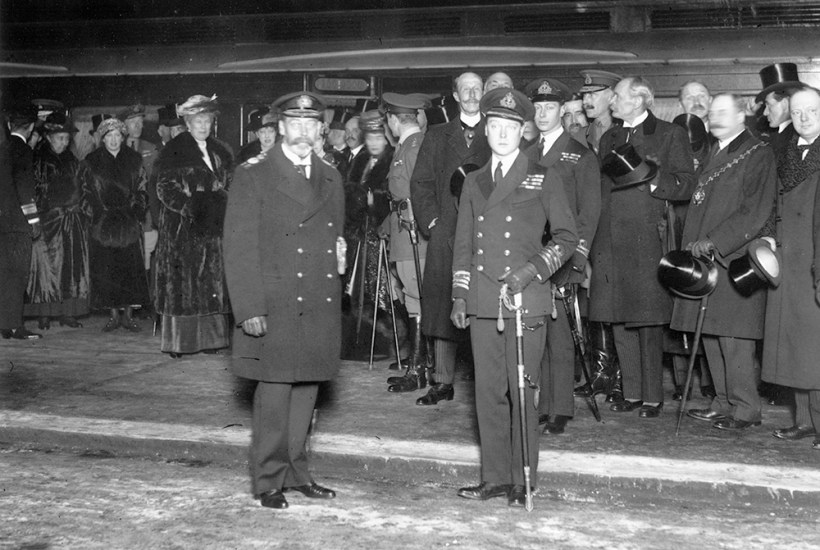
Relations with George V deteriorated when Churchill suggested naming a ship HMS Oliver Cromwell
Pure, unrequited love is the best way to describe Churchill’s attitude to Elizabeth II. They had a shared interest in horse racing; but the 25-year-old queen also excited the septuagenarian statesman’s old-fashioned chivalry, to the point of heroine-worship. He hung a framed photograph of her, smiling radiantly on her way to open her first parliament, above his bed at Chartwell.
Elizabeth made the historian in Churchill – never far from the surface – burst forth. ‘Famous have been the reigns of our queens,’ he proclaimed. ‘Some of the greatest periods in our history have unfolded under their sceptre.’ He lauded ‘the grandeur and genius of the Elizabethan Age’, arguing that she heralded a new one. ‘Lovely, inspiring,’ he described her to his doctor. ‘All the film people in the world, if they had scoured the globe, could not have found anyone so suited to the part.’
Hardinge’s successor Tommy Lascelles recalled how often Churchill was moved to tears by her youth, radiance and beauty. He wrote of their audiences that Winston ‘generally came out wiping his eyes… “She’s en grande beauté ce soir,” he said one evening in his schoolboy French.’
Got something to add? Join the discussion and comment below.
You might disagree with half of it, but you’ll enjoy reading all of it. Try your first month for free, then just $2 a week for the remainder of your first year.