China and Russia are twins. Both are great Asian land empires; both are continental, multi-ethnic powers that expanded by pushing forward their borders rather than by crossing oceans; both have a deep tradition of autocracy that survives to this day; and both (more plausibly in China’s case) believe that their social contract, ideology and system of government is a universal one superior to all others.
In Entangled Empires, the German historians Sören Urbansky and Martin Wagner explore the convoluted story of Russo-Chinese relations from the moment in the mid-17th century that roving Cossack bands bumped up against Siberian tribes who owed fealty to Beijing up to the latest performative amity between Vladimir Putin and Xi Jinping. Their conclusions, in a nutshell, are that the two nations’ association has never been defined by genuine friendship or ideological unity but rather by recurring patterns of dominance, asymmetric dependency and rivalry, dressed up in the language of brotherhood:
The prospect of a revanchist China reclaiming its lost lands lives in the minds of Russian nationalists
Florid proclamations of friendship are undoubtedly a façade behind which historic rivalries persist. While Russia primarily defined itself in relation to Europe, China has shaped itself in relation to Russia, Europe and Japan.
Since the late 20th century the leaders of China and Russia have been ‘united by a common enemy, namely the liberal world order’ – an alliance which, as luck would have it, also happens to furnish China with a cheap source of energy and raw materials, as well as a vast captive market for Chinese goods.
From the outset, relations between Asia’s two great imperial powers have been characterised by misunderstanding, arrogance and rivalry. In 1618 the Muscovite Tsar Mikhail Romanov put out tentative approaches towards his great southern neighbour, despatching the Cossack Ivashko Petlin of Tobolsk as Russia’s first emissary. Ming officials assumed that Petlin was a tribute-bringer from a hitherto unknown, pale-skinned, northern tribe, but, on learning that he bore no gifts, refused to allow him to proceed to the capital.
In 1670 the Manchus were forced to take notice of their upstart neighbours when Cossacks established an ostrog (fort) at Albazin on the Amur river, the Chinese empire’s only natural northern boundary. The Cossack leader, underestimating his opponent’s strength, wrote to the Chinese emperor suggesting he accept the suzerainty of the Tsar. This message, in Latin, was judged by puzzled Manchu court translators to be a grammatical error.
When the two nations did finally sign a border agreement at Nerchinsk in 1689, the preamble of the Chinese version of the treaty read:
Mutual trade… does not benefit China, but because the Great Emperor loves all human beings he sympathises with your little people who are poor and miserable, and because your Senate has appealed to His Celestial Majesty He has agreed to approve of the petition.
The Sinophone Jesuits who drew up the treaty tactfully left this out of their translation. Sadly this telling episode, quoted in Lo-Shu Fu’s A Documentary Chronicle of Sino-Russian Relations (1966), is overlooked by Urbansky and Wagner.
By the middle of the 19th century it was Russia’s turn to throw its weight around in north-east Asia. Like his predatory European neighbours, the Tsar began feasting on the disintegrating body of the Qing empire. The stakes in this larcenous imperial free-for-all were high and the spoils rich. In 1860 the Russian envoy General Nikolai Ignatyev inveigled the Chinese into signing the Convention of Peking, by which Russia gained, without firing a shot, territories larger than Germany and Poland combined. Russia’s end of the deal was to mediate the withdrawal of British and French troops from Beijing (where the eighth Earl of Elgin, a chip off the old block, had burned the Old Summer Palace). Impressively, Ignatyev was just 28 at the time and went on to become Britain’s chief antagonist in the Great Game for dominance in High Asia. (His fictional doppelgänger, Pavel Ignatyev, is the villain of Flashman at the Charge.)
Imperial Russia continued to take bites out of Manchuria and made the Amur a Russian river. The great new port of Vladivostok, connected to Europe by a railway from 1903, was built on the site of an ancient Chinese settlement known as Yongmingcheng, or ‘City of Eternal Light.’ The new (or perhaps we should say ‘current’) Russian name was blunter: ‘Lord of the East.’
The first half of the 20th century saw China riven by revolution and civil war in which communists fought a long and usually losing battle for supremacy. Stalin, despite nominal ideological affiliation, wasn’t much help, backing Chiang Kai-shek over the Chinese communists in the 1920s with catastrophic results for the CCP. Stalin remained deeply sceptical of Mao’s peasant-based revolution, which didn’t fit the orthodox Marxist-Leninist theory of urban proletarian revolt.
As late as 1945, the USSR signed a friendship treaty with the Nationalist government and advised the CCP to enter into a coalition with Chiang rather than push for outright victory. Stalin’s suspicion, cynicism and personal mistrust were not forgotten by Mao. A short period of wary amity, which began with Mao’s triumph in 1949, crashed into hostility and a border war with the Sino-Soviet split of 1963. Thus for most of the Cold War the communist world was divided, with the twin poles of the People’s Republic of China and the USSR pursuing separate strategies for exporting their influence, often violently, throughout the Third World.
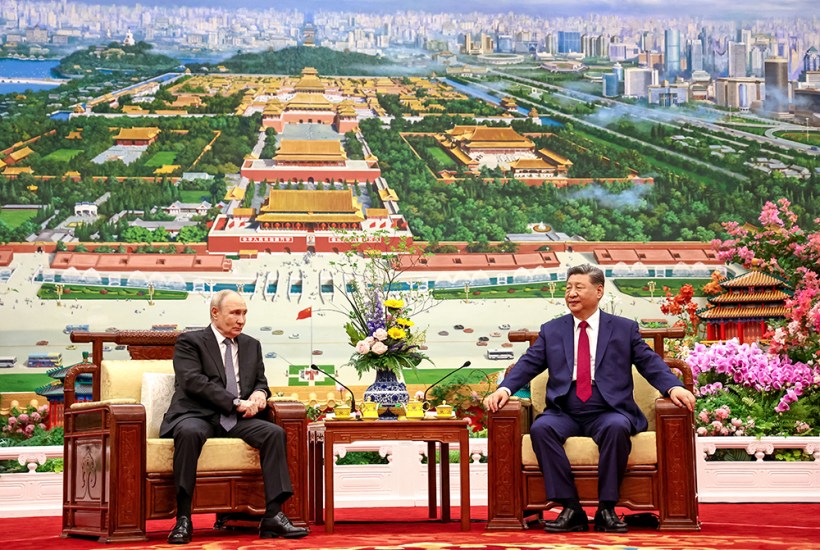
Relations were restored in the 1980s, and soon thereafter came a tipping point where China’s rising economy passed Russia’s sinking one on the great department store escalator of geopolitical fortune. In February 2022, just days before Russia launched its full-scale invasion of Ukraine, Putin and Xi signed a ‘no limits’ friendship pact. With appropriate scepticism, Urbansky and Wagner cast this new-found amity as the latest iteration of a long tradition of performative declarations that conceal real tensions. The two nations ‘cultivate a cult of personality around their respective leaders and… are united by an outlook that divides the world into spheres of influence’. In practice, China, as the clearly superior partner, takes a strictly self-interested view of the alliance. The ‘no limits’ partnership has indeed proved a significant downgrade from the ‘cooperation for 10,000 years’ pact signed by Mao with Nikita Khrushchev in 1958. China has declined to supply the Kremlin with arms or troops; many of its largest companies have pulled out of doing business with Russia, in compliance with US sanctions; and Xi last month refused to sign a gas pipeline deal ardently pushed by Putin.
Deep down, China’s scars still hurt. ‘The loss of territory by the Amur and Ussuri rivers continues to be a source of imperial phantom pain,’ write the authors. It seems increasingly bizarre as Russia withers and China flourishes that Moscow still rules a far larger chunk of north Asia than Beijing does. The prospect of a revanchist China reclaiming its lost lands lives in the minds of Russian nationalists. Nor is this mere paranoia. In 1964, Mao, speaking of the Soviet territories east of Lake Baikal, declared: ‘We have not yet presented our account.’
A Russian friend notes that modern Harbin, once a major hub on the Russian-built and controlled South Manchuria Railway, now presents a nightmarish vision of a Chinese future. The architectural relics of Russian control have been relegated to theme park status, complete with local vendors selling matryoshka dolls made in Guangzhou, with the former colonial masters represented by a handful of pale-faced, mixed-race descendants.
Entangled Empires is a thorough, scholarly and workmanlike book. English readers used to more zingy history may find it too academic – perhaps a consequence of it being translated from German. Frustratingly, it does not really get to grips with what can be done to avert looming conflict with the US. In an influential essay last year in Foreign Affairs, the Yale professor Sergey Radchenko argued that Beijing is genuinely uncertain whether it wants confrontation with the West, fears being dragged into a conflict by unreliable partners, and may be persuaded that de-escalation on Taiwan is a more effective way of uniting China than sabre-rattling.
While Urbansky and Wagner note the economic interdependence with the West, they don’t develop the idea that this financial relationship might act as a meaningful constraint on China’s Russia policy. In Radchenko’s reading, it is precisely the combined $1.5 trillion in EU-US-China trade – 12 times more than the Russia-Chinese balance sheet – that has created genuine pressure on Xi not to fully align with Moscow. Backing Putin would come at the cost of definitively crashing China’s economy. As with many historical and mythical siblings, Moscow and Beijing’s brotherhood continues as ever – rivalrous and wary.
Got something to add? Join the discussion and comment below.
You might disagree with half of it, but you’ll enjoy reading all of it. Try your first month for free, then just $2 a week for the remainder of your first year.