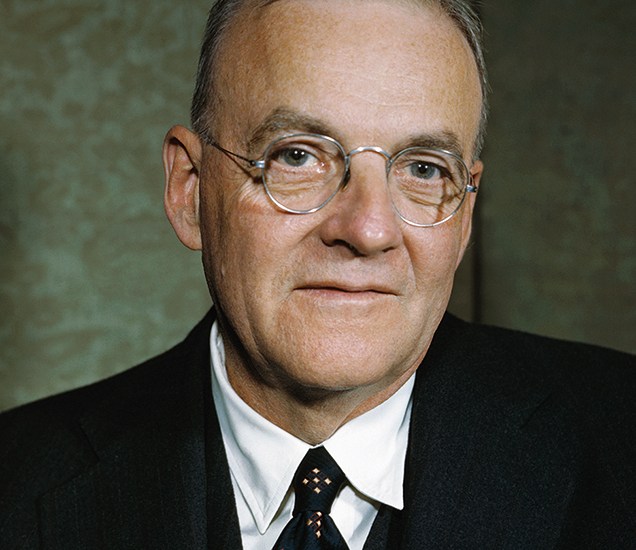
In the era of Trumpian foreign policy incoherence, a new intellectual biography of the American Cold War icon John Foster Dulles might seem welcome for hawks and doves alike. Indeed, Dulles’s tenure as secretary of state during the first six years of the Eisenhower administration could be viewed – even by the harshest left-wing critic of American imperialism – as a useful and reassuring point of reference, despite its narrow anti-communist dogma and too cavalier approach to the dangers of nuclear confrontation with the Soviet Union and China. After all, the Eisenhower administration extricated the United States from President Truman’s stalemated Korean War and started no major new wars before the end of Eisenhower’s second term in January 1961. Dulles and Eisenhower, unlike Marco Rubio and Donald Trump, were well-read and widely travelled sophisticates.
Yet Bevan Sewell’s recounting of Dulles’s life and career does little to restore faith in any sort of innate or learned American talent for keeping the peace, either in the short or long term. If anything, given his glaring limitations of perspective and philosophy, Dulles could be simply viewed as having been lucky – lucky in his elite family connections and fortunate that the more critically minded and politically independent Eisenhower ran the country’s foreign policy without listening much to his subordinate.
The grandson and nephew of two secretaries of state, ‘Foster’ Dulles wasn’t short of ambition and energy. But it’s hard to believe that such a pedestrian writer and thinker would have got as far as he did without knowing the right people – and by representing the powerful corporations that were his clients at the establishment Wall Street law firm of Sullivan & Cromwell. Despite the idealistic excitement of being part of the US delegation during Woodrow Wilson’s temporary triumph at the Versailles Conference (his poor eyesight prevented Dulles from serving overseas in the Great War), he seems never to have outgrown the blatant conflict of interests between his law practice and the imperial policies of the United States in Central America and the Caribbean. Here Sullivan & Cromwell’s billable hours dovetailed neatly with the Monroe Doctrine and the quasi-religious concept of Manifest Destiny. It was all helpful experience for a future political or business career but not necessarily the best training for a creative or enlightened diplomat.
Sewell nevertheless labours to present a livelier, more reflective side to the well-born, deeply orthodox Christian son of a Presbyterian minister. A year abroad at the Sorbonne during college had brought Dulles under the influence of the French philosopher Henri Bergson, whose thesis of ‘dynamic flux’ in the world, according to Sewell, marked the Princeton undergraduate for life. Within what Sewell refers to as ‘the relentless nature of human consciousness’ resided what Bergson describes as a ‘dynamic, flowing, interconnected continuum of processes’ that was ‘constituted by ceaseless movement and change’.
The banality of Bergson’s prose – and perhaps his ideas – also seems to have marked Dulles for life. Was Winston Churchill unfair to jibe: ‘Dull, duller and Dulles’? Not if you read Sewell’s compilation of excerpts from Dulles’s writing, which appear with dispiriting regularity throughout the book. Not for Dulles the ‘zig zag streak of lighting in the brain’ attributed by H.H. Asquith to Churchill at his most original. Dulles was forever going on about ‘boldness’ and dynamic change while employing empty, flaccid phrases in praise of Cold War bromides: ‘We have developed, with our [Nato and Seato] allies, a collective system of great power which can be flexibly used on whatever scale may be requisite to make aggression costly.’ Eisenhower had already determined that mutually assured nuclear destruction was deterrent enough for the Soviets and was mercifully less inclined to take aggressive action against the perceived communist menace.
It’s not surprising that Dulles’s principal outlet for uncreative thought was the Time & Life empire of Henry Luce, the son of Protestant Christian missionaries and, like Dulles, a stalwart believer in America’s fundamental goodness, inherited from the founding fathers – the Protestant leaders of the Massachusetts Bay colony whose vision of New England as a ‘city upon a hill’ blessed by God was supposed to inspire all true believers. In this the Pilgrim Fathers were the precursors of the vainglorious Woodrow Wilson, whose foreign policy was most adroitly summed up by the British jurist and biographer Patrick Arthur Devlin: ‘What America touches, she makes holy.’
Despite all his talk of ‘patience’, ‘evolution’ and ‘pragmatism’ in policy making, Dulles didn’t believe that just setting a Christian example was good enough for America. Writing in the Presbyterian Tribune in 1947, he declared:
History teaches that a static peace is a dangerous peace… Surely it was a static peace that Christ had in mind when He said Think not that I am come to send peace on Earth: I come not to send peace, but a sword.
When Dulles, as a Republican senator, voted in 1949 for the ratification of the Democrat-initiated Nato treaty (he hoped the American people would support it as an ‘act of faith’), he broke decisively with America’s second set of more secularist founding fathers, especially George Washington, who warned against ‘passionate attachment’ to foreign powers.
Such moralistic rhetoric was offputting to true pragmatists such as General George C. Marshall and George Kennan, the author of the celebrated ‘containment’ policy toward the Soviet Union that made him Dulles’s intellectual rival. Dulles in his heart and in his pronouncements apparently wanted ‘rollback’ of the Soviet empire. Thank goodness Eisenhower wouldn’t allow it, limiting himself and the would-be crusader to regime change in smaller, less dangerous countries (as well as the reining in of colonialist Britain and France in the Suez crisis).
Curiously, Sewell chooses the US overthrow of elected democracy in Guatemala in 1954 to illustrate Dulles at his most imperialistic and hypocritical. Why not spotlight the more significant and historically far-reaching ousting of the democratically elected Mosaddeq government in Iran in 1953, for which the entire world is still paying the price? Moreover, it’s during the Anglo-American coup plotting that we see Dulles behaving with more brio than the earnest Christian pamphleteer portrayed by Sewell. As Stephen Kinzer, in All the Shah’s Men, describes the ‘crucial meeting’ that finalised the coup plans, Dulles picked up the written report prepared for the conclave and exclaimed: ‘So this is how we get rid of that madman Mossadegh!’ Together with his brother Allen, the director of the CIA, and the other assembled members of the coup’s brain trust, the vote for overthrow in Iran was unanimous. ‘That’s that, then,’ Dulles said with an uncharacteristic grin. ‘Let’s get going.’ Onward Christian soldiers!
Got something to add? Join the discussion and comment below.
You might disagree with half of it, but you’ll enjoy reading all of it. Try your first month for free, then just $2 a week for the remainder of your first year.