Highly effective campaigning from parents and parliamentarians has forced the government to agree to introduce age restrictions for under 16s on social media. This promises to be extraordinarily popular among the public, but there are many well-founded objections that should be taken seriously.
Raising the age limit for social media for under 16s will not be a silver bullet
Some of these objections are practical. How exactly would a social media ban work? Critics point to Australia, where a world-first ban was implemented in December last year. It is being claimed that the policy is not working, but it’s far too soon to write off the Aussie experience. Nearly five million child social media accounts have been removed and 61 per cent of Australian parents already report positive behavioural changes in their offspring. Where children are still evading the ban, this is not a failure of the law but a conscious decision to break it since social media companies have not yet been forced to remove minors’ accounts.
The most strident objections to social media restrictions come from those who believe that a ban for children is a threat to civil liberties, both by ushering in universal digital ID and threatening freedom of speech. Yet digital ID is not required to keep kids off social media: a wide range of effective third party age verification services are already available.
As for free speech, it is right to be concerned about the state seeking to control what can and can’t be said online. We saw during Covid how governments and Big Tech colluded to shut down dissenting views. But while adults ought to be free to choose what to say and see, almost all of us recognise that children should not be exposed to a wild west of pornography, manipulation and lies. We must either prevent children from accessing these platforms, or let someone – either the government, Big Tech or both – decide what content is ‘harmful’. I know which option is more likely to protect free speech.
Perhaps the most persuasive argument against a ban is that there isn’t enough evidence of harm, and that it should be a parent’s responsibility to keep their child safe online. For some children there have been tragic consequences of social media use, including suicides and sexual abuse, but are individual cases enough to justify a blanket ban?
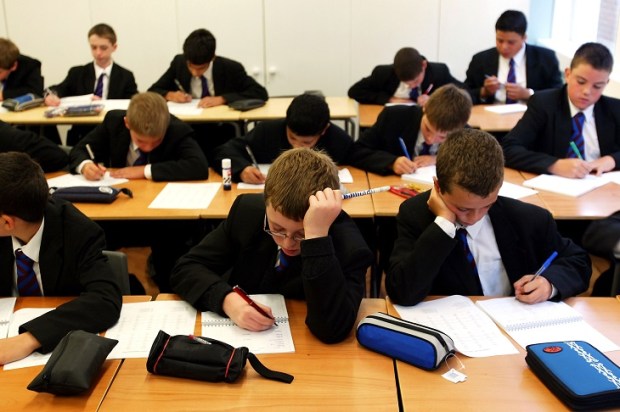
For me, the compelling argument for legislation is not the extent of individual harm caused by TikTok, Snapchat et al, but rather that these platforms pose a threat to our civilisation. Perhaps readers think I am catastrophising, but consider this: since the advent of smartphones and social media, educational scores have fallen across the world. Children’s concentration spans have plummeted, they read less, they know less and they are less creative. Even IQ scores are falling for the first time on record. Whether or not you believe social media is technically ‘addictive’, TikTok slop is undeniably more compelling for children than maths homework, Shakespeare or exercise. Social media is condemning our economy to a future of declining productivity and innovation.
Ban-sceptics maintain that parents should be able to keep their kids off social media. If only a minority of children were using these platforms, they may be right. But when 97 per cent of teens have smartphones and the vast majority of them spend hours a day online, parents are playing a zero sum game: allow kids on social media and watch their brains rot or cut them off entirely from any social life at all.
It is not only the quality of our future society that is under threat, but the very existence of society itself. In the West, birthrates have been declining for some time, but fertility has fallen sharply across the globe since smartphones and social media were introduced. As John Burn-Murdoch demonstrates in the FT, in every country around the world, rich or poor, fertility rates declined as soon as smartphones were introduced. Again, it is easy to understand the mechanism. Social media use reduces face-to-face interaction, which is a prerequisite for meeting romantic partners and having sex. Dating and seduction require compromise, effort and risk; it’s far easier to doomscroll and watch porn. No one gets rejected on Only Fans.
If Big Pharma introduced a drug that appeared to be reducing children’s IQ and threatening their future fertility, would our response be to tell parents to keep children away from it? Of course not; such a product would be withdrawn from the market immediately. But then pharmaceuticals go through decades of stringent safety testing before they are approved for sale; if only the same could be said for social media.
Raising the age limit for social media for under 16s will not be a silver bullet. Yet if ever there was a role for regulation it is now, when the exploitation of our children by Big Tech is threatening our nation’s future. Standing up for free speech and civil liberties is all very noble, but these freedoms will be wasted on a generation who are increasingly sad, sedated, single, sexless, and glued to a tiny screen.