The federal budget was presented as a story of discipline and restraint. Australians heard the usual arguments. Surplus versus deficit. Spending versus savings. Productivity. Cost of living. Housing. Debt.
All important.
But beyond the budget was a significant new data set released a few weeks ago that received little attention.
Because while politicians and commentators continue debating how to divide prosperity, the deeper question is whether Australia is still particularly good at creating it.
The budget papers themselves suggest growing uncertainty about the answer.
One of the most revealing details in the budget was Treasury’s treatment of productivity growth. The long-run productivity assumption remains at 1.2 per cent – down from the older 1.5 per cent benchmark that underpinned much of Australia’s post-reform economic confidence.
More tellingly, Treasury now assumes it will take around five years, rather than two, for productivity to recover toward that already lowered trend.
That might sound like a technical adjustment. It isn’t.
Productivity is ultimately what determines whether living standards rise sustainably over time. It shapes wage growth, economic dynamism, tax revenues, and the state’s long-term fiscal capacity. Lower productivity assumptions do not merely mean slightly weaker growth forecasts. They imply a future where prosperity itself becomes harder to generate.
And that is where the new global dataset, the Simon Abundance Index, offers an important clue about what may be happening beneath Australia’s economic surface.
The Simon Abundance Index attempts to answer a deceptively simple but increasingly important question: Are humans running out of resources, or becoming better at creating them?
Rather than measuring scarcity purely through prices, the index tracks 50 key commodities – including food, energy, metals, and raw materials – against global wages and population growth. Crucially, it measures ‘time prices’: how long the average person has to work to afford something. If a resource requires less labour time to purchase than it once did, it is considered more abundant.
The underlying argument is provocative but compelling: that human ingenuity, innovation and productivity do not merely consume resources but continually expand humanity’s capacity to access and produce them.
At the heart of the Simon Abundance Index is the concept of ‘time prices’ – not simply how much something costs in dollars, but how long the average person has to work to afford it. If wages rise faster than the price of food, energy, or raw materials, those resources become effectively cheaper in human terms, even if their sticker price increases.
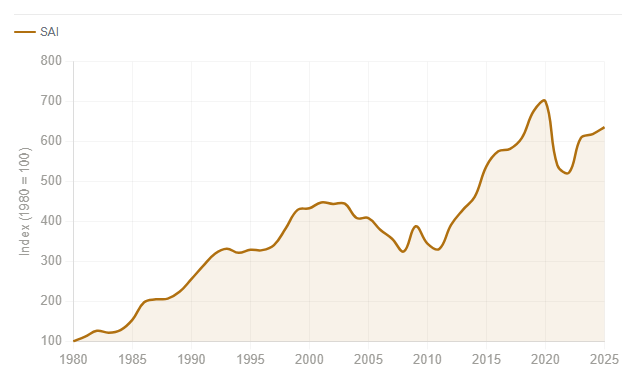
By this measure, the index argues the world has become dramatically more abundant over time, with the average ‘time price’ of key commodities falling by around 70 per cent since 1980.
Source: The Simon Abundance Index 2026 – Human Progress
The global figures tell a remarkable story. Despite recessions, financial crises, pandemics, and geopolitical shocks, the long-term trajectory of human prosperity continues upward. There are dips – the early-2000s slowdown, the Global Financial Crisis, the sharp disruption of Covid – but each time the system absorbs the shock, adapts and moves higher again. Supply chains fracture, prices spike, commentators predict a new era of limits, and yet innovation, markets and human ingenuity steadily reassert themselves. The broader trend is not one of civilisational fragility, but of adaptive capacity.
Australia’s story, however, is more complicated.
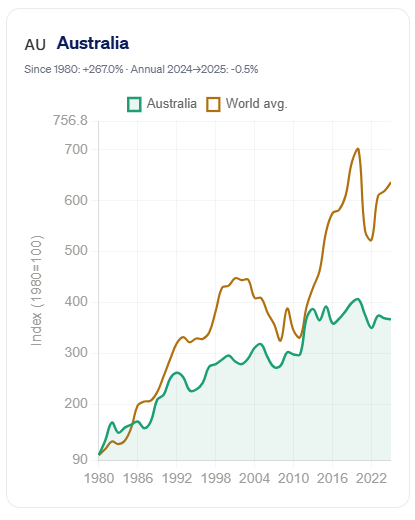
While the world’s abundance curve accelerates, Australia’s increasingly flattens. Growth remains, but it becomes more volatile, less consistent, more hesitant. Over time, Australia begins to under-perform the global average.
Source: The Simon Abundance Index 2026 – Human Progress
That distinction matters because it suggests the central challenge facing the Australian economy is no longer simply whether the world is becoming more prosperous – it clearly is – but whether Australia still possesses the productivity, policy settings, and economic dynamism required to convert global progress into local prosperity.
Increasingly, many Australians feel it doesn’t.
And here is the uncomfortable part: this stagnation is occurring despite Australia possessing almost every natural advantage imaginable. We are resource rich. Institutionally stable. Highly educated. Geographically secure. We should, theoretically, be one of the greatest beneficiaries of the modern abundance economy.
Instead, we have spent much of the past decade building a system that struggles to convert global innovation into local prosperity.
Productivity growth has slowed significantly since the mid-2000s: real wage growth has weakened, housing construction has become slower and more expensive, major projects take years to approve and governments are increasingly relying on redistribution because generating new prosperity has become harder.
And this is where last night’s budget becomes particularly revealing.
The budget sells discipline, but the documents themselves tell a more complicated story. Debt continues rising and interest costs continue compounding. Increasingly, the real fiscal politics of Australia are hidden in provisions, tax concessions, deferred liabilities and long-dated promises.
At the same time, the assumptions underpinning future prosperity are being quietly lowered.
And people instinctively sense the shift.
The old promise of advanced economies was simple: each generation would live more abundantly than the last. That promise now feels less certain and yet much of the political conversation still treats the economy as though prosperity is automatic – something governments merely allocate through tax changes, rebates and transfers.
But abundance is not automatic. It must be produced. That requires productivity and all that it encompasses: dynamism, innovation, investment, infrastructure, competitive energy, and efficient regulation.
Perhaps more than anything else, it requires a system that rewards building more than administering.
Instead, modern Australian politics increasingly revolves around managing scarcity. Who gets subsidised. Who gets compensated. Who gets taxed more heavily to sustain systems that themselves are becoming harder to fund.
Even the language has changed. Governments once spoke about growth, expansion, and nation-building. Now they speak of resilience, affordability, and mitigation.
It’s a subtle shift with massive implications.
None of this means Australia is collapsing. Far from it. We remain an extraordinarily wealthy country by historical standards. But relative stagnation inside a rapidly advancing world carries its own risks.
Decline will at least provoke reform, but stagnation is more dangerous precisely because it can be explained away for years. Australians heard plenty on Tuesday about budget repair, productivity packages, and cost-of-living relief.
But the more important question is whether we still understand how prosperous societies become prosperous in the first place.
The story of the Australian economy is not merely about inflation or deficits.
It is about whether we are still capable of converting abundance into lived prosperity.
And increasingly, that answer looks uncertain.