There’s a sense within Jewish communities that something cohesive, structured, and even more dangerous is taking shape: a multi-sourced hostility that operates as a unified force.
Some observers have called it a ‘red/green alliance’ – far-left and Islamist alignment. That captures the surface, but not how distinct ideologies converge toward shared conclusions about Jews, power, and legitimacy.
What has emerged is convergence – the alignment of intellectual and political traditions that now reinforce one another.
Three currents are particularly influential.
1. Islamism: Ideology, Organisation, and Centrality of Antisemitism
Political Islamism is a modern ideological movement seeking to reorder society under a totalitarian vision of governance. Originating with Hassan al-Banna and the Muslim Brotherhood, it’s developed into a structured, globally influential system shaping movements such as Hamas, Hezbollah, Al-Qaeda, ISIS, and Boko Haram.
Its influence is not confined to Sunni contexts. Despite deep theological divides, elements of its ideological framing – particularly conspiratorial and civilisational views of Jews – resonate within the revolutionary worldview of Iran’s Islamic regime. This creates a convergence in which distinct traditions arrive at similar conclusions about Jews as a central adversary.
Antisemitism sits at the core of this ecosystem. Sayyid Qutb’s writings cast Jews as a transhistorical, civilisational enemy, while the 1988 Hamas charter codifies this in explicit, often apocalyptic terms.
Across key texts and thinkers, a consistent pattern emerges: antisemitism fundamentally shapes interpretations of conflict, identity, and legitimacy.
2. Postmodernism and the Reframing of Power
Postmodern critical frameworks interpret society through power – privilege and marginalisation, oppressor and oppressed.
Within this lens, Jews are frequently cast as symbols of systemic dominance, particularly in Western contexts and in relation to Israel.
Complexity collapses into categorisation. A diverse people are reduced to a single role within a moral hierarchy. Hostility is reframed as resistance.
This framework operates primarily in the realm of identity and moral status. It determines who is afforded empathy, and on what terms.
In its more extreme forms, empathy becomes conditional – extended or withheld based on identity rather than circumstance.
Victims, who are sometimes labelled as ‘fascists’ simply for being Jewish, are assessed through an ideological lens that determines whether they are worthy of grief. Innocence becomes something assigned rather than inherent.
3. Neo-Marxism and the Recasting of Old Tropes
Contemporary neo-Marxist frameworks analyse capital, class, and power, rearticulating longstanding antisemitic tropes in modern terms. Associations between Jews, finance, and control are absorbed into critiques of capitalism and globalisation.
Where postmodernism assigns moral hierarchy, neo-Marxism offers material explanation. Together they reinforce each other, preserving and updating ancient prejudices within a contemporary ideological framework.
Where These Currents Converge
These ideologies differ in origin, structure, and intent, yet converge when Jews become the focus. Jews are cast as both powerful and illegitimate – privileged yet malign – central to systems deemed oppressive. This alignment arises through parallel reasoning, not coordination.
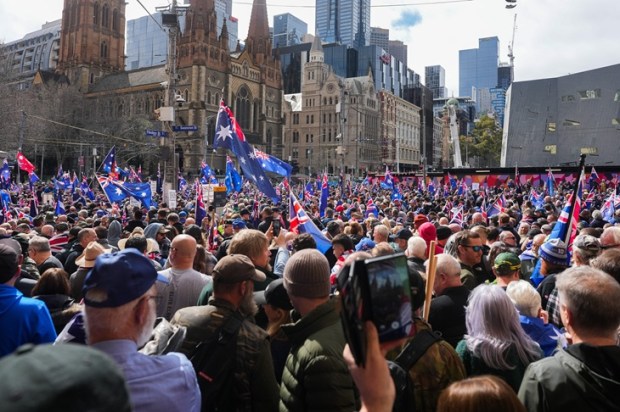
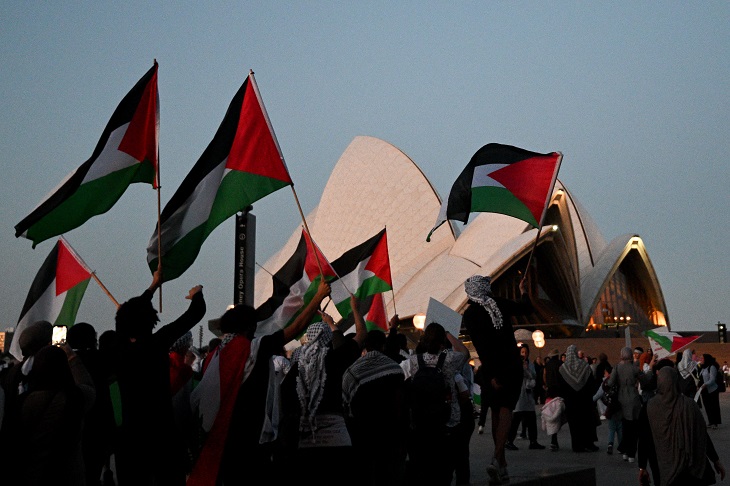
It is visible in protest imagery across Western cities. In Australia, it appeared on the Sydney Harbour Bridge march, where politicians stood beneath at least one Iranian regime flag, Palestinian symbols, and an image of Ayatollah Khamenei.
Flags of a regime that represses women, executes gay men, and kills its own citizens appear alongside Palestinian symbols and rainbow flags. The alignment rests on a shared narrative: contradictions are absorbed, and a common antagonist binds the coalition.
A Pattern Repeating Through History
Antisemitism adapts to the dominant moral language of its time.
Across centuries, Jews have been cast as the embodiment of a society’s greatest perceived wrong.
In medieval Europe, the charge was deicide. Later, it was the blood libel.
In contemporary frameworks, the language has shifted.
Jews are cast as colonialists, oppressors, or illegitimate occupiers. Each formulation reflects a different ideological lens. The underlying pattern remains constant: Jews are positioned as the object that must be opposed.
This pattern is now most visible in the treatment of Israel.
Israel and the Question of Moral Expectation
Israel has repeatedly been forced into conflict and has developed methods of warfare designed to limit civilian harm, including advance warnings, evacuation corridors, direct communication with civilians, and ‘roof-knocking‘ techniques.
These are systematic responses to the realities of urban combat.
According to John Spencer, one of the world’s leading authorities on urban warfare, Israel has taken more measures to prevent civilian harm than any other nation operating under comparable conditions, establishing what he describes as a ‘remarkable‘ standard.
Despite this, Israel is subjected to a level of scrutiny and condemnation that is unparalleled.
From Theory to Culture
These ideas are embedded in public discourse, protest movements, and institutions, shaping interpretation and empathy. In Australia, the Executive Council of Australian Jewry recorded over 1,200 antisemitic incidents in 2024 – the highest ever, far above historical averages.
Within this climate, some Jewish Australians seeking mental health support report ‘traumatic invalidation’, including being told their Jewish identity is the source of distress, or to be ‘less Jewish’. This reflects a framework that places Jews outside ordinary moral consideration. It is difficult to imagine any other group being told to diminish their identity as a condition of support or acceptance.
Conclusion: An Old Hatred, Newly Aligned
Antisemitism has long resurfaced in periods of social and political change. What distinguishes this moment is the degree of alignment across incompatible ideologies, spread globally. Different intellectual traditions are reinforcing one another, lending weight, legitimacy, and reach to shared conclusions.
The result is a form of hostility that is increasingly cohesive. That convergence – the alignment of ideas into a unified front – defines the current moment.
And it is this alignment that gives it force. To understand the present, it helps to step back.
Across history, similar periods of alignment and intensification have occurred, each shaped by the ideological forces of their time. What can appear as something uniquely cohesive or unprecedented often reflects a familiar pattern – hostility adapting to the dominant language and structures of a given era.
The historical record is clear. Empires, regimes, and movements that defined themselves in opposition to Jews have risen with conviction and force, often appearing dominant and enduring. Yet they have receded, fragmented, or disappeared altogether. The Jewish people have not. The present convergence, however serious, sits within that longer arc. It reflects the conditions of this moment – but it is not historically unique, nor historically final.
And if history offers any guidance, it is that even in moments that feel most uncertain, it is courage, clarity, and belief that carry people through.