When I was a teenager, I became mildly obsessed with The Darwin Awards. The Darwin Awards, in their own words, ‘salute the improvement of the human genome by honoring those who accidentally remove themselves from it in a spectacular manner.’ They include a man who tested a supposedly broken detonator in his mouth (it wasn’t broken) and a bloke who stabbed himself to test if his new jacket was actually stab-proof (it wasn’t either). Darwin Awards almost always go to men: one study published in the British Medical Journal found that nine out of every ten Darwin Award winners were male.
My inkling is that men and women alike both massively overestimate the risks from a nuclear accident – men just have a lower threshold for seeing nuclear as safe
I was reminded of the Darwin Awards study by a recent YouGov poll looking at attitudes towards nuclear power. It was mostly good news for nuclear power. Supporters (51 per cent) outnumber those opposed (29 per cent). Almost every group you can think of is pro-nuclear. Young and old, rich and poor, leave and remain – they all back nuclear. Every major political party’s voters back nuclear. Even the anti-nuclear Greens backed it 46 per cent to 39 per cent. There’s just one exception: women.
Women are less likely than men to support nuclear power (30 per cent female vs 74 per cent male), less likely to believe that nuclear power is safe (28 per cent female vs 64 per cent male), and less likely to know nuclear power is low in carbon (31 per cent female vs 68 per cent male).
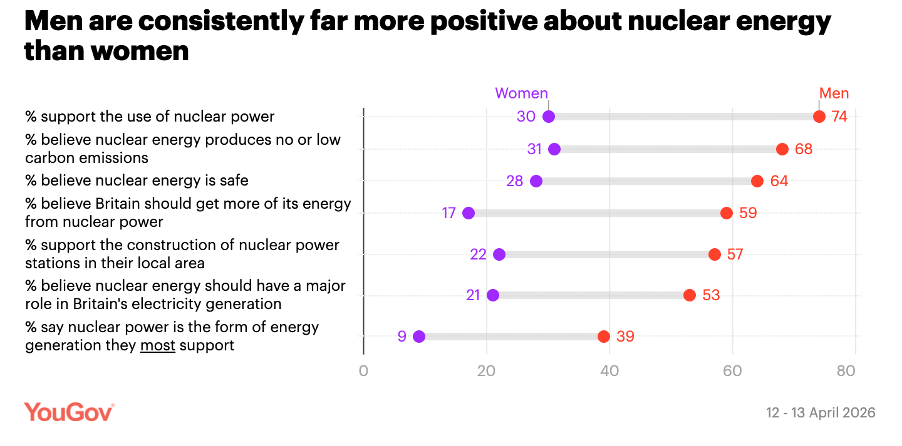
It is a remarkable gender divide. It prompts the question, why? Well, there’s the ‘don’t know’ factor. When women don’t know the answer (or lack a strong view), they are much more likely to tell pollsters they don’t know. Men, by contrast, will take a punt. Still, excluding the ‘don’t knows’ cuts the gender divide, but it doesn’t eliminate it.
So, what explains the gender divide? It is the same reason why men are massively overrepresented among Darwin Award winners: risk. Opinions may differ on why, but few dispute that men have a higher tolerance for it.
One amusing result from the YouGov poll is that male supporters of nuclear outnumbered men who think nuclear is safe. Ten per cent of men don’t think (or don’t know) if nuclear power is safe, but support it anyway.
But, what is ‘safe’ anyway? There are few things in life without risk. What’s considered safe by one person might be considered dangerous by another, even if both people agree on hard facts. My inkling is that men and women alike both massively overestimate the risks from a nuclear accident – men just have a lower threshold for seeing nuclear as safe, just as they have a lower threshold for seeing motorcycling as safe.
Yet a laissez-faire attitude to risk taking isn’t necessary to support nuclear power. Nuclear accidents are extremely rare and, as a result of multiple failsafes, unlikely to kill anyone. In the absurdly unlikely event that Hinkley Point C were to experience a meltdown, people living nearby are unlikely to be exposed to more radiation than they would from a summer holiday in radon-rich Cornwall.
YouGov’s poll was timed for the 40th anniversary of Chernobyl. No event did more to shape popular fears around nuclear power and radiation. There is no doubt it was a tragedy – and one that could have easily been prevented had the Soviet Union not been so deeply flawed – but anti-nuclear activists have stretched the truth to present nuclear power as uniquely dangerous.
It isn’t. Last year, I met Prof. Geraldine Thomas, the founder of the Chernobyl Tissue Bank. Like most women it appears, Prof Thomas started out anti-nuclear. It was only after having studied thousands of tissue samples from people exposed to radiation from Chernobyl that she became one of the technology’s strongest advocates. She concluded that there was a big mismatch between the scientific reality and the stories we were told. The best studies have put the death toll from Chernobyl somewhere in the low hundreds.
Yet the scientific consensus has had little impact on how the disaster is portrayed in the media. Take HBO’s Chernobyl mini-series. As a work of drama it is flawless, sadly it contains multiple errors. In one scene, the pregnant wife of a firefighter suffering from radiation sickness is told not to touch her husband because second-hand radiation could kill her unborn child. In a later scene, her baby dies shortly after birth. The viewer is invited to link the events. Yet, radiation sickness isn’t ‘contagious’.
Likewise, the viewer is told that there is a real risk of a secondary larger explosion with a blast 100 times more powerful than the bombs dropped on Hiroshima and Nagasaki that could make much of Eastern Europe uninhabitable. There wasn’t. There was a risk of a secondary explosion, but the show exaggerated its potential impact by a factor of four million.
Chernobyl’s legacy is a deadly one. Before Chernobyl, nuclear output was growing rapidly to meet growing electricity demand across the world. After Chernobyl, the government got cold feet about building nuclear plants. Instead, we burnt coal to fill the gap. Hundreds of thousands more will have died from the air pollution that resulted.
Burning things to create power has another side effect: climate change. Nuclear by contrast is as low carbon a way to produce energy as it gets. Women, however, are more likely than not to say nuclear is moderate or high carbon.
Given what we know they think about safety that’s not surprising. We tend to think that good (and bad things) go together: that beautiful people are nice, that ugly people are mean. If you see nuclear as extremely dangerous, it is likely to negatively colour your perception of completely unrelated traits like its carbon intensity. It’s the halo effect in reverse.
Some will inevitably use this polling for point-scoring in the battle of the sexes. They shouldn’t. Everyone is ignorant about something. Most of the time, it is because there is no need or opportunity to learn the facts. The sad truth is that the case for nuclear power is most often confined to publications and media disproportionately consumed by men.
There is cause for hope on this front. Rad Future by Brazilian-supermodel-turned-science-influencer Isabelle Boemeke was published last year and makes the case that nuclear power is essential to the fight against climate change. Fans include Katy Perry, Gwyneth Paltrow and Paris Hilton.