On Monday, the House of Lords threatened to derail the government’s Children’s Wellbeing and Schools Bill by reintroducing an amendment which would ban social media for the under-16s. The Commons will vote on amendments today.
This is the third time that the Lords have attempted to force this amendment into the legislation. On each occasion that it has been added, the government has whipped its MPs to reject the amendment. The Prime Minister wishes to delay the implementation of a social media ban until a consultation that he commissioned into online harms for teenagers concludes this summer.
Perhaps the reason advocates want to rush this legislation through is that if they wait any longer, the evidence coming out of Australia – that these bans do not work – will become so overwhelming that they will have missed their chance.
The first study which has been conducted into social media usage by teenagers with a ban in place has found that 61 per cent of Australian 12-15 year olds who had social media accounts have continued to use them since the ban came into effect. The Molly Rose Foundation, which commissioned this study and campaigns for safety online, said that the findings show that for Britain to copy the ban and implement it now would be a ‘high stakes gamble’.
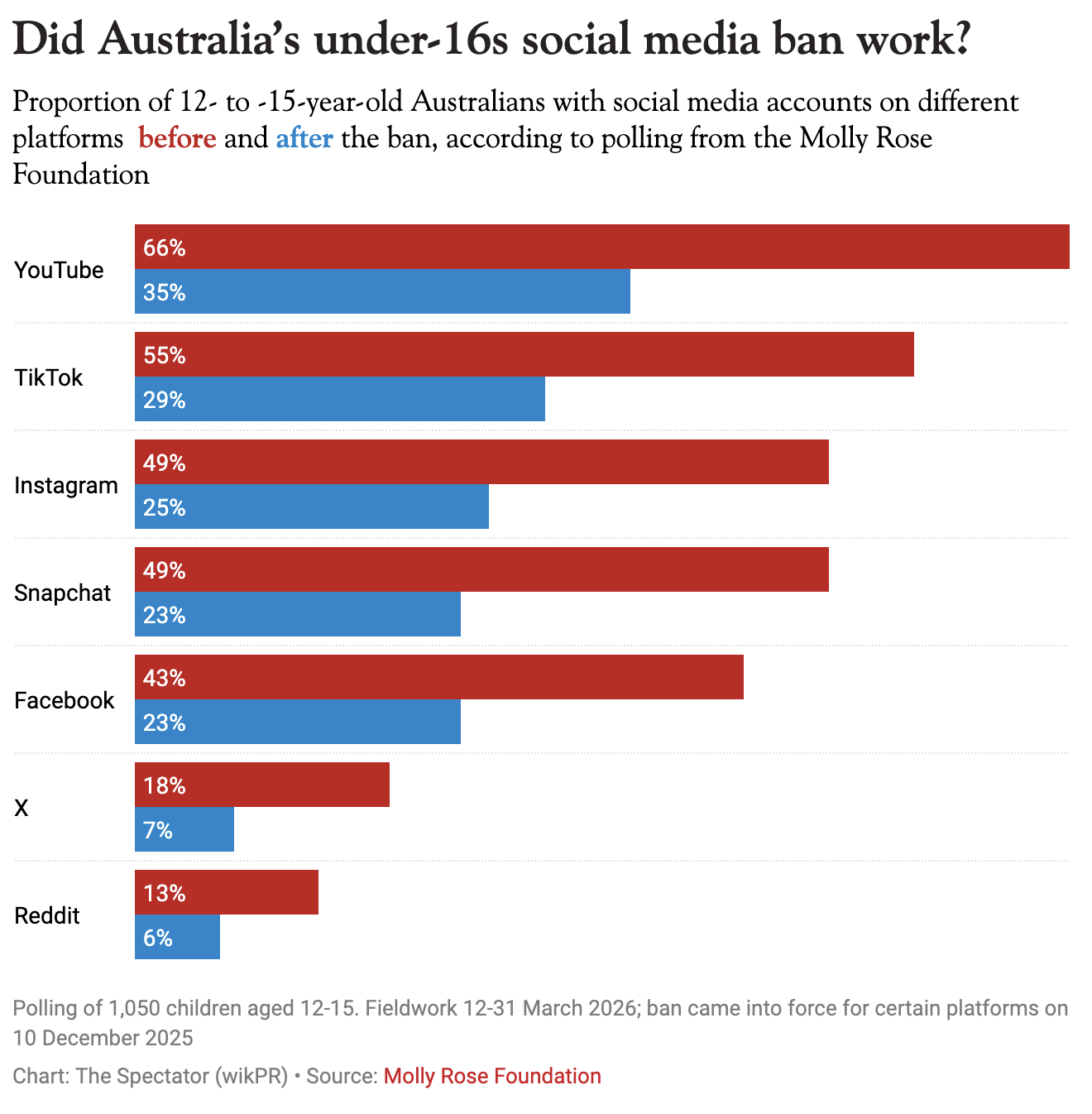
Part of the problem is platform enforcement, but another issue is that just as negligent parents might not be monitoring their children’s social media use, they may also enable their children’s social media use to help them evade a ban. A parent who wants their child to be quiet and watch YouTube is not going to be deterred by age verification technology from handing over an iPad. What’s more, social media is often accessed on shared devices, especially Smart TVs, by design. Children will still be able to get their hands on animated brainrot so long as they can point and click a remote control.
The evidence that social media is having a negative impact on children’s mental health is at best thin
Leaving aside the efficacy of the bans themselves, the evidence that social media is having a negative impact on children’s mental health is at best thin, as Christopher Ferguson, a Professor of Psychology has written about for The Spectator before. Many studies have been conducted into whether or not there is a correlation between social media usage and mental illness and the majority have not found a causative link, including a major study by the University of Manchester earlier this year which followed 25,000 11-14 year olds and found no link between social media use and poor mental health.
The British Medical Journal also recently published a study into British schools which have focused on the effects of smartphone bans in individual schools. The government is considering rolling out a national smartphone ban in schools. This study found that smartphone bans within schools have little impact on pupils in regard to their attainment or mental health.
A social media ban for under 16s will radically change our relationship with the state by forcing us to prove who we are to use the internet. Keir Starmer is right to delay any changes until after the consultation ends. The real question is whether he will have the moral fibre to reject a ban if the consultation concludes that the evidence does not support the thesis, adopted credulously by so many, that social media is to blame for teenagers’ ill mental health.