In the lead-up to Anzac Day, the Australian National University has released an interesting poll. The headline finding is that most Australians (nearly 60 per cent) think life was better 50 years ago, during the 1970s.
What’s striking is that it is not young Australians, who tend to be more optimistic and more satisfied with the direction of the country, who think this way, but those in the middle of the age distribution, in other words, who may have had first-hand experience of the 1970s.
Is this a nostalgia for bell-bottoms, platform shoes, polyester and paisley prints? For Donna Summer or disco dancing? For Abba and Star Trek, Jaws and Farrah Fawcett-Major.
Perhaps those who hanker after the 1970s have forgotten that this was the decade of the Whitlam government, whose out-of-control spending, combined with the first oil shock, which was created by Opec’s oil embargo in 1973 against any country that had supported Israel during the Yom Kippur war, combined to give us stagflation.
If you’re missing the 1970s, don’t worry, because Jim Chalmers has channelled his inner Jim Cairns so that we are about to re-experience the joys of stagflation, with its sluggish economic growth or outright recession combined with high inflation and unemployment.
Stagflation is a nightmare in its own right because the key lever for dealing with it – raising interest rates – raises unemployment without driving down those prices, which have risen because of supply-side shocks such as rising oil prices.
But in the lead-up to Anzac Day, we should also remember that the 1970s was when America managed to lose the Vietnam war on the television screens of middle America, having won the war, at an enormous cost in blood and treasure, on the battlefields of Vietnam.
In Australia, progressives expressed their contempt for Australian veterans. Some 15,000 troops were sent, most of whom had no choice in the matter because they were drafted, but as the Cold Chisel classic, ‘Khe Sanh’, records, ‘there were no V-Day heroes in 1973’.
Yet even then, the left’s hatred for Australian soldiers was nothing new. On Saturday, 12 April in 1919, in the lead up to the fourth Anzac Day, the Northern Star, the local newspaper in Lismore, in northern New South Wales, records that George Clarke, a well-known local labor (sic) organiser for the Australian Workers’ Union in Bingara, was fined the substantial sum of five pounds ‘for using insulting words to John Jennings, namely “The Australian soldiers are in fact six bob a day murderers.”’
Clarke wasn’t the only one to say it. The local paper in Albury, the Border Morning Mail and Riverina Times, recorded on Saturday, 7 February 1920, that Ernest Judd’s appeal against the conviction imposed by the Central Police Court, at which he was charged with using insulting words in the Domain, was dismissed. ‘The words alleged to have been used were “I did not go away to commit murder for six bob a day. The men who went away to fight for Australia are murderers!”’
Which brings us to this Anzac Day, which falls 110 years after the first Anzac Day was commemorated in 1916. Even if the contempt for Australian diggers is nothing new, the persecution of Australia’s most highly decorated soldier is still shocking.
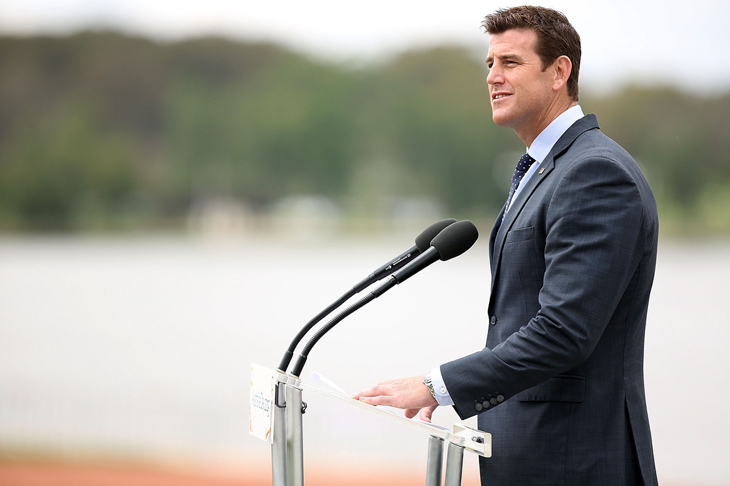
As I argue in the May issue of Quadrant magazine, the left never tires of decapitating tall poppies and at 196 cm, none stands taller than Roberts-Smith, twice decorated for bravery, in 2006 with the Medal for Gallantry and in 2011 with the Victoria Cross.
Although he had long indicated he would surrender if charged, Roberts-Smith was instead arrested at Sydney airport during a family holiday in a made-for-television spectacle, with a battalion of reporters and cameras from Nine News, including nemesis Nick McKenzie, on hand to immortalise his downfall.
The manner of his arrest alone raises many questions about this extraordinary trial. Who can be confident that Roberts-Smith will receive a fair trial when he is meted out such treatment despite supposedly being afforded the presumption of innocence?
Is it true that Roberts-Smith was arrested in Sydney because the AFP think it has a better chance of securing a conviction than in the state where he lives – Queensland – or the state where he was born – Western Australia – both of which are considered more conservative and more sympathetic to the armed forces?
How is it acceptable that a man who has repeatedly risked his life to protect his fellow soldiers – and who poses no flight risk since he is determined to clear his name – was imprisoned rather than granted bail?
How is it possible that the prosecution has allegedly built its case on the testimony of anonymous soldiers, shielded – unlike Roberts-Smith – from the horror of trial by media, who have allegedly confessed to murder on the basis that they have been offered immunity in exchange for pinning the blame for their actions on Roberts-Smith?
The case also raises deeper questions. If Brereton was correct to identify 39 unlawful killings, the implication is not just individual misconduct but a grave collapse of command, discipline and oversight at the Army’s highest levels.
But if Brereton’s allegations cannot be substantiated to the criminal standard – as the glacial pace of prosecutions seems to suggest – then abandoning two dozen veterans in a Kafkaesque quagmire to wage grinding legal trench warfare is even more reprehensible.
In Afghanistan, as in Vietnam, thanks to the recklessness of an American president, a war that was won on the battlefield has been lost in peace.
In Vietnam, you can still buy old Zippo lighters from the Vietnam war era. They are inscribed with an Australian coat of arms: a crown over a kangaroo on guard in front of crossed guns, standing over a boomerang inscribed with ‘Royal Australian Regiment’. On the other side is written, ‘For those who fought for it, freedom has a taste the protected will never know’.
This Anzac Day, as Roberts-Smith faces years more before he gets his day in court, spare a thought for all those who sacrificed their health, their lives, or their reputation for the freedoms that our political and military leaders treat with such palpable contempt.
Got something to add? Join the discussion and comment below.
Rebecca Weisser is the editor-in-chief of Quadrant magazine. A longer editorial on Ben Roberts-Smith appears in the May 2026 edition.
You might disagree with half of it, but you’ll enjoy reading all of it. Try your first month for free, then just $2 a week for the remainder of your first year.