Henry Parkes, the Father of Federation, was converted to free trade by Richard Cobden, the apostle of free trade and working-class hero.
Parkes visited England in the winter of 1860-61. Cobden told him:
‘How futile any attempt to give unnatural growth to any industry must ultimately prove itself, and how the cost of the experiment must always fall upon those whom it is proposed to benefit.’
Although Parkes ‘had been bitten by the doctrine of fostering infant industries, I never afterwards wavered from the cause of free trade’.
Parkes turned NSW into a free trade colony, whose leaders clashed with protectionist Victoria after Federation.
In his coach ride (there was no train) back from visiting Cobden, Parkes listened to two locals discussing a landowner who had caught poachers stealing his pheasants. They sympathised with the landowner, which surprised Parkes.
Cobden later explained that the modern world was built on ‘enquiry as to their utility or suitableness to our days…’ Such inquiry and resulting parliamentary decisions were the golden thread of colonial Australia, as it struggled to survive and develop, as it built modern Australia in the face of every hardship. And of successful modern Britain, too.
Parkes gave ‘loose pence’ to a beggar girl in London and also saw beggars on the streets of Sydney. Economic prosperity and development were surely the answer!
Parkes said in 1878 free trade was ‘casting off from the people engaged in commerce the shackles that hampered them at every turn’. When he took office as Premier in 1872, he decided to ‘throw New South Wales open to most of the products of the whole world’. This was endorsed by the London Times, the Scotsman, the Argus, and the Cobden Club (Lyne), and prosperity came.
The Hawke to Howard governments (1983-2007), again converts to free trade, made a concerted attempt to make the economy efficient by removing shackles, promoting competition, and reducing tariffs.
Cheaper goods for ordinary people resulted, although manufacturing declined, a new problem arose. Malign actors took the benefits of international free trade while manipulating it to their benefit, without following the rules. They systematically combined trade and defence and threatened the geopolitical safety of the West through rare earths and monopolies of manufacturing:
‘Critical minerals are … vital to modern supply chains for electronics, semiconductors, batteries, and electric motors … essential to economic and national security.’ (WilmerHale)
Neo liberalism allowed this. ‘Just in time’ and the specialisation of economies works in economic theory and enriched us while assumptions of stability lasted. But theory did not adequately build in geopolitical threats.
The answer is not a return to government selecting ‘sunrise industries’ and wasting taxpayers’ money. The Hawke government (1983-1991) discovered this when it considered industry policy based on Sleeper’s, Wake! a book by Minister Barry Jones. No one could produce a list of target ‘sunrise industries’ when repeatedly asked. No government can identify suitable industries except by accident.
Instead, tailoring to defence needs is required, and new assumptions of malignity and hatred are needed. This is to become one of our great debates for decades, along with government rediscovering the total priority of providing reliable fuel and energy in a cost-effective fashion. The world energy shock makes our climate change policies look even shabbier.
But free trade is not the only conventional idea under attack. Immigration policies introduced violent foreign hatreds to our streets, and land use has become a bonfire of litigation. Equal opportunity has become a vast system of preference.
Compulsory opinions are forced on us, traditional liberties ignored, and the consent of the governed is not sought.
Conventional thinking is practically perfect in every way, as Mary Poppins said. Spit spot. Or perhaps now should be liberation day, a day when we can throw off oppressive opinions and institutional bias. We should think and talk freely.
Although free discussion is frustrating. One of my first involvements in national policy was trying to convince a Commonwealth Department in the 1980s that English language skills were an advantage and should be recognised in the immigration points system.
Eventually, the argument was won (by others) – but a simple issue became a long-inflamed one. The odd notion of world citizenship, unrecognised in law, was entrenched and protected by all.
We are still systematically told how unfair Australia is. Ordinary taxpayers fund many voluble Australia haters. Should they?
The decision of the US Supreme Court rejecting ‘skin colour’ and affirmative action in 2023 (Fair Admissions v. Harvard) overturned an historical problem: ‘The student must be treated based on his or her experiences as an individual — not on the basis of race.’ (Roberts CJ)
The problem came from the courts, as a substitute for democracy, and the substitute did not work well. The Mabo decision (1992) was not made by Parliament, but by the courts. The result has been litigation.
In NSW alone, there are somewhere between 42,000-44,000 unresolved land title claims, an increase of 320 per cent in claims last financial year, and unmanageable. I was told that Native Title was ‘just an easement,’ which is false. The usual clamour will slow down any attempt to resolve the problem.
The war of labour legislation and litigation will continue. Employers may be able to achieve limited practical changes which do not undermine workers. But change to new laws promoting industry not enterprise bargaining will be unlikely until a change of government.
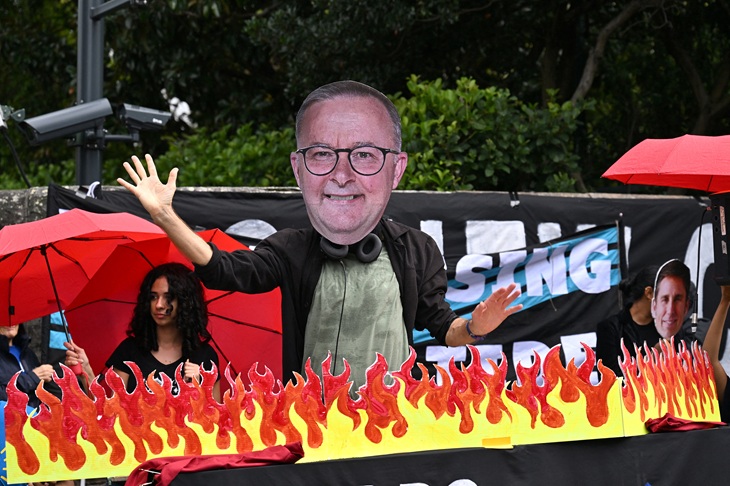
The bonfire of traditionally proclaimed ideals is unmistakable. It is time for us to rediscover our spirit of practical inquiry, from Federation to building great cities, farms, and the Hills Hoist. We can solve the world’s problems with it. Conventional opinion is a bonfire of ideals.
The Delphic Oracle is now silent: ‘The fair-wrought house has fallen. No shelter has Apollo.’ The Oracle told King Croesus that ‘a great empire would fall’ if he went to war; it did not tell him that it would be his.
The Hon. Reg Hamilton, Adjunct Professor, School of Business and Law, Central Queensland University