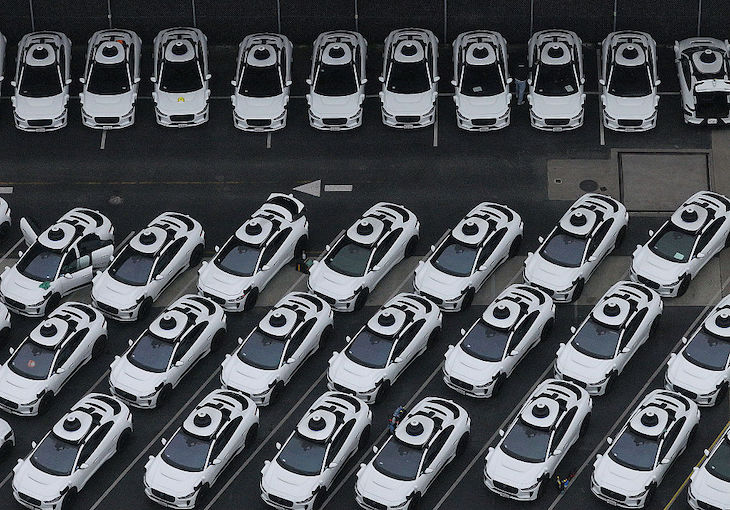
After an eleven hour flight, I stepped out of Phoenix International Airport into the balmy Arizona heat. It felt like I had stepped into the future. Weaving in and out of lanes of regular taxis and airport shuttle busses, I saw a constant flow of white Jaguars adapted with roof mounted cameras and sensors, gliding past. I recognised them instantly as Waymo driverless cars. I could not wait to try them.
Once I’d been driven by a robot, I suddenly noticed how much worse almost every human driver was
Over the last few weeks I’ve been flying in and out of different US cities to record a series of interviews for an upcoming documentary series. The trips have been busy and quick, with each airport and business hotel blurring into the next: Miami, Dallas, Vegas, Boston, Manchester.
But Phoenix offered me an exhilarating opportunity I will never forget – to be driven in completely autonomous cars, alone, with no driver present. I have always been fascinated by robots, seeking them out years ago on trips to Japan, and putting an early autonomous vacuum cleaner on my wedding list. Machines which in my childhood were science-fiction are now part of real life.
I tried the driverless cabs as often as as I could during my Phoenix trip, and can confidently say that from hereon, I will always opt for a robo-taxi over a human driver whenever I can. The experience was transformational. The superiority of the service was immediately apparent, and the experience sold itself to me better than any advert or PR could do. I wish I could take these driverless taxis every time, here in London, and just about everywhere else I go.
That possibility might arrive sooner than expected. In recent weeks, you may have seen Waymo’s curious looking vehicles weaving in and out of London traffic. Half white SUV, half Dalek, they nearly blend in unnoticed, but for the whirring sensors on their wings, or the LED displays atop their bulky roof-racks of technology. London’s Waymos still have someone inside them, guiding and helping as they learn our streets. That phase is already underway, with roughly two dozen vehicles mapping the city ahead of a planned commercial service target set for September, subject to regulatory approval.
If they can get Waymo to work as well on London’s old and peculiar road system as it does on the grid-based, multi-lane roads of modern American cities like Phoenix, then I will happily kiss goodbye to human-driven rides overnight. Waymo drives beautifully – smoothly, carefully, quickly – but never scarily or aggressively. It never takes its eye off the road to text, forces you to listen to music you don’t care for, or gives you the creeps. Once I’d been driven by a robot, I suddenly noticed how much worse almost every human driver was. As I continued on to other states and cities, I was disappointed every time I couldn’t get a robo-cab.
Unlike a human, the driverless car never gets tired. It can keep going for ever, pausing only to recharge the battery or for cleaning. The temperature control, music selection, and even seat position are all entirely in the control of the passenger. I know too many women who are afraid to get in an Uber alone or late at night, too many Jews who have changed their name on taxi apps to avoid potential abuse from a seemingly majority immigrant Muslim workforce. Neither group will have anything to fear from Waymo. If it ever becomes allowed, you could put your child in one alone to be met at the other end.
The cars arrive as quickly as possible, and never decline a job because it takes them where they don’t want to go. They don’t smell bad, either. They don’t talk to you when you want silence, or eavesdrop on your conversations. With the greatest of respect to every single taxi or minicab driver I have ever ridden with – and I thank you all for your service – there is not a single thing you managed to do better than my robot chauffeur rides. According to the company’s data so far, they are far less likely to have accidents with serious or fatal consequences than human drivers are. They are just better.
Robot transport might also help fix even bigger social issues. From now on, whenever we discuss limiting incoming immigration, the questions of ‘who’ll drive our minicabs’ or ‘who’ll deliver our food’ will have an easy answer. Because just as Waymo provides a safer, more reliable, more comfortable minicab experience, parts of the U.S. also are now also overrun by so-called sidewalk robots – little dishwasher sized vehicles which pootle along the pavements to deliver food orders from shops to homes. They are less obviously superior to their predecessors, but transferred to Britain, they won’t require visas, won’t be sub-let by illegal workers earning cash from asylum hotels, and won’t come with the vetting failures and public safety rows now hitting our delivery apps.
Sometimes a technology comes along that is so clearly superior it instantly supersedes everything that came before it. It might once have seemed unthinkable to have a lift which drove itself. Yet automatic elevators, introduced in the early 1900s, quickly made human attendants obsolete as they proved faster, safer, and far more scalable. Aircraft autopilots, invented just nine years after the Wright brothers’ first flight, took over routine flying duties so effectively that pilots now rely on them for the vast majority of commercial flight time, reducing fatigue and human error dramatically. Driverless metro trains, first fully deployed in cities like Kobe and Lille in the 1980s, delivered higher frequency, precision, and safety than manned systems.
When a technology’s advantages are overwhelming, adoption accelerates dramatically once scepticism fades. In my case, that scepticism took less than five minutes in my first ever driverless ride to disappear completely. Autonomous cars appear to belong to this rare category: a leap so clear that smelly, noisy, argumentative human cab drivers seem instantly old fashioned. The technology will only improve, and many sceptics will quickly abandon their disapproval when they just try it. No doubt there will be crashes and fatalities to come, as well as union battles and luddite protests. But for every twist and turn in the road to full automation, the direction of travel is clear.