What have North Sea oil and gas production and grammar school education got in common? Both are subject to a fiddle by which they can be expanded while the government pretends they are not expanding. After David Cameron changed his mind on grammar schools and said he wouldn’t allow new ones to be created, a deal was done whereby existing schools could open a ‘satellite’ on another site in another town. Hence Tunbridge Wells Grammar School opened a new site in Sevenoaks – a separate school in all but name, and yet the government could claim that it had stuck to its promise of no new grammars.
The cabinet battle over the energy crisis is still far from resolved
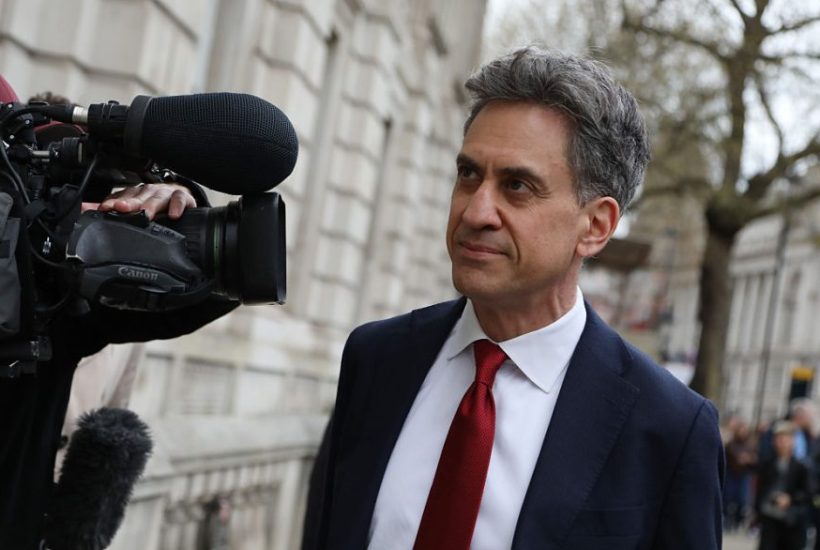
Rachel Reeves has suggested that the present government may take the same approach to North Sea oil. While Ed Miliband has hunkered down on his promise not to allow licences for the development of new fields – in spite of a gathering oil crisis which could see shortages of fuel within weeks – the Chancellor told a meeting of the IMF in Washington that the government will give the green light to so-called ‘tie-backs’. This is where new wells are dug but no new oil platforms are installed; instead, the oil is transferred to existing platforms some distance away via a flexible hose. By such means, new drilling could indeed take place beneath the North Sea while Ed Miliband continues to pretend that it wasn’t really a new oil field, just an extension of an existing one.
It is the latest chapter in a growing stand-off within the cabinet. Two weeks ago it was reported that Miliband had given in to ministerial colleagues – as well as RenewableUK, the trade body for the wind and solar industries – which have demanded new development in the North Sea as a short-term measure (at least) to alleviate the energy crisis. This later proved premature, with Miliband continuing to insist, somewhat unconvincingly, that new drilling in the North Sea would neither help to boost energy security nor to reduce prices.
Reeves, at least, has appreciated the potential of the energy crisis to develop into a political disaster for the government. She has also quietly announced the abolition of the Carbon Price Support Levy, one of the earliest carbon levies which was designed to create a price floor for fossil fuels in order to aid the development of carbon trading. However, the levy – introduced in 2001 – will not be removed until 2028, and even then it will have limited effect on household bills because domestic consumers don’t pay it, only industrial users. Gas power stations, however, do pay it, and so its abolition should exert some downwards influence on electricity prices.
A more effective way to tackle bills would be to rewrite the rules of marginal cost pricing in the electricity market. This is the bizarre system whereby power stations bid to provide power for each half hour period – and then everyone is paid the same as the highest bid. It is rather as if you bought 11 bottles of plonk and one bottle of Chateau Lafite from the supermarket, and then when you got to the checkout, you were charged for 12 bottles of the latter.
When marginal cost pricing was conceived, it didn’t make a lot of difference to electricity prices, but the more intermittent renewables that are fed into the grid, the more expensive it becomes. We end up paying through the nose because the price of all electricity ends up being set by gas peaking plants – power stations which exist to provide short bursts of power at short notice to make up for a lack of wind and solar energy and which, like an Uber at rush hour, can charge very handsomely for it.
The cabinet battle over the energy crisis is still far from resolved, with Reeves and Miliband pursuing very different lines. As to who will win the stand-off, that may well depend on whether Keir Starmer can survive the latest fallout from the Lord Mandelson affair. Energy consumers may be left hoping that Miliband doesn’t make it to No. 10.