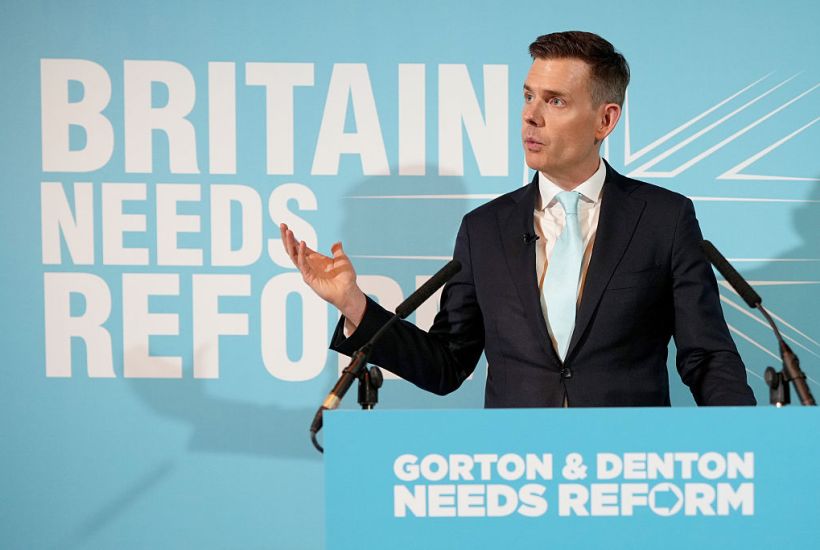
It’s been a rather unusual month. In the last four weeks, I’ve gone from being renamed ‘Matt Badloss’, after finishing behind the Greens at the Gorton and Denton by-election, to ‘MattGPT’, on the basis, my many critics claim, that parts of my new book were written not by me but artificial intelligence.
Many of my critics, I genuinely believe, have seized on a few minor imperfections to try and stigmatise a major argument about how demographic change is destroying Britain
While even I accept that my new moniker of MattGPT is amusing – prompting even my own mother to call and ask ‘what’s ChatGPT?’, unfortunately for my critics the underlying claim is categorically untrue.
Let me explain what really happened and how this book ended up being the most controversial, and best-selling, of all my books, having now rocketed to number two on the Amazon bestseller list – behind a children’s book about an Easter fluffy chick.
On March 17, I released a trailer for my book Suicide of a Nation: Immigration, Islam, Identity, which was soon watched by half-a-million people. The title is a deliberate reference to Arthur Koestler’s Suicide of a Nation, a collection of left-wing essays, published in 1963, and the subtitle of Douglas Murray’s excellent book The Strange Death of Europe, published a decade or so ago.
The book, helped largely by my 94,000 Substack subscribers and appearances on the podcast circuit, began to climb slowly in the rankings. People began to talk about my argument – that we are losing our country. That by 2063, according to my projections, white British people will be a minority in this country; by the 2070s the foreign-born will be a majority, and by 2100 the share of people following Islam will go from one in 17 to one in four.
At this point, the only criticism, ironically, came from the ultra-right-wing, where an assortment of increasingly extreme young men began to criticise the book for being ‘too soft’. This was strange, I thought, given that I use the book to call for an immediate end to mass immigration, an exit from the European Convention on Human Rights, the deportation of illegal migrants and foreign criminals and a reversal of the ‘Boriswave’, which brought millions of low-wage, non-European migrants into Britain with no democratic consent whatsoever.
But then all hell broke loose. At the other end of the political spectrum, a largely unknown left-wing activist named Andy Twelves cobbled together online a list of what he said were factual inaccuracies in my book, along with misquotes, typos and limited footnotes. Taken together, this led him to claim that large parts of the book were written by artificial intelligence.
This quickly went viral, the amusing moniker MattGPT was born, and Twelve’s claims were uncritically accepted by countless onlookers – even though more than a few of them are either misleading or simply wrong.
There is no doubt the book contains a few errors and typos – which I regret and are currently being corrected. It is one of the potential perils of deliberately choosing to publish a book outside the woke publishing industry.
For instance, I do, mistakenly, describe Boris Johnson as being ‘in opposition’ when he promised the British people, in 2019, that he would ‘lower the overall number’ of immigrants. In reality, he was already prime minister.
Some of my historical quotations are also imperfect. For instance, in the book I write that the great Roman orator Cicero said: ‘The state should begin with those who are closest to us.’ As a ‘world expert’ on Cicero confirmed to the Times a few days ago, what Cicero said was: ‘The supreme duty of the state is to protect its own citizens’.
I also misquote Sir Roger Scruton as having said: ‘A society that cannot distinguish its friends from its enemies or that extends hospitality to those who despise its way of life, is a society that has lost the instinct for survival.’
Having checked my notes, this is clearly a misquote from Scruton’s The Need for Nations, in which he warned of the distinction between ‘those who are entitled to the benefit of the sacrifices that my membership calls from me, from those who are interloping.’ But I got it wrong.
My critics also quibble with things such as a reference to a report from Bradford which claimed that ‘only four of 28 students’ in one school spoke English as their first language, which I attributed to the BBC. In reality, this comes from a piece in the Times Educational Supplement and the Daily Mail, which noted ‘only four out of 417 children spoke English as their main language’ at a Bradford primary school. You get the drift.
Unfortunately, these claims about ChatGPT were also fuelled by my inclusion of references to ChatGPT in the footnotes, regarding data on how immigration is rapidly changing classrooms in England.
To be perfectly honest, I didn’t think twice about it. Every major academic, journalist and data analyst uses artificial intelligence to interrogate data and if they claim they are not using it then they are lying. It has become a crucial tool and so long as you are cross-checking the data with official datasets, as I did, then you are on solid ground.
But there is an enormous difference between using AI as a research tool and claiming it has been used to write a book. It’s like saying if you use a calculator, you are not doing maths, which is obviously ridiculous. So, I stand by all the numbers and (peer reviewed) demographic projections in this book.
On Friday, I took part in a GB News debate with Andy Twelves and he asked me to name the leading demographers who reviewed my projections regarding Britain’s future population. I could not tell him this because peer review is by its nature anonymous. Twelves would have known this had he ever written a book or conducted a major academic study. He has done neither. My anonymous reviewers know who they are and I thank them.
There are also many things my critics get wrong. For example, Twelves criticises my claim that ‘In Leicester, Luton, Slough, and virtually all of London, most primary school pupils’ main language is no longer English’, accusing me of ‘statistical illiteracy’.
I’ve gone back to check the numbers from the Department for Education. The percentage of primary school pupils who do not speak English as their first language is 53 per cent in Luton, 59 per cent in Leicester and Slough, 65 per cent in Tower Hamlets and 72 per cent in Newham.
While the left might not think this is a problem, I do. Either way, it’s a matter of opinion, not something that can be shut down because the left doesn’t want to talk about it.
Similarly, my critics claim that my argument that teachers struggle with the reality of mass immigration in the classroom is nonsense. Even the Bell Foundation, in evidence to parliament, notes the problems and challenges many teachers report when dealing with multiple languages in the classroom.
The left want us to pretend everything is fine; but I don’t think it is. The British people, for example, have been forced to spend £243 million in recent years on translation services in the NHS. How is this right, or fair? If you come to England you should learn and speak English.
The key point, I think, is that we should be able to debate what is happening to Britain, whereas many of my critics, I genuinely believe, have seized on a few minor imperfections to try and stigmatise a major argument about how demographic change is destroying Britain.
While I could have asked my long-suffering family and friends who watched me write Suicide of a Nation for four months to vouch for me, ahead of the debate with Andy Twelves on GB News, just for fun, I asked artificial intelligence detection software what it thought.
One, called GPTZero, said: ‘We are highly confident this text is entirely human’, estimating just 3 per cent of the text was AI generated. Given that AI detection programmes are notoriously unreliable because they tend to overstate the influence of AI this is quite something.
Another, ironically, pointed to human error and typos as one reason why the book could not have been written by artificial intelligence, alongside its use of ‘a consistent overarching thesis’, ‘clear ideological positioning’, ‘emotional language’, ‘polemical voice’, ‘repetition in a deliberately rhetorical way’, and as having a ‘personally recognisable style consistent with your previous work which AI cannot replicate over an entire manuscript.’
My critics, of course, will never believe me. But I really don’t care. Because what I also suspect is that millions of other people can quietly see what is going on.
Suicide of a Nation, as I say, has already risen to number two in the Amazon charts, sitting alongside the likes of Jamie Oliver and Harry and Meghan. It is, by far, my biggest selling book and is clearly connecting with thousands of people.
It’s sold somewhere around 12,000 copies in just one week and I’m now taking it on tour around Britain. Were it not for a book about an Easter fluffy chick it would currently be the best-selling book on Amazon. Although as another amusing critic replied: ‘You must be getting rather used to finishing in second place by now’.