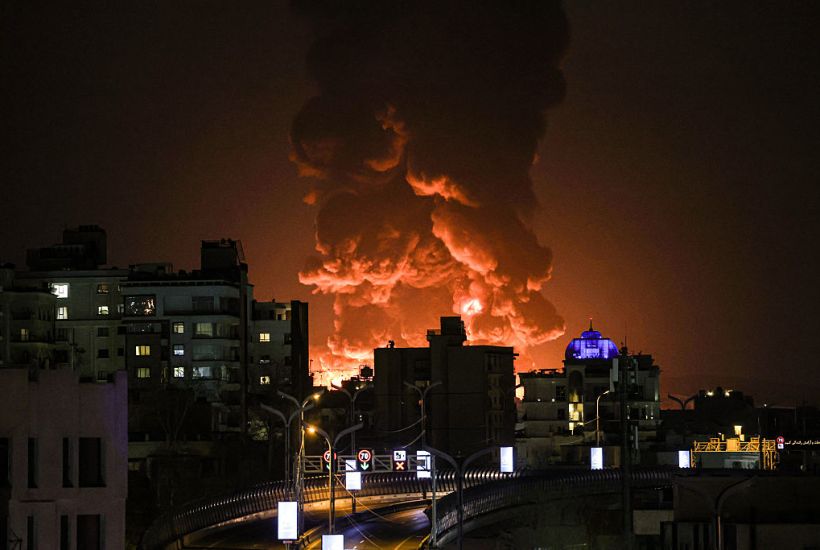
The magnitude and speed of the US and Israeli airstrikes eliminating Iranian regime officials can be explained in part by their unprecedented use of advanced technology and AI systems.
The US military embraced AI earlier this year when Secretary of War Pete Hegseth ordered the Department of War to ‘accelerate America’s Military AI Dominance by becoming an “AI-first” warfighting force across all components, from front to back.’
Despite US President Donald Trump’s order for federal and military agencies to cease using AI tools developed by Anthropic, it was Anthropic’s Claude AI that was pivotal in making intelligence assessments and identifying targets in the opening salvos of the Iranian attack. Likewise, Palantir’s Maven Smart Systems (MSS) has been essential to the US Central Command’s (Centcom) operation in Iran for summarising raw intelligence and identifying people, vehicles and weapons to be targeted.
Israel has been developing AI in its war against Hamas in Gaza over the past two years. Its Habsora AI system cross-references satellite imagery, communications data and human intelligence from hundreds of sources to identify Hamas infrastructure and facilities in the dense urban landscape of the Gaza Strip. Its sister system, Lavender, uses similar databases to identify Hamas militants and leadership personnel.
The Israeli military used AI systems to analyse years of intel and reconnaissance on Khamenei to anticipate his movements
The precision strike that killed Iran’s Supreme Leader Ali Khamenei occurred within the opening hours of Israel’s ‘Operation Roaring Lion’ on 28 February, but its planning and intelligence gathering efforts had been in the works for nearly two decades under the oversight of the covert Israeli intelligence unit 8200.
The Israeli military used AI systems to analyse years of intel and reconnaissance on Khamenei to anticipate his movements. Leading up to the February operation, Israeli cyber intelligence had hacked into nearly every traffic camera in Tehran, bugged communications systems, and directed transmissions to the IDF intelligence headquarters in Tel Aviv. Israeli intelligence specialists then employed AI-based algorithms to analyse details such as duty schedules, guard breaks and commuting routes, making it easier to predict Khamenei’s movements and schedules.
In the final hours, these systems provided the Israelis with the optimal time and place to strike Khamenei. It was as if they prompted a souped-up, militarised ChatGPT with the question: ‘When and where is the best time to kill Khamenei today?’
The unexpected daylight strike that killed the Iranian Supreme Leader included roughly 30 missiles, including Blue Sparrows, launched from a distance by Israeli F-15 fighter jets. These missiles briefly exit the Earth’s atmosphere before flying straight down at incredible speeds onto their target. As scores of aircraft appeared over Iranian skies in the early morning hours of 28 February, Tehran’s first line of defence was to jam global positioning satellite (GPS) systems to disrupt navigation and missile guidance systems. Widespread GPS jamming (that is, the disruption of position coordinates) and signal spoofing (giving false locations) were used on all sides to disrupt the travel paths of missiles and drones and confuse target coordinates.
To counter this, the Israeli Air Force (IAF) carried out most air strikes using Rocks (Rafael’s operational combat-proven kinetic stand-off) missiles. This air-to-surface missile is designed to strike stationary and relocatable targets in GPS-denied areas by using local imagery and target recognition technology. The F-15 pilots allocate a target and release the missile from a distance, while still outside heavily air-defended areas. The missile uses GPS systems for its initial and mid-course trajectory before switching to what Rafael calls ‘a unique scene-matching algorithm and anti-radiation technology’ to home in on the final target. The pilots monitor the missile’s progress and can make on-the-spot decisions to alter or abort the mission.
The Rocks missiles allowed Israel to achieve air superiority over Tehran in the early days of the war. With complete freedom of the skies, the US and Israeli forces have been able to pluck away unhindered at the regime leadership and IRGC military positions.
One successful mission occurred on March 11, when the IAF carried out a precision drone strike on a Basij militia checkpoint in Tehran. According to sources at Iran International, the operation was carried out using an unprecedented ‘mother launcher’ to deploy drones equipped with AI-databases. The drones cross-referenced facial recognition and behavioural patterns of the militants on the ground to check that they were the designated targets in the database before striking.
Effective AI systems have also protected the Israeli home front in the course of Iranian and Hezbollah aerial attacks. As multiple missile and rocket barrages descend on Israel from various locations, AI defence systems perform ‘sensor fusion’ operations. They process data from various radar and sensor inputs to determine and triage, within milliseconds, which interceptors to launch for optimal defence.
Other Israeli defence systems are capable of detecting and rapidly targeting Iranian missiles immediately after they are fired, roughly 1,000 miles away. This allows air defence systems to intercept the incoming missiles, often outside of Israeli airspace, and provides the Israeli Home Front Command with crucial real-time data for issuing early warnings to the civilian population. Complex algorithms, handled by the AI team at Israel’s reconnaissance satellite operation ‘Ofek’, allow the Home Front Command to make calculated estimates about where a missile is headed, the expected arrival time, and what regions to issue real-time warnings and alerts.
The use of AI marks a dramatic shift in modern warfare. If the Israeli systems in Gaza – like Ukraine’s pioneering AI-enabled defence technologies used against Russia – were the testing stages for a new generation of hi-tech combat, the current war in Iran marks a full-scale paradigm shift toward the irreversible path of AI-assisted warfare.