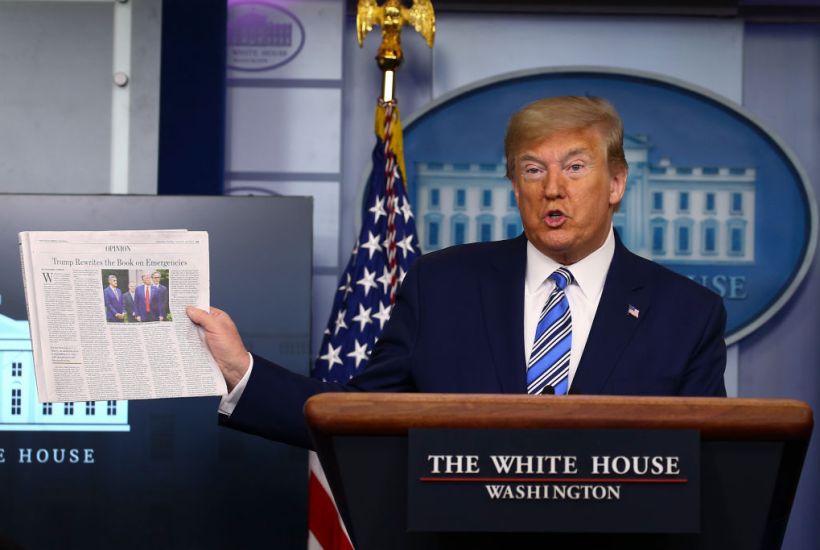
For the better part of a decade, Donald Trump has been an avid, if irascible, reader of the Wall Street Journal – particularly the columns overseen by its long-time editor Paul Gigot.
Because the Journal is among the few American conservative outlets willing to criticize Trump – on everything from tariffs to temperament – he has developed a habit of denouncing it in public while devouring it in private.
The Journal, Trump recently declared on Truth Social, is “one of the worst and most inaccurate editorial boards in the world.” The ritual extends to annotated hard copies – margins filled with indignant scrawl – before the offending pages are FedExed back to News Corp headquarters in Midtown Manhattan.
A policy intended to restore order could instead tighten Iran’s chokehold on global energy and trade
Which makes what happened last weekend all the more curious. On April 10, the Journal – a reliable standard-bearer of neoconservative foreign-policy thinking – urged Washington to quarantine vessels carrying Iranian oil. Within two days, Trump had done precisely that, announcing a naval blockade of the Strait of Hormuz targeting ships trading through Iranian ports. The paper, in turn, was quick to approve.
The move marks a sharp escalation. Until now, Tehran had been selectively restricting passage through Hormuz – impeding much of the world’s tanker traffic and nudging energy prices higher – while continuing to export oil, particularly to China. The new American policy seeks to end that asymmetry by imposing direct costs on Iran’s own energy trade.
The Journal’s case is clear enough. A tougher line, it argues, is justified so long as Washington is willing to stomach the resulting disruption to global energy markets. Why should Iran continue to earn oil revenues while constricting supply to everyone else?
By targeting Iranian exports, the United States would raise the cost of continued disruption while drawing in other stakeholders – not least China, a major purchaser of Iranian crude – with a renewed interest in restoring stability to the waterway. Interdicting tankers and clearing mines are presented as steps toward the ultimate goal: reopening Hormuz to all traffic.
It is a neat argument. It is also, on closer inspection, a gamble. Retaliating against Iran for disrupting the Strait of Hormuz by disrupting it further has a certain circular logic. As J. D. Vance put it on Fox News yesterday, “What [the Iranians] have done is engage in economic terrorism against the entire world… well, as the President of United States showed, two can play at that game.”
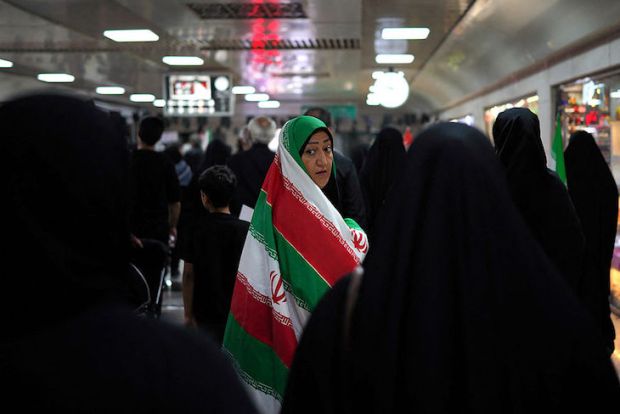
But will it work? Let’s start with Iran’s likely response. Tehran, as most seasoned foreign-policy observers recognize, sees itself as facing an existential threat from the United States and Israel. In such circumstances, states do not typically fold; they dig in. A country with Iran’s nationalism and resilience is unlikely to surrender under economic pressure alone.
Moreover, allowing Iranian oil on to global markets during the war has not been an act of benevolence but of necessity. Once it became clear that the conflict would not be short or decisive, the priority shifted to keeping Iranian oil flowing to stabilize the global economy.
Removing that supply – not just of energy but fertilizers – will mean a messy shock to markets, with predictable consequences for inflation, growth and political stability throughout the rest of the world. Allies and adversaries alike will not simply accept energy prices climbing and growth faltering – nor, in an election year, will ordinary Americans already feeling the pinch of higher living costs.
The plan – or hope – is that Iran will capitulate. But Tehran may instead choose to escalate, widening the conflict to other energy waterways such as the Red Sea, with the assistance of its Houthi allies in Yemen. It’s well known that roughly 20 percent of the world’s oil and LNG passes through the Strait of Hormuz; less remarked upon is that a further 10 percent share, including much of Saudi Arabia’s exports, moves via the Red Sea.
Already, Riyadh is urging Washington to reconsider its blockade, mindful that any escalation could imperil the Bab al-Mandeb, a critical chokepoint for Gulf energy shipments. The paradox is that a policy intended to restore order could instead tighten the chokehold on global energy and trade.
Recent diplomacy – including talks in Islamabad – has done little to shift Tehran’s position. If anything, Iran may calculate that control over the Strait of Hormuz offers leverage of a different, but no less potent, kind. Even a partial or intermittent disruption of that waterway gives Tehran enormous influence over global energy flows – a form of strategic power that can rival any uranium enrichment program.
Which brings us back to the Wall Street Journal editorial page. A certain irony lurks behind Trump’s decision to escalate against Iran, culminating in a naval blockade of the Strait of Hormuz. The neoconservative school of thought he once ran against appears, at least for now, to have found a second life in his foreign policy.
The candidate who campaigned on “America First” – a language of restraint, limits and strategic discrimination – now sounds, at moments, rather closer to the voices he once dismissed. One hears familiar echoes not only from the Journal, but from hawkish pundits such as the New York Times’ Bret Stephens and Commentary magazine’s John Podhoretz, as well as the broader Washington ecosystem that has long favored a more muscular use of American power.
This is not to question their seriousness. These are thoughtful and articulate advocates of American primacy. But recent history offers grounds for caution. The post-9/11 interventions – ambitious in conception, uneven in execution – imposed heavy costs in blood and treasure, while doing less than advertized to enhance American standing.
Iran is unlikely to become another “forever war” like Iraq or Afghanistan. Yet even short of that, the risks are evident. The issue is no longer confined to the mechanics of shipping lanes in the Gulf, but extends to the broader question of American prestige and credibility. The greater a nation’s prestige, the less it must rely on force; the weaker its credibility, the more it is tempted to compensate with it.
If there is a wider lesson, it is not simply about Iran, or even the Strait of Hormuz. It is about the limits of coercion when strategy outruns circumstances – and about the recurring temptation, in Washington, to mistake resolve for results. This is the sort of moment when advocates of muscular policy risk being, to borrow their own phrase, “mugged by reality.”