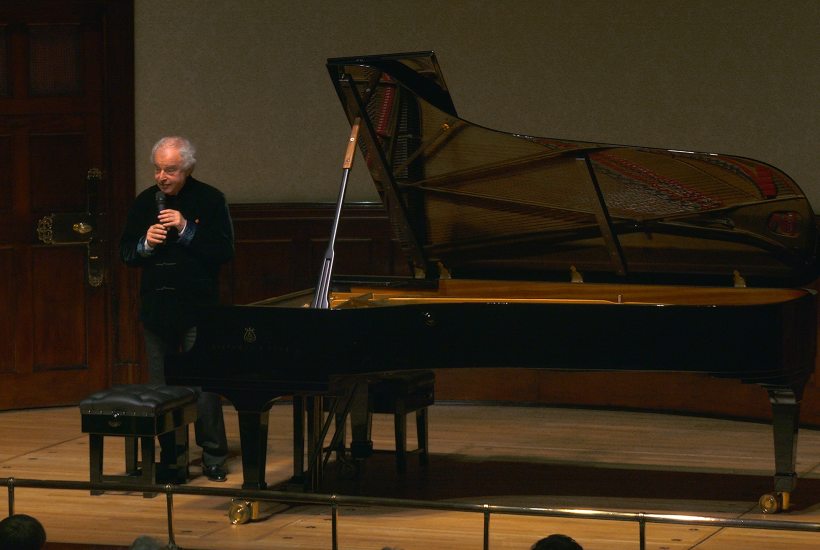
Is Sir Andras Schiff becoming the Ken Dodd of the piano? In his later years, you’ll recall, the Yorick of Knotty Ash took to delivering marathon one-man routines that finished long after midnight. A couple of years back, Schiff expressed a similar wish: why should he have to tell us in advance what he was going to perform? And fair enough, because even with no advertised programme, the Wigmore Hall was sold out. Clearly, a lot of people will gladly pay to hear Schiff play anything at all, and part of me hoped he’d launch into Chopsticks or Richard Clayderman’s Ballade pour Adeline.
But no, Schiff had a far crueller joke up his sleeve. He walked out without a word and began the ‘Aria’ from Bach’s Goldberg Variations. A purr of happy recognition ran through the room. The numb horror of the (presumably smaller) constituency for whom the Goldbergs are sonic kryptonite was, of course, inaudible. True, I’d heard the rumours – that Schiff had been known to sit down at these open-ended gigs, and plunge straight into the full 70-minute nightmare. Somehow you never believe it will happen to you, until suddenly you’re wedged in the middle of a row hearing those tinkly little mordants and that deadly three-four tread.
What if he decided to play the rest of the Goldbergs after all, locking us in until long after the last train home?
Anyway, he played the ‘Aria’ and then he stopped. Disappointment for the Bach-heads (surely the majority of a Schiff audience; his artistic brand is nothing if not consistent), and a proper fright for the rest of us. Schiff gave a flicker of a smile as he turned on the piano stool to explain that he had other plans. There was more Bach, but on a human scale: the Capriccio BWV992, a sun-dappled Italian Concerto and a Chromatic Fantasia that gathered and built in great rippling waves, until it discharged coolly to earth in its closing fugue. Whatever your tolerance level for old JSB, there’s no denying that Schiff can play the stuff with an intelligence and a clarity that really does draw you in, if you’ll let it.
And I can forgive a lot to any artist who cares so deeply for Haydn; a wisp of an early sonata in G minor, whose two movements slipped like water through Schiff’s fingers, glinting with poetry and wit. You can’t pretend to make existential statements with Haydn, and Schiff didn’t. He simply found the music and let it speak. The applause was restrained. ‘Haydn never has success,’ he grumbled (Schiff’s deadpan asides to his public on these occasions are a big part of the fun). ‘But we still do it, yes?’
Mozart came next, the A minor Rondo K511, and for some reason Schiff decided that this needed a double serving of rubato. Out it came, with hardly a bar or phrase that wasn’t squeezed, stretched or tastefully prodded. I know, I know, it’s a Schiffian thing; very expressive, no doubt. That doesn’t make it bearable. The first half ended with Beethoven’s Tempest sonata – character and form coming together with aristocratic understatement. And then, a good 90 minutes into the concert, we reached the interval.
I’d been tipped off that the first half would last 75 minutes and that the second would last around 50, but by now it was clear that this was wishful thinking, and that there was little to prevent Schiff going full Doddy for the rest of the night. What if he decided to play the rest of the Goldbergs after all – thus locking us in until long after the last train home had departed? Keyboard philosophers don’t concern themselves with public transport, and I once witnessed Schiff berating a hapless civilian who’d arrived late. Attempting to leave mid-Bach would be even more disruptive. I cut my losses and headed for Euston.
In Manchester, the BBC Philharmonic sounded off-colour, though I don’t think that was down to the conductor, Nicholas Carter, who’s making a big impression in German opera houses and brought some of that breadth and long-range command to a sumptuous (if brief) programme. The Tristan Prelude and Liebestod and Strauss’s Four Last Songs bookended Bax’s Tintagel and a new work, The Landscape Wakes, by Edmund Finnis – a pleasant, gradually lightening triptych of oscillating orchestral textures that kept sounding as if it was about to generate a big Sibelian theme, but was too polite to do so.
Tintagel is always a treat but while the BBC Philharmonic violins had all their accustomed sheen (it’s long been a bright-sounding orchestra), the brass sounded scrappier than we’ve come to expect from all those splendid Chandos recordings. The evening’s main thrill came from the rich, luminous Wagnerian soprano of Sarah Wegener – soaring effortlessly in grand, luxuriant phrases. There were no surtitles, though, and even with a house that was far from full, there weren’t enough printed programmes to go around. What’s all that about, then?
Got something to add? Join the discussion and comment below.
You might disagree with half of it, but you’ll enjoy reading all of it. Try your first month for free, then just $2 a week for the remainder of your first year.