On the weekend, I tweeted that Antarctica would become the next frontier of geopolitical conflict as oil shortages in the Middle East tempt China to mine in the protected frozen wilderness.
If Middle Eastern oil comes under threat – China's next stop is Antarctica and Australia will be powerless to protect our oil-rich territory.
Zero environmentalists will be able to stop the communists.#Prediction
— Alexandra Marshall (@ellymelly) March 8, 2026
Every time I have tried to write about the strategic issues circling Antarctica, there is very little interest.
The entire region is shoulder-shrugged despite it holding the potential to become a military nightmare for Australia’s national security if China decides to shed its pretence of scientific research for their military-grade bases. We’d have our tail pinned down in a war scenario.
Like the Arctic, holding a pole location is a major advantage.
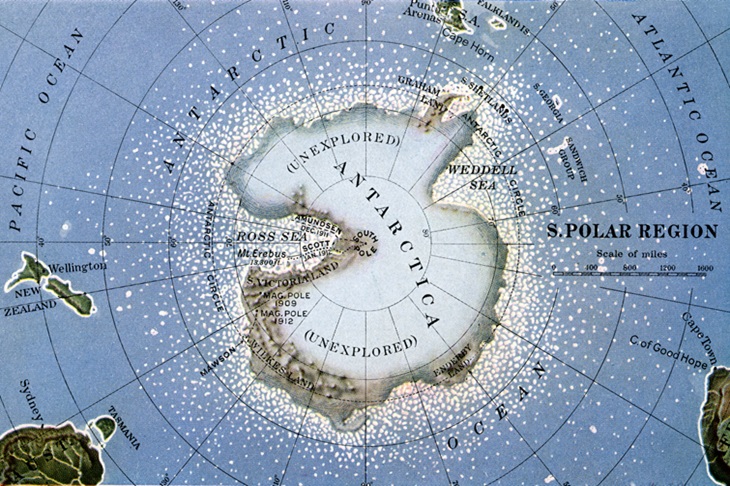
Currently, Australia has the largest land and sea claim in the region. We’ve been left with it for decades because no one else wants the bother of paying for its environmental protection.
But watch how fast those accepted claims are overturned when the interest is oil, gas, and coal instead of penguins.
Roughly 60 per cent of China’s critical oil supply, crucial for the functioning of its domestic capacity let alone any military action, has been disrupted or stopped entirely. The first fall came with the regime change in Venezuela. The second, and more critical, is the free-fall of Iran into a state of war. Normally, China could pivot to Russia, and to some extent it will, but Russia is using its oil to fight a war and economically trap its European friends and foes.
Regardless of how China sources extra oil, it will significantly lift the cost of energy. The West knows how dangerous this is, with energy prices undermining all major industries. To China, whose global competitive economic model is built on cheap energy, this could be catastrophic.
This morning, NewsWire published a piece raising concerns that a total breakdown of the rules-based world order ‘could see the South Pole and the waters that encircle it descend into lawlessness’.
To be fair, China and other nations have been treating both Australian and international territorial waters around Antarctica as an all-you-can-eat buffet, illegally pulling krill and whales from protected areas.
Researchers involved with Antarctica are concerned about the fragile nature of its treaty. Already, the boundaries have been tested with China’s scientific research bases looking suspiciously militarised.
If China or Russia decided ‘F- it!’ and began military and mining operations, there would be little Australia could do to defend its territory, considering we lack the ability to defend the main continent.
Besides, a few scary phone calls to the Prime Minister’s office would probably result in the whole thing being written off as a ‘special trade deal’ rather than a hostile takeover.
China might be beaten to the punch by Russia.
As the article states:
Russia has also recently carried out extensive seismic surveys in the Weddell Sea. While Moscow claims it is geological mapping, Western analysts point out that the data gathered is exactly what a commercial oil company would need to identify drilling sites.
A few years ago, Russia declared it had discovered (magically?) 511 billion barrels of oil under Antarctica.
This makes it the most valuable fossil fuel reserve on the planet.
And it is undefended.
A presentation to the UK House of Commons Environmental Audit Committee showed that these reserves came as a result of the ‘geological mapping’ done by Russia in the Weddell Sea from the vessel Alexander Karpinsky. This is considered an egregious violation of the Antarctic Treaty in which scientific research was used as a cover for commercial exploration for mineral and oil extraction (which is specifically banned).
The area in question is claimed by the UK and disputed by Chile and Argentina.
Considering this is larger than Saudi Arabia’s entire proven reserves (almost double), this discovery presents a huge problem for global security.
We have to take this news in conjunction with Russia’s major budget increase to Antarctic exploration for the 2025-27 period.
Where does China fit in?
China and Russia are cooperating on joint Antarctica drilling, you know, to study ‘climate change’ and definitely not to conduct geophysical surveys on precious minerals.
Together, they are pursuing drilling along the Gamburtsev subglacial mountains located in Antarctica’s east. These are of immense geological interest, being almost perfectly preserved under the ice. Although that is unlikely the reason China and Russia are interested…
Where does scientific research and climate science collide with mining and military operations? Many would argue, that line, if it ever existed, has long been eroded.
‘Energy policy is vital to the global economy and ensuring unfettered supply is the responsibility of all. China will do what is necessary to ensure its energy security,’ said the Chinese Foreign Ministry spokesperson earlier today.
What that means for Antarctica’s future as a wildlife haven is anyone’s guess.
The only thing that the Iran war has made clear is that China isn’t interested in its renewable energy infrastructure, sold to the West as some sort of modern miracle. China wants oil. And it wants it now.