As a metal, gold never corrodes. As a possession, the reverse is too often true. It has the power to warp morality, destroy decency and tarnish humanity. This duality – entrancing beauty alongside corrupting potency – lies at the heart of this magnificent book that engagingly blends African history with a current relevance that reaches far beyond the continent.
The history is laid out with clarity and conviction. The Asante nation (Barnaby Phillips wisely settles on this spelling over a variety of homophones including Ashante, Ashanti and Achantis) is a component part of the modern west African nation of Ghana. Much like the Zulus in South Africa, their foundational history dates back only a few hundred years and is underscored by military prowess bordering on barbarism. Human sacrifice was routine, described coyly as ‘sanguinary rites’ by early Victorian pioneers of wokeism, Phillips tells us. But unlike the Zulus, the Asante’s political power, indeed national identity, was underscored by gold – vast amounts of it recoverable mostly from alluvial riverbeds. This remains largely the case, even if miners today have to dig deeper. Ghana last year was Africa’s leading gold producer.
Phillips cannot be accused of coyness, describing how the Asante nation was built in part on stolen gold plundered from a rival kingdom, the Denkyira. He also lays out how the nation benefitted from slavery, a cottage industry in the early days, a full-blown intercontinental concern when Europe got involved. Yet, as all strong nations attest, success that was built on conflict is made lasting by cooperation. Diplomacy and compromise drove the Asante nation’s golden period when neighbours became tributary client states and skilled craftsmen created gold regalia that bedecked not only the family of the king, the Asantehene, but also the homes of courtiers and common citizenry.
Gold played such a central role in Asante identity that the Asantehene’s divine power was held to reside in a stool made of gold that descended from the heavens. To be crowned was to be ‘enstooled’, the original stool being still so venerated that it has its own throne upon which it is perched during ceremonies of national importance.
As this book makes clear, gold drove the modern history of the Asante nation, drawing the acquisitive attention first of the Portuguese and the Dutch and finally the dominant power of the late industrial revolution age, Britain.
The colonial project is often described in simplistic, binary terms, as if there was a single 19th-century moment when mutton-chopped men with modern weaponry suddenly settled on foreign land grabs. The reality was much more gradual, nuanced and evolutionary – something Phillips captures brilliantly. He writes of the British governor in Sierra Leone thinking that he would teach the Asante a lesson with a decisive military coup in 1824, only to pay with his head. According to legend, poor Sir Charles MacCarthy’s skull was later used for wartime rituals. And we also hear of the moral corruption of the African Company of Merchants, a west African cipher for the East India Company, that doggedly continued to enslave long after abolitionism had prevailed at Westminster.
The Asante nation was built in part on stolen gold plundered from a rival kingdom
That same corruption seeped back in the 1870s when a British expeditionary force under Sir Garnet Wolseley set out from the coast with orders to subdue the Asante. The contingent could only move up country when thousands of locals, mainly women, were obliged at bayonet-point to work as porters. Thus, decades after the British had outlawed slavery they were continuing to rely on it.
There were other skirmishes, raids and invasions throughout the 19th century, the road to the British colonial creation of Ghana being a long one. Phillips handles them deftly with an eye for the telling anecdote. The journalist and chancer Henry Morton Stanley took his ‘embedded’ role a bit too seriously when accompanying Wolseley, bearing arms and firing a rifle repeatedly when a battle broke out. ‘The war correspondent of the 21st century, typically taught to embrace an ethos of detachment and neutrality, can only marvel,’ Phillips writes drily.
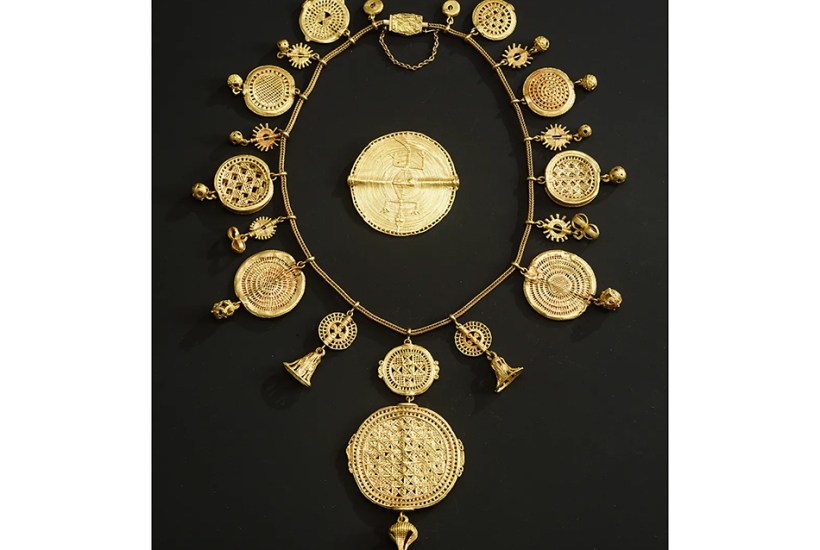
What makes this book so much more than a history is its focus on the gold items plundered during the various British forays against the Asante. The revered stool escaped them, but not much else did. Swords, sunshades, ornaments and gilded clothing were carried off in enormous volumes. There was some effort to camouflage the process, with senior commanders ordering lists to be made of the items, which were then auctioned as legitimate prizes of war rather than regular loot. The distinction feels moot. In another display of journalistic chutzpah, one reporter feigned illness and hid his booty in his hammock bedding to get around the official logging of spoils.
At one level this book is perfect for anyone engaged with the subject of restitution – the return of objects to a rightful owner after historic injustice. Phillips explores with rigour all the complexities of the issue, dedicating serious effort to tracing what happened to the gold items taken from the Asante. He even comes across a piece of gold leaf forgotten in an archive, tucked into the very letter discussing what had happened to that particular specimen. ‘The relevant piece of gold leaf had fallen from the letter and landed on the floor by my feet. With an embarrassed look around me, I hurriedly returned it to the file,’ he writes.
What makes the book all the more valuable is its contemporary resonance. In our age of an American president kidnapping another president in Venezuela, cashing in on the Gaza conflict and claiming a right to Greenland, a book on the travails of a foreign power helping itself to a sovereign nation’s wealth feels all too pertinent. Phillips describes the moment that a British colonial governor demanded not just the surrender of the Asante but their formal humiliation. In a scene one can all too easily picture at Mar-a-Lago, he ordered the Asante king to kiss his boots, and then uttered the most Trumpian of sentences: ‘Now the question of money.’
Got something to add? Join the discussion and comment below.
You might disagree with half of it, but you’ll enjoy reading all of it. Try your first month for free, then just $2 a week for the remainder of your first year.