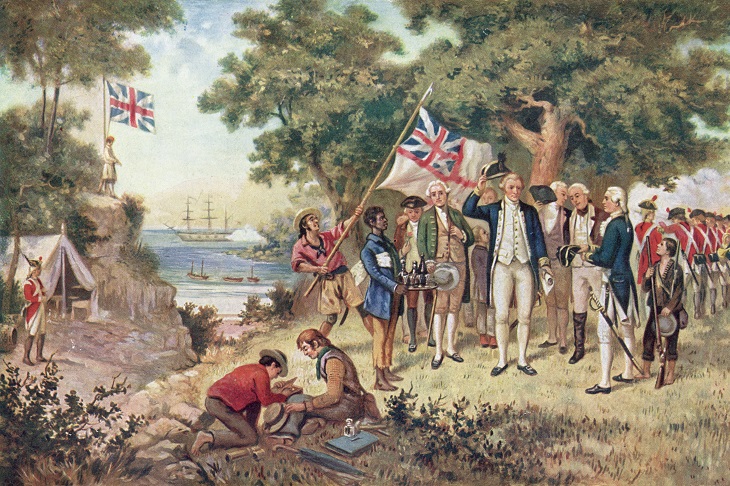
Leading up to Australia Day a number of media outlets produced content claiming the First Fleet committed genocide by unleashing Smallpox on Aboriginal people in Sydney.
Their argument centred on Australia Day marking the deadliest day in Aboriginal history.
There are four main points made by these critics:
- The British introduced Smallpox.
- The introduction of Smallpox was intentional.
- This is supported by historians.
- Australian society remains silent about it.
But is it true?
These claims originate predominately from one primary source – Captain Watkin Tench. In 1791, when he was reviewing the source of the 1789 Smallpox outbreak, Tench was unsure at what caused the outbreak but mentions ‘variolous matter’ (Smallpox) was speculated to be a potential origin.
Is it a disease indigenous to the country? Did the French ships under Monsieur de Peyrouse introduce it? … no person among us had been afflicted with the disorder since we had quitted the Cape of Good Hope, seventeen months before. It is true, that our surgeons had brought out variolous matter in bottles; but to infer that it was produced from this cause were a supposition so wild as to be unworthy of consideration.
Immunisation with live virus matter was a common practice at the time. The problem with argument of deliberate introduction is that it goes against the available historical evidence and the current consensus on Smallpox incubation periods.
Smallpox cannot survive in scabs for longer than three weeks in temperatures of 35°C and humidity around 65 per cent. Early records show temperatures had regularly peaked above 40°C degrees in the summer before the outbreak. Smallpox had also not occurred in any members of the First Fleet during or after their voyage. It is a relatively well-documented disease because it leaves visible facial scarring with permanent pockmarks.
Additionally, there is no evidence of Smallpox in Aboriginal Tasmania. If it was an intentional policy to introduce Smallpox, it is strange that the colony with the most physical conflict with Aboriginal people did not employ it as a tactic of biological warfare. It is also surprising it did not occur in the early Tasmanian colony unintentionally, again most likely due to the fact the first settlers had no cases of Smallpox brought over from England.
In response to this evidence, the leading expert on Smallpox in the early colony, Judy Campbell, in her book Invisible Invaders: Smallpox and Other Diseases in Aboriginal Australia 1780-1880 (1998) writes, ‘In the absence of any reliable evidence that Smallpox was introduced into the Aboriginal population of eastern Australia by the British in 1789 or between 1829 and 1831, other sources must be explored.’
So where did it come from?
It most likely came from Indonesian fishermen who came in contact with tribes in Western Australia, the Northern Territory, and Queensland. An expert in Indonesian sea trade found that around 2,000 fishermen traded with Aboriginal people every year. In contrast, only 1,500 people were on the First Fleet. The sailors were skilled navigators and could make it from south Indonesia to Northern Australia in 10-15 days, which sits within the incubation period of Smallpox. One of the earliest European accounts of Smallpox in the ‘Malays’ comes from the explorer Matthew Flinders. His crew recorded conversations with sailors who treated Smallpox by pouring cool water on the patient.
New research shows close social and economic ties between these sailors and Aboriginal people. It is not surprising then that an Aboriginal man named Jack Davis from Port Essington in 1870 said Aboriginal people referred to Smallpox as Meeha-meeha and the disease was on the Cobourg Peninsula a long time ago.
Another reason to believe Smallpox probably came from Indonesian fishermen is that it happened on the record at least twice, in 1830 and 1860. As Campbell Macknight writes:
‘We already know that contacts between … fishermen from South Sulawesi and Aboriginal people may have initiated outbreaks on the coast of northern Australia during the fishing season on several occasions in the nineteenth century.’
Based on the fact outbreaks occurred later, and the disease could not have survived the eight-month journey from Britain to Sydney Cove, it is the most plausible explanation that the virus originated from contact with Indonesian fishermen. The First Fleet did not cause a Smallpox genocide.
In the end, ‘Smallpox reduced Aboriginal numbers around Sydney to such an extent’ writes Campbell, ‘that newcomers never saw Aboriginal communities anywhere near full strength.’
It is also notable that Aboriginal people were treated for Smallpox by British doctors, a strange admission if the goal was to eradicate a ‘dying race’. Again, the example of Tasmania not having early cases of Smallpox is revealing considering, Tasmania is the furthest away from the Indonesian fisherman who brought it to the Northern Territory.
In summary, for the theory to be true, the First Fleet would have needed to bring a live virus of Smallpox 24,000km over eight months in temperatures and humidity that would have killed it, then wait one and a half years to unleash it onto the Aboriginal population and risk spreading it to their own settlers.
Not only do some of Australia’s most preeminent historians, Stuart Macintyre and Manning Clark, disagree with these claims, the most authoritative historian on the subject firmly dismisses these claims.
To the final assumption, that Australians do not like talking about our genocidal history, I would add that the study of colonisation is now embedded in the national educational curriculum, covered extensively in the ABC our public broadcaster, and protested in the tens of thousands on Australia Day.
The problem is not how much we talk about historical genocide, but how little rigorous historical research is used by those who support it.