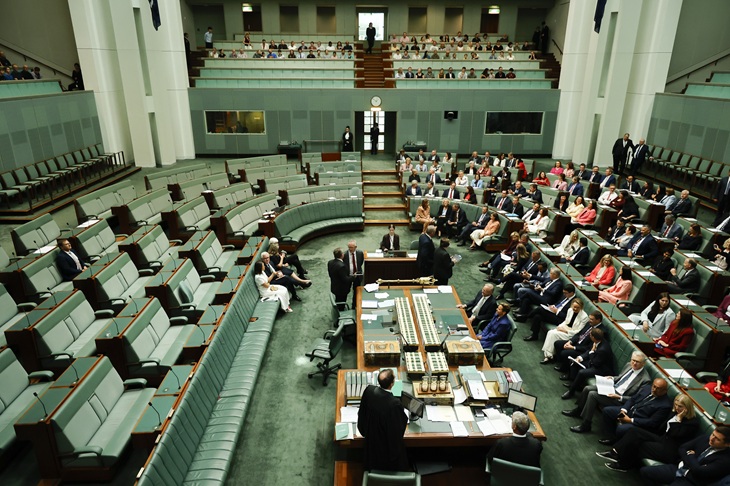
Never let a good crisis go to waste. Anthony Albanese must have been pondering these sage words as he presided over the Combatting Antisemitism, Hate and Extremism Bill (2026), a version of which has now passed Parliament in two parts.
The Bill is sold as an attempt to crack down on Nazis and terrorists. Much like when buying a used car, you should never trust the sales pitch.
The original version of the Bill was a mess. It was an omnishambles, governing matters ranging from gun rights to vilification to migration to hate groups. The backlash was swift and severe. Such was the disquiet with the so called ‘racial vilification’ rules that the government was forced to drop them, at least in part (while surreptitiously reinserting them into the definition of a so-called ‘hate crime’). The government also separated the firearms provisions in an attempt to divide and conquer. However, the migration and so-called ‘hate group’ provisions remain. The eventual version of the Bill was still a mess.
The final version of the Bill is less bad, but it is still bad and is still all about control. Albanese has been playing politics while accusing detractors of doing the same. Tellingly, Labor moved to rush the Bill through Parliament to curtail scrutiny.
It is not ‘playing politics’ to resist a terrible law. Making no change is better than making a change for the worse.
Several key issues emerge, and this is by no means an exhaustive list of all the Bill’s failings.
Due process, procedural fairness, or the lack thereof
The Bill runs roughshod over established notions of procedural fairness and due process. The clearest example relates to the rules surrounding hate groups.
The Bill allows the relevant minister to classify a group as a hate group. This carries significant penalties of up to 15 years prison for organising the group. The classification is notionally based on whether the group, or its members, committed a hate crime. The arbitrariness exists in several areas:
Discretion: The classification decision is within the minister’s discretion. The relevant minister need only be satisfied on reasonable grounds that the organisation ‘assisted’ or ‘advocated’ engaging in a vaguely defined ‘hate crime’ (more on that below). No proof or investigation is necessary (more on that below, as well).
The minister should, but need not, make such a classification on advice from government departments. Appointees are themselves a matter for government. So the government can simply advise itself about whether it is a good idea to ban a group.
The net result: the decision to classify an organisation as a hate group is entirely within the minister’s discretion.
Vagueness: The classification decision seemingly would be partly based on whether members are involved in a ‘hate crime’. A ‘hate crime’ is not itself a crime in the legal sense of the word. Rather, it is broadly defined. It includes criminal conduct that would cause a ‘reasonable person […] to be intimidated, to fear harassment or violence, or to fear for their safety’. The person need not have intended to intimidate anyone.
Superficially, this sounds fine, but, the devil is in the detail. Notably, the provisions use precisely the same wording as had been used in the now junked ‘racial vilification’ offence.
The problem with the wording is that it chills legitimate speech. For example, would a report about crime by particular ethnically based gangs cause a reasonable person of that ethnicity to fear retribution and harassment? Or what about a discussion of immigration from Gaza, a region where – reportedly – between 35 per cent and 70 per cent of people support Hamas? Here, peaceful Gazans might fear being associated with Hamas-supporting ones, and come to fear that visas might be revoked. Or what about advocating boycotts of Israeli goods (or goods from any country)? A boycott is a form of harassment.
Let’s take the phrase ‘Globalise the Intifada’. Jewish groups claim – rightly in my view – that it is a call for a violent uprising against Jews and/or Jewish organisations. This is based on the nature of prior intifadas. A reasonable Jewish, or Israeli, person might well regard an intifada as a call for violence or intimidation. However, there is an alternative view of the word ‘intifada’. This is a metaphorical view, reflecting a struggle against Israel. Of course, even the metaphorical view might be used to justify harassing Israeli companies or blockading shipments. Unfortunately, the Bill does not care whether you intended the metaphorical meaning, it just cares about whether a reasonable person would fear harassment.
An allegedly protective layer is that the conduct itself must have been ‘criminal’ to constitute a hate crime. But, that is a broad net. For example, the conduct need only violate a Commonwealth law. Clearly, if a government controls both houses, this gives enormous control.
Conduct by whom and when? The Bill requires that the AFP minister be satisfied that an organisation is engaged in the proscribed conduct.
The first issue is that this includes conduct even before hate crimes were proscribed. That is, the Bill effectively assigns criminal liability for historical conduct. The law is retroactive in effect. Any retroactive criminal law is highly troubling: people should be able to know the law in advance so that they can comply with it.
The next concern is precisely who must have committed the ‘hate crime’ for the minister to designate the group as a hate group? The Bill says that it is conduct of an organisation. But, this includes ‘informal’ members. So, if a person is in the practice of attending an organisation’s rallies, but is not invited and simply attends, and then decides to engage in a hate crime, is the organisation to be tarred by the hanger-on’s conduct?
To use a topical example: if pro-Hezbollah supporters gatecrash a pro-Palestine rally, are the rally organisers to be proscribed? What if neo-Nazi’s gatecrash an immigration rally? The rally organisers might have wanted to make a point about the economic implications of immigration, but attendees might take the rally in a different direction. Are the rally organisers then to be tarred?
Proof? Is proof required to make a hate group declaration? Seemingly not. As indicated, the minister need only be satisfied ‘on reasonable grounds’ that the group engaged in the proscribed conduct. The Bill specifically says that no one need have been committed of any crime (See Section 114.A.4(4)). Not only that, the Bill explicitly says that procedural fairness is not required (Section 114.A.4(5)).
The result: the minister can deem a group to be a hate group even if no member has committed a crime and there is no right of reply or ability to appeal. Placing this much discretion in a politician to ban free association is troubling.
The foregoing shows precisely how the legislation could be used: deem certain types of conduct or words to be threatening, classify any group of such people to be a hate group, and ban them.
And, it gets worse. If you lead a group that the minister deems to be a hate group, you face a prison sentence of up to 15 years. This even though you, or your group members, may never have committed a crime. And, even though you may never have had the right to dispute the classification.
Ideological control over migration
The Bill is clearly designed to give the government the power to restrict speech and association on ideological grounds. This is clear from the definitions of hate groups, and racial vilification. However, the government is also seeking to restrict movement.
Specifically, the government is seeking to change the Migration Act so that it could stop someone arising if they merely might vilify a segment of the Australian community, or might ‘incite discord’. It is very clear that this would enable the government to stop people with contrary ideological views on grounds that they might create discord by rocking the boat. After all, what is more discordant to a government than people advocating against its policies?
We are now stuck with bad law
The net result is that the Bill is bad law. A cynic might wonder if it was drafted badly in order to maximise government control and discretion. Of course, a future government could amend the law. That said, it seems easier for politicians to increase government power than it is for citizens to reduce it.
Mark Humphery-Jenner, Associate Professor at UNSW