Over the last two years, leadership has been one of the most commonly used words in political discussions.
Whether it’s politicians saying they are showing great leadership or politicians being called on to show leadership by their opponents and constituents, the word is heard almost every day.
However, leadership is a difficult word to define.
And can be used as a political cudgel to suit the agenda of the person using it.
One thing everyone can agree on is that failures of leadership, at various levels of politics and the public service, have got us to where we are today.
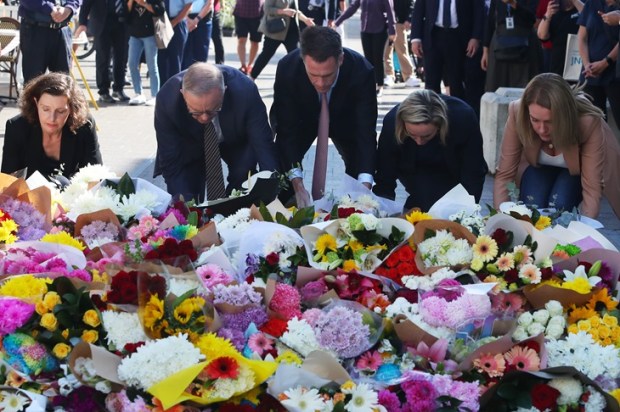
Leadership failure brought us to a place where 15 Australians were murdered by alleged radical Islamist terrorists. Where a community continues to live in fear of being targeted for their immutable characteristics. And where a Prime Minister is claiming to be acting with ‘unity and urgency, not division and delay’. A claim that rings hollow.
Take a look at the Prime Minister’s X account.
While his concessions on whataboutism – being able to condemn antisemitism without mentioning Islamophobia – are welcome, the stronger rhetoric is more than two years too late.
I spoke on the topic of leadership failures at a local synagogue in Melbourne in the middle of 2025.
In this presentation, I drew on the teachings of Rabbi Lord Jonathan Sacks, a great modern-day thinker and leader who has written extensively on the topic of leadership.
In one of his essays on leadership, Rabbi Sacks explores how leaders fail. Sacks proposes two explanations for why leaders fail…
The first is external failure.
External failures could come about because of unlucky timing, poor conditions, in essence, things outside of the leader’s control.
Machiavelli referred to this as Fortuna, the power of bad luck that can topple even the greatest leaders. Some with a legal background might recognise this as Force Majeure.
The second kind of failure is internal.
Put simply, a leader can lack the courage to lead, to oppose the crowd and say no when others are saying yes.
Rabbi Sacks gives the biblical example of Aharon, brother of Moses, who, when asked by the Jewish people to make an idol, created for them the golden calf, rather than emphatically saying ‘no’.
It took Moses coming down from the mountain to stop the idolatry and restore order.
Aharon lacked the leadership characteristics of Moses to prevent what happened.
At the time I gave Anthony Albanese, Penny Wong, Tony Burke, and the gang the benefit of the doubt and thought maybe, just maybe, the failures of leadership were not all internal but external.
Maybe there were pressures from certain voting blocks and seats would be lost.
Maybe there was pressure from the hard left of the party that kept us on this road.
Maybe there was something else that I hadn’t thought of, or couldn’t figure out, that was preventing our leaders from acting.
After all, in Pirkei Avot, The Ethics of the Fathers, one of the most cited Jewish texts, teaches us to ‘judge every person favourably’.
But even if external events coalesced, it was never too late turn back along the path and cauterise the festering wound of hatred and the violence.
Good leaders would have done this.
But now, in the wake of the Bondi massacre, I have realised that was naïve.
Our leaders could not have averted the Bondi massacre because they are internally incapable of leading. Our Prime Minister follows the party, not the other way around.
As Benjamin Disraeli would say, ‘Of course I follow the party. After all, I am their leader.’
The Prime Minister’s continued deflection towards gun laws and ‘far right extremism’ is a failure of leadership.
The Prime Minister’s continued refusal to call out the root cause of the violence is a failure of leadership.
These are internal failures of leadership, an inability to step up to the plate and take charge, regardless of the circumstances.
Calling an Independent Commonwealth Review into Australia’s federal law enforcement and intelligence agencies, instead of a Royal Commission, is a failure of leadership.
It will be too narrow in scope to get to the bottom of the issues and to hold anyone in our political leadership accountable.
The terms of reference make no mention of antisemitism, Islamic extremism or the actions, or lack thereof, of the Albanese government in the lead up to the attack.
It will transfer the responsibility of our politicians’ failures onto the bureaucrats in Australia’s intelligence and law enforcement agencies, by design.
A Royal Commission is the only way to get to the bottom of what has transpired in Australia over the last two years, culminating in the murder of 15 Australians.
Can you imagine how bad the failures in leadership must be if the Labor government is willing to lose this much political capital refusing to call a Royal Commission?
Unlike the biblical examples, where people were held to account (Moses wasn’t allowed into the land of Israel after leading the people for 40 years), our leaders want to move forward from this unscathed.
They are scared of what a Royal Commission will unearth and the accountability it will bring with it, perhaps an end to some political careers.
And allowing that fear to rule their actions is the greatest leadership failure of all.
Which raises the crucial question: where is the responsible, moral leadership Australians need?
Leadership is more than holding office; it is about setting direction, taking responsibility, serving people, and acting with integrity — even when the choices are hard.
Australians deserve leaders who put the nation first, act with transparency, bring people together, confront uncomfortable truths rather than hide from them, and have the courage to do what is right.