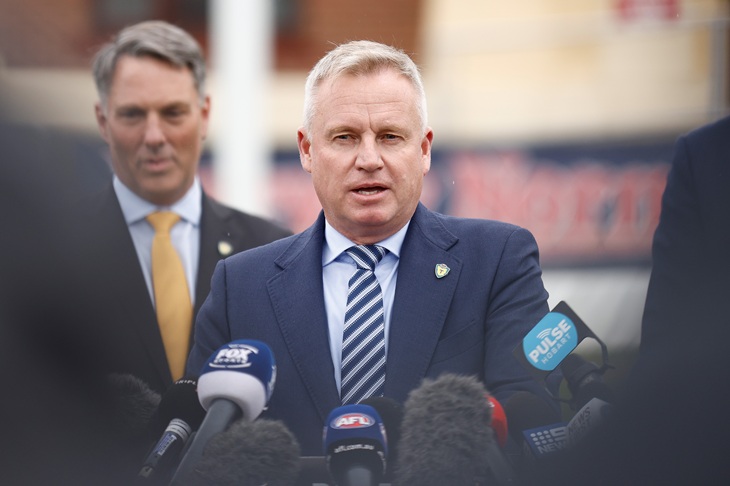
The election of Michelle O’Byrne as Speaker of the Tasmanian House of Assembly on May 14, 2024 marked a significant departure from parliamentary convention, raising questions about stability, leadership, and media coverage. The decision’s implications are all the result of Premier Jeremy Rockliff’s inaction. Meanwhile, the mainstream media’s response has focused on Rockliff’s inadequacy with barely a mention of Michelle O’Byrne’s role of Speaker.
Are we quietly accepting socialism while ignoring our Westminster traditions?
In my opinion, the situation in Tasmania proves that the federal Coalition’s pandering to the left will only end in more tears than conservatives are shedding already. Sure, the Liberal Party is a complete rock show, but its inability to call out Byrne’s nonsense in Tasmania is a new level of utter inaction.
Michelle O’Byrne, a Labor member and former federal MP for Bass (1998–2004), was elected as Tasmanian Speaker via an uncontested vote on the opening day of Parliament following the 2024 state election. Despite Labor holding only 10 seats and remaining in opposition, O’Byrne secured the backing of the crossbench, including five Greens, three Jacqui Lambie MPs, and independents, including Michelle O’Byrne’s brother David O’Byrne.
The minority Liberal government, led by Jeremy Rockliff, initially planned to nominate Mark Shelton but chose not to contest, allowing O’Byrne’s unopposed election. This was a major mistake in judgement. It also marked the first time in over 60 years (since 1959) that Tasmania’s Lower House chose an opposition member for the role of Speaker, aside from a brief period with independent Sue Hickey in 2018.
Historically, the Speaker’s role is crucial for maintaining parliamentary stability. Traditionally, the Speaker is from the governing party. O’Byrne’s election as an opposition member disrupted this balance, leading to increased tension and conflict that culminated in a major error by the Rockliff minority government where every vote is critical.
This break from convention risked undermining the Speaker’s ability to act as an effective arbiter, particularly in deadlocked votes where the casting vote becomes crucial.
The casting vote, a key aspect of the Speaker’s role, is used to break ties. While the standing orders of the Tasmanian House of Assembly do not explicitly detail how this vote is cast, conventions like Speaker Denison’s rule in the British Parliament suggest it should maintain the status quo or allow for further debate.
Rockliff’s decision not to contest the speakership was a concession to the crossbench, reflecting a broader weakness in his leadership. The Liberal Party, in every place and space, is navigating an increasingly fragmented political landscape. Those in positions of power (however defined) within the Liberal Party machine seem to think that pandering to progressive agendas will lead to electoral success.
The problem is that none of the moves by the Liberal Party to court leftist voters ever work.
At the same time, the Liberal Party is sacrificing its own members who would otherwise turn themselves inside-out to see a permanent Labor opposition. Instead, contemporary Coalition leaders, except the under-rated David Crisafulli, are hell-bent on proving they are a manifestation of modern communism as they pander to the same people who would run away if they ever had to defend our country.
Rockliff may well get what he deserves for being part of the party’s drift to a ‘Woke’ stance on social and economic issues. The shift that has alienated the Liberal base while failing to appeal to progressive voters leaves the party caught between the two worlds the liberals created.
Rockliff’s leadership lacks the decisiveness needed to navigate such challenges. At the same time, the way the Liberal Party immediately apologises before deferring to the socialists is a disgrace.
Rockliff, for all his wet faults, is right to stand his ground in Tasmania, and his colleagues ought to support him.
In the absence of a leader who calls out the speaker for being an activist and refusing to support the status quo in accordance with the Westminster tradition, the mainstream media’s response to O’Byrne’s election has been indifferent. They might as well all come out and admit they are republicans.
In the meantime, the Tasmanian Premier is facing a no-confidence vote.
Most importantly, the mainstream media appears to support the demise of the Westminster system. Either that, or the situation in Tasmania is so unimportant that it doesn’t warrant the media’s attention.
But that assumes business as usual from here on in.
In my opinion, what is happening in Tasmania will soon happen in Victoria. Subsequently, the Federal Budget will replicate Victoria’s basket-case budget. Soon after, Westminster conventions won’t mean anything to the government or to the voters. Our Westminster system, the best in the world and in history, will disappear, and soon after compliant journalists will all work for state media.
We may all pretend to live happily ever after, but when the next revolution comes, nobody will recall how we let the demise of our Westminster tradition begin in Tasmania.
It all comes down to a lack of leadership. It’s like a virus that regrettably seems to have infected Liberal leaders at all levels in recent times. It’s a crying shame.
Dr Michael de Percy @FlaneurPolitiq is The Spectator Australia’s Canberra Press Gallery Correspondent. If you would like to support his writing, or read more of Michael, please visit his website.
Dr Michael de Percy @FlaneurPolitiq is The Spectator Australia’s Canberra Press Gallery Correspondent. If you would like to support his writing, or read more of Michael, please visit his website.