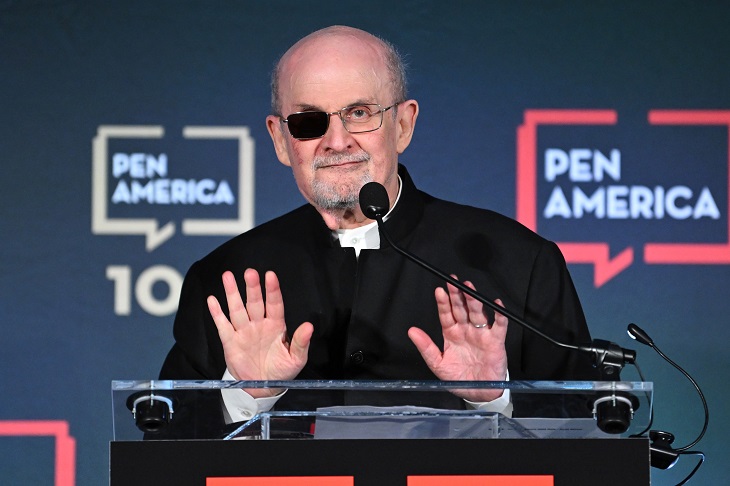
Salman Rushdie did not die. Attempts to murder the author have been numerous, but Hadi Matar is the one charged with sticking the knife in deepest while Rushdie was on stage in New York.
As Matar stares down an attempted murder charge, Rushdie has made a remarkable resurrection worthy of any prophet – in this case, a prophet of free speech.
Never one to waste a story, Rushdie has announced that he intends to write a book about the attack that nearly saw him removed from history’s tireless saga.
‘I’m trying to write a book about the attack on me – what happened and what it means, not just about the attack, but around it. ‘It will be a relatively short book, a couple of hundred pages. It’s not the easiest book in the world to write but it’s something I need to get past in order to do anything else. I can’t really start writing a novel that’s got nothing to do with this … so I just have to deal with it.’Thank goodness this is Rushdie and not George R R Martin – we won’t have to wait long to hear his thoughts on this deeply personal event. Rushdie’s book may end up being short, but the epic of his personal liberty is not. He has been under constant threat since the publishing of The Satanic Verses in 1988, or in other words, the entire lifespan of a Millennial. Given how much content there is in the world critical of Islam, it seems bizarre that Rushdie should attract so much active hate, but his myth has long since eclipsed the content of his work. He is the free speech temple which zealots seek out and attempt to destroy as an act of devotion. Islamic extremism will hunt Rushdie until the end of his days, but you won’t hear a progressive liberal pick a fight with the censorial branch of this particular faith. The champions of safe spaces and trigger warnings are not exactly racing over to Rushdie with cotton wool and a cup of tea. Imagine if a group of devout Christians had an active bounty on the head of an author… Does anyone think the media would ‘let it go’ most of the time and only drag the issue up whenever a knife-wielding member of the congregation gets close enough to nick an artery? After the attack on Rushdie, the media quite rightly went quiet to give him space to recover. In the days following the violence, his prognosis was dire and some wondered if terror was about to claim another victim. No doubt journalists around the world had their press releases ready – fingers hovering over keyboards trying to decide if they should go the he brought it on himself for saying mean things line that was run in the aftermath of the Charlie Hebdo attacks. Rushdie was stabbed 10 times, saying of the stab wound to his eye, ‘The knife went quite deep in. The knife went as far as the optic nerve.’ Rushdie lost that eye and now wears tinted glasses giving him a pirate aesthetic that he will be pleased to hear rather suits him. The nerve damage to his face and neck are clear, but his hand – which doctors originally thought would remain paralysed – has regained the majority of its normal function. A small mercy for someone who spends their life typing. It’s one thing to bravely stand up and keep fighting, as Rushdie does, but he admitted that he has nightmares from the event. At the time of his attack, his latest work, Victory City, was released. As is the morbid reality of human behaviour, Rushdie’s near-death experience sent people rushing out to buy what they thought might be his last word. It is understandable that he is thrilled people enjoyed his latest book on its own merits. As Rushdie said: ‘I’m happy to be on the [2023 Times 100 list of the most influential people in the world] list. It means that somebody’s noticing what I do. One of the things that I liked about the way in which Victory City has been received – it’s been wonderfully received, but I didn’t get the sense that the reviews were written out of sympathy. They were serious reviews, which were about the work. And I thought, in a way that it’s good because that book, coming out when it did, slightly changed the subject, that it’s not only somebody who is the target of an attack, but also there’s a creative artist here. Being included in this eminent list is another way of saying I’m not just somebody who got attacked.’ There are people out there in the creative world that thrive on the attention scandal or chaos brings them. People who couldn’t care less if they were famous for their work or their reputation. They are the sort of ‘writers’ who have their novels ghost-written by poor literary serfs and believe me, there are plenty of them out there. Rushdie is something special. A humble warrior who has taken up the fight for free speech at great personal cost in an age where today’s ‘brave and strong’ youth burst into tears when someone forgets their current fictional pronoun.’ ‘I have this old-fashioned view that I’m mainly a novelist. I’ve done my fair share of fighting for free expression,’ he said. ‘One of my things of greatest pride is to have co-founded the PEN World Voices Festival, which in its origin really was a way of introducing American readers to the rest of the world, to make the literary experience of Americans less parochial, perhaps. And it’s succeeded beyond our wildest dreams.’ Rushdie may have to fund a second festival, this time to re-introduce Americans to their classic texts because they are no longer being taught. The chasm between Rushdie’s fight for freedom of speech and the world the West has created in the last 20 years is almost too depressing to fathom. It would not be surprising to find our universities full of students studying human rights condemning Rushdie for offending Islam and quietly whispering to each other: #HeDeservedIt. ‘Now I am sitting here in the US,’ said Rushdie, during his acceptance speech at the British Book Awards, ‘I have to look at the extraordinary attack on libraries and books for children in schools. The attack on the idea of libraries themselves. It is quite remarkably alarming, and we need to be very aware of it, and to fight against it very hard.’ It was said in response to the rise of ‘sensitivity readers’ who take it upon themselves to re-draft the greatest works of literary history. ‘…and if that’s difficult to take,’ he added, of so-called ‘challenging’ concepts within older texts, ‘don’t read it. Read another book.’ In what must be a traumatic revelation, progressive Woke censorship in America is on the path to becoming just as intolerant, unhinged, dogmatic, and puritanical as Islamic fundamentalism. This is unsurprising, given they are both a type of religion. Speaking to Time, Rushdie said that he was ‘getting there’ with his recovery and that the body has a remarkable capacity for healing. When asked what full recovery would look like, he replied: ‘It’ll look pretty much like this. And that’s to say, the eye is not coming back. The eye is lost. The hand that was badly damaged is recovering quite well with a lot of therapy. And the other wounds are getting better. There’s a lot of therapy that’s needed. Obviously, there was quite a lot of PTSD. But I’m getting better.’ Writing a book about what happened is likely to be the best therapy available. It may allow him to close that traumatic chapter. ‘For me,’ he said, ‘that’s a way of kind of taking charge of it. I’m still working out exactly how it might go.’ When it comes to in-person appearances, Rushdie is not defeated, but he is certainly cautious. Regardless of what the left has to say about immigration, the West has imported Islamic terror and even if it represents only a fractional percentage of migrants, there are still more than enough people in the heart of the West prepared to risk their lives to silence speakers such as Rushdie. Western nations are not safe and their people are not safe. While America has laws capable of handling violence on this ideological magnitude, Australia and most of Europe have no idea how to handle acts of terror. Usually, they are treated as ordinary crimes and the perpetrators released straight back into the arms of their violent delusions. And when we’re not importing terror, we’re rescuing it from Syrian camps. In old money, this is what nations used to call a ‘death wish’ – a civilisation so careless it is destroyed by stupidity. Rushdie would like to sit in front of a live audience again, but he has reservations. Were it to happen, it would no doubt be small with the guests put through significant safety checks. Though still recovering, it was encouraging to hear Rushdie had not lost his sense of humour. When the Time interviewer pointed out that Rushdie might outlive the Islamic Republic, his lips curled. ‘Well, that’d be nice…’ Unfortunately, Rushdie might also outlive the Age of Western Liberty.