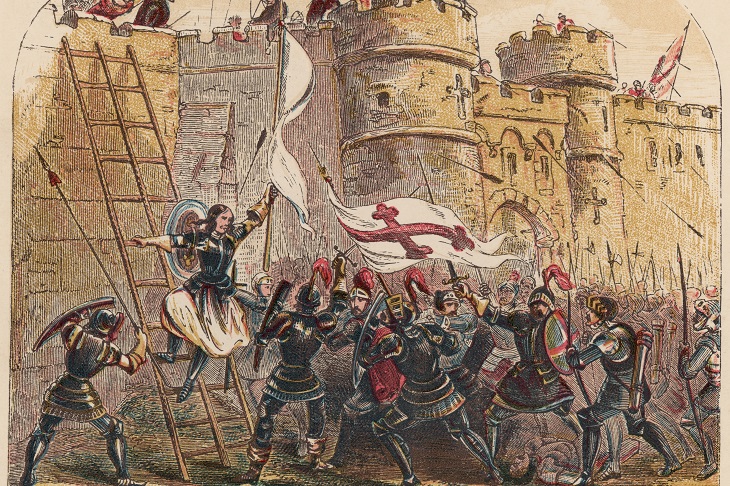
Now I know how Joan of Arc felt – as the flames rose to her Roman nose – Bigmouth strikes again.
It has done so in a predictable form as a perverse arm of our odious Cancel Culture.
According to Shakespeare’s Globe Theatre, Joan of Arc was ‘a nonbinary’ or ‘enby’ person. This hip/Woke statement coincides with the release of their latest production I, Joan by Charlie Josephine. It is penned as a ‘re-imagination’, but I can hardly see anything imaginative or novel about this hackneyed take, considering our times.
In an essay accompanying the play, academic Dr Kit Heyam, writes that:
‘Saying Joan’s gender nonconformity was motivated by practicality doesn’t prevent us from also saying that it had other, deeper motivations – or that it had other, deeper, unexpected consequences for how Joan felt. Feelings and identity are messy; few of us can honestly say we have only a single motivation for any decision we take, let alone so momentous a decision as Joan took when they asked to meet Charles VII in 1428.’
Well, it seems that Dr Heyam knows the secrets of Joan of Arc’s feelings.
This is anachronistic at best and offensive to the memory of this historical figure at worst, but it does draw our attention to the following point – feelings and identity are messy. Sure, but this is why we stick to historical facts and avoid cherry-picking big old personalities to bolster trending ideologies.
If I was Joan of Arc, I’d feel exploited.
How is it that we have gone from Carl Theodor Dreyer’s unsurpassed film The passion of Joan of Arc (1928) – widely recognised as one of the greatest films ever made – to this turgid nonsense? Supported by the Globe Theatre, of all places?
As Theodore Dalrymple points out in his book The Cult of Vulgarity, the out of touch elite have been responsible for pushing a culture of vulgarity. They act on a mistaken impression that they are giving the public what they want. Moreover, vulgarity has become a token of warm-heartedness and if one objects to this line (reminding others of good taste and also in this case, historical accuracy) one is seen as cold.
These re-imagined productions are so concerned with how they feel that they never ask how the wider community might feel. I would elaborate on this point and argue that, as well as being vulgar, gimmicks like I, Joan and the accompanying essay are quite aggressively political.
Politics is, of course, unavoidable, but in my opinion, (and there is a good chance Joan would agree) it should be about the individual. What these productions do (perhaps accidentally) is reinforce gender stereotypes that we should be opposing in the name of individualism.
Although this ‘nonbinary’ push may be a momentary cultural phenomenon, its penchant for re-imagining historical figures such as Joan of Arc may be (unintentionally) offensive to the French. Joan of Arc is not only a feminist icon, but also symbolises a distinctive French identity based on freedom and independence. This ‘deconstructive’ take, I believe, would insult even Derrida, the father of ‘reading against the grain’.
In his book The gift of death (1996), one of France’s modern bards wrote:
‘How can another see into me, into my most secret self, without my being able to see in there myself? […] It’s perhaps there that we find the secret of secrecy. Namely, that it is not a matter of knowing and that it is there for no one. A secret doesn’t belong, it can never be said to be at home or in its place. […] What is the – I and what becomes of responsibility once the identity of the I trembles in secret?’
Dr Heyam and the Globe Theatre have ignored this basic tenant of responsibility when dealing with identity – and importantly – the identity of a fifteenth-century national martyr. This is why facts matter. Joan did, of course, don male garb in order to attempt to save France from the English and is universally deemed an early feminist and a symbol of freedom and independence. How odd that she is now portrayed through a confused lens of identity victimhood, wrapped up in a status hierarchy, and heavily politicised by our modern sensibilities.
One does wonder what the response would be if sensitive religious figures were portrayed as non-binary? I don’t think it would be passed off so easily, particularly by cultures who are less tolerant to artistic licence. What is next? Father Theresa? Body shaming Buddha? Gay pride Gandhi? Bi-curious Muhammad? Where will the iconoclastic assault on significant cultural, religious, and national figures end or even draw a line?
In the midst of this boorish moaning confusion, the line, ‘Mit der Dummheit kämpfen Götter selbst vergebens,’ (against stupidity, the gods themselves battle in vain) comes to mind. The quote is from Schiller’s play The Maid of Orleans (1801) which follows the life of Joan of Arc and which Tchaikovsky based his opera of the same name on. In both pieces Joan is condemned for her worldly passion for Lionel and is redeemed through martyrdom.
The idea that an artistic piece would re-imagine Joan as non-binary is both politically dubious but also non-nonsensical. Give me Tchaikovsky over that any day. I will continue to battle; albeit in what feels like vain.
‘I, Lana.’