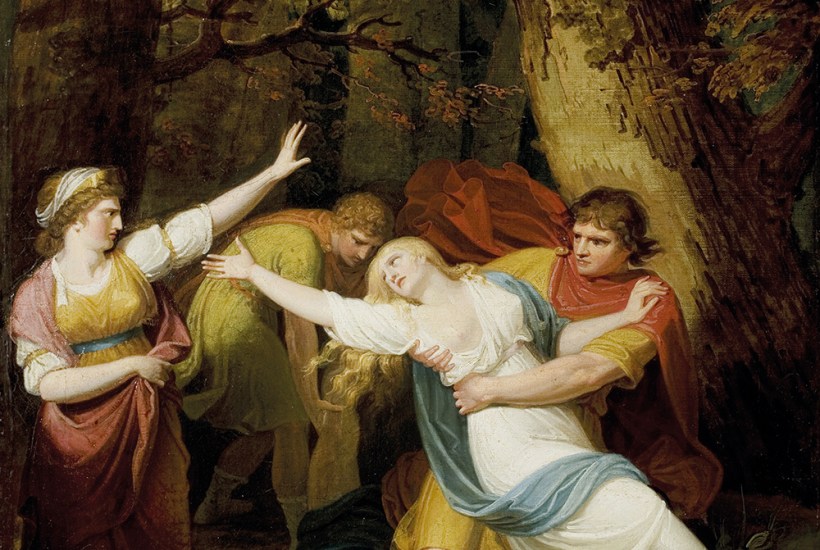
Are Shakespeare’s early plays terrible? Rory Loughnane seems to think so, which is perhaps surprising, given that his new book is an account of Shakespeare’s writing life until the age of 30. The playwright starts out in 1588, aged 24, with The Two Gentlemen of Verona, which is mostly remembered for an unpleasant subplot about rape. ‘The treatment of the female characters is dreadful,’ writes Loughnane, while the ending is ‘underdeveloped and therefore somewhat dissatisfying’.
Next up, Titus Andronicus, which was popular with audiences but less so with Loughnane, who gives a summary of the demented plot, quotes some long-dead scholars being mean about it (‘I wish I had never read it’), and concludes: ‘The end, phew.’ There are a couple of history plays about Henry VI and The Taming of the Shrew: ‘We cannot save Shakespeare from this play’s misogyny, nor should we wish to.’ Then there is Edward III, written in 1591, and filled with ‘tub-thumping jingoistic stuff’.
Hang on, I hear you say: Edward III? Is that a play by Shakespeare? Good question, and the simple answer is no, not really. The more complicated answer is that Loughnane is on the editorial team of the New Oxford Shakespeare, which was published in 2017. This large, scholarly project included re-edited texts of the plays, extensive commentary on their printing history and an emphasis on identifying Shakespeare’s co-authors. The edition included, among Shakespeare’s plays, several which were – the editors argue – partly written by Shakespeare: Arden of Faversham, which has long been published as by ‘anonymous’, and Edward III.
Loughnane also co-wrote a book-length chapter called ‘The Canon and Chronology’. This is the kind of thing that strikes academics as iconoclastic and general readers as incomprehensible. It establishes a new chronology for Shakespeare’s plays – that is, the order in which they were written – along with an extensive discussion of the methods of analysis, including rare vocabulary tests and studies of rhyme rate. It is dry, brilliant, infuriating and the basis for Loughnane’s new book.
There is a curious, double-headed impulse inside Shakespeare at Thirty. On the one hand, here is a serious scholar doing serious scholarship, distinguished by deep attention and equally deep generosity, as Loughnane’s work offers valuable material for biographers and academics in the years to come. On the other hand, we live in a time in which expertise is laughed at and those of us who teach in universities are endlessly told that our work must engage with the wider world. Hence this occasionally half-hearted and quasi-commercial book, written in a style which moves between colloquial banter and professorial abstraction. Here is Loughnane in scholarly mode: ‘Issues about authorship and text complicate any critical approach to the play’ he observes at the beginning of an extensive discussion of the alternate textual versions of The Taming of the Shrew. To quote Hamlet: ‘Where be your jibes now?’
This is a shame, as the two scholarly areas in which Loughnane excels – the chronology and collaborations – may be dry but they are important. For 150 years after Shakespeare died, nobody seems to have cared much about the order in which he wrote the plays. Then, at the end of the 18th century, an Irish barrister named Edmund Malone arranged them chronologically and began to draw conclusions. Ever since, chronology has been one of the foundations of Shakespeare study, and not only for textual scholars. It permits biographers to trace the development of motifs across time and to attach the plays to the political events of their immediate moment. It flowers into less scholarly works such as Hamnet or Shakespeare in Love, both of which are fables about creativity resting on arguments about chronology.
Equally, the realisation that Shakespeare co-wrote many of these plays, and particularly those at the beginning and very end of his career, has reinvigorated Shakespeare studies over the past two decades or so. That some scenes in some of Shakespeare’s plays were actually by George Peele or John Fletcher helps us escape an old-fashioned and highly romantic vision of the playwright at work alone in his garret. Instead, we might picture Shakespeare as an apprentice writer, finding his voice and style by collaborating with others in a sociable, lively world.
This is the story that Loughnane is almost telling, for another way to see Shakespeare’s early plays as lacking something is to think about where he found it. Shakespeare likely reached London in 1587, which was also the year in which two absolute bangers were written: Tamburlaine by Christopher Marlowe, and The Spanish Tragedy by Thomas Kyd. These transformed English drama, and it is not an exaggeration to see Shakespeare’s whole career as a slow-motion grapple with exactly these two plays. It is highly likely that he collaborated on other plays with both of these playwrights. After their early deaths, he went on mimicking their styles and building upon their innovations. Without Tamburlaine, no Henry V; without The Spanish Tragedy, no Hamlet. He was lucky – and we are lucky – that he arrived at this moment, and paid attention, and absorbed the rich and changing world around him.
Got something to add? Join the discussion and comment below.
You might disagree with half of it, but you’ll enjoy reading all of it. Try your first month for free, then just $2 a week for the remainder of your first year.