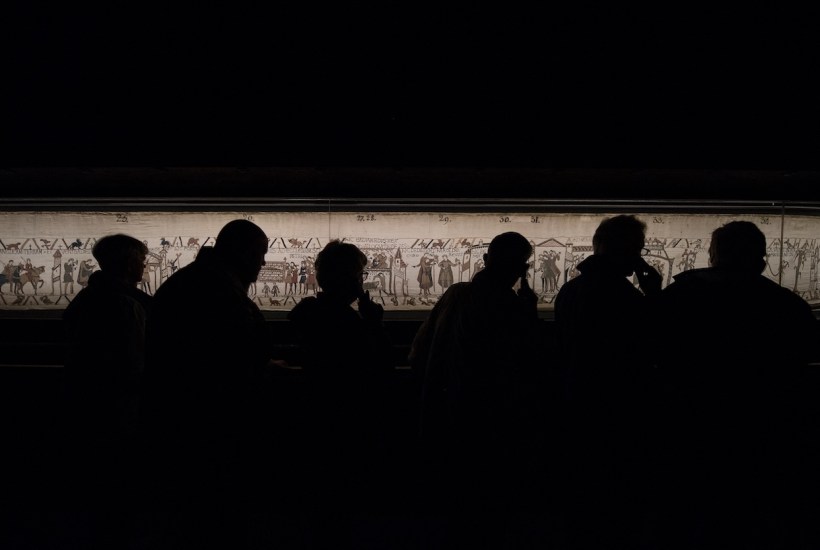
Queuing for up to two hours to enjoy a fleeting encounter with the Bayeux Tapestry is not the only sign of history lovers’ dedication. A peak-entry adult ticket, including a donation, will set them back £36.50. But that price has not deterred visitors. The loan broke British Museum sale records, with the first tranche of tickets selling out within a day and similar popularity likely for the second release.
Nor is this an isolated instance. The Tate Modern’s Frida Kahlo exhibition had the highest pre-sales in the Tate’s history, with more than 41,000 tickets snapped up before the opening. At the National Gallery, over 22,000 have booked for ‘Renoir and Love’, surpassing the previous record of 15,654 set by its 2024 Van Gogh exhibition. No wonder the Guardian proclaimed ‘a resurgence of the blockbuster exhibition’. But culture vultures are paying for the privilege. Joining a group tour of Kahlo costs £49 for non-members, while a weekend visit to the V&A’s Elsa Schiaparelli exhibition is £30.
The contrast with the recent past is striking. In 2010, admission to the National Gallery’s Canaletto exhibition cost £12 and it was £13.50 to get into the Tate Modern’s Gauguin show. It would be easy to dismiss the increase as simply another symptom of inflation. But £12 in 2010 is equivalent to around £19.25 today. Even accounting for cost-of-living pressures, today’s blockbuster shows are significantly more expensive.
Yet, for all the extra money taken, museums and galleries remain in dire financial straits. The National Gallery has been forced to make major cuts, despite attracting more than four million visitors in 2025. A review led by Baroness Margaret Hodge this year found that ‘most (organisations) are experiencing severe financial challenges; some are in crisis. The cuts in public funding over the last decade and more represent an existential threat to the health and vibrancy of the arts and culture sectors.’
But government cuts are not the whole story. A source working on funding at a major London museum tells me that ‘corporate financing has dried up and is no longer the magic wand it used to be’. A 2022 parliamentary report calculated that business sponsorship of arts and culture had fallen by 39 per cent since 2013, equivalent to tens of millions of pounds. In 2020, Arts Council England reported that ‘corporate income was consistently flagged as the most challenging income category’, noting that ‘businesses did not show a high willingness to engage in new sponsorship or partnership packages’.
According to my source, this is partly a reflection of firms being more financially risk-averse in a stagnant economy, yet also points to growing distance between the art and corporate worlds. While curators want to engage with the issues of the day and push the boundaries on politics and morality, companies are wary of the online backlash associated with being dragged into culture war issues raised by exhibitions. Firms’ eagerness to prove their brand values means seeking a level of editorial control that can be difficult for curators to accept. In today’s corporate climate, stumping up cash for less controversial and more obviously necessary causes, like healthcare or the environment, feels both safer and more popular.
Besides, sponsoring an exhibition can draw the attention of keyboard warriors to a firm or individual’s wider activities. The British Museum’s Bayeux Tapestry exhibition is a case in point. Sponsorship by Belarus-born billionaire Igor Tulchinsky drew public and media scrutiny of his funding of a ‘therapy yurt’ in an illegal Israeli settlement in the West Bank for soldiers who had fought in Gaza. The controversy spilled into the museum itself, thanks to in-person demonstrations, and prompted Green [arty leader Zack Polanski to call for a government investigation.
But the dynamic works both ways. Museums, for all their financial strife, reject some corporate sponsorship for fear that accepting would mean stirring controversy among staff, artists and the general public. My source tells me that their museum has turned down approaches from companies suspected of ‘values washing’ – specifically, firms with links to Israel or the fossil fuel industry that may be hoping to enhance their public image by associating with a cultural institution. Yet one hopes that visitors discerning enough to spend a Saturday at a museum are capable of holding two ideas in mind at once: appreciating a company’s contribution to an exhibition while retaining, entirely separately, whatever views they may hold about that enterprise.
Lest this seem like galleries merely preening over how they look, protests can inhibit the functioning of a museum, depriving it of visitors, artists and funds. After the Science Museum terminated its decades-long partnership with oil giant BP, campaign group Culture Unstained claimed that the decision followed pledges from educators and schools to boycott the museum. Back in 2018, defence firm BAE Systems withdrew its sponsorship for the Great Exhibition of the North following an online petition and participants threatening to pull out. Meanwhile, the Centre for Contemporary Arts in Glasgow shut down this year following serious financial issues. It had also been the subject of protests by pro-Palestine artists who wanted the centre to boycott Israel.
Then there is the risk of dissent among staff and partners when institutes accept money from controversial sources. In 2021, two Science Museum trustees – mathematician and broadcaster Hannah Fry and scientist Jo Foster – resigned after the museum partnered with Adani Green Energy, which operates in coal mining, to fund a gallery promoting green energy and decarbonisation. Campaign group Stop Adani claimed that the project amounted to ‘green washing’ intended to improve the company’s image. A 2026 FOI request by Culture Unstained found that 64 per cent of surveyed staff members at the Science Museum disagreed or strongly disagreed with their employer’s ‘decision-making on public programmes, sponsorship and partnerships’.
For all the internal debate over funding sources, museums have significant infrastructure costs to bear. Many institutes that received Culture Recovery Fund loans during Covid are expected to struggle with repayments. Hodge’s review noted that ‘over three-quarters of arts centres are unable to complete planned building work and 60 per cent have undertaken no significant refurbishment in over a decade. In several cases, the cost of repair has been deemed so high that demolition is being recommended.’
Then there is the hefty price tag associated with putting on an exhibition. An art world source estimates that the Tate Britain’s recent James McNeill Whistler exhibition cost around £10 million, including transportation, insurance, a fee for loaning works – which is how many smaller regional museums stay afloat – conservation work, fittings, research and developing the catalogue. It can take three or four months to get a sense of how well an exhibition will perform, encouraging museums to ramp up the ticket price to be sure of a quick return. While there will usually be two or three ‘blockbusters’ planned (along with other, smaller exhibitions), all are considered as part of the same financial package. Promotion ratchets up prices as well. We may assume that names as famous as Frida Kahlo or David Hockney sell themselves. However, institutes outside of central London complain of advertising being necessary to compensate for the lack of natural footfall.
Curators are likely to grow ever more cautious
So how do we resolve this dilemma and ensure that Britain’s cultural sector remains genuinely world-leading? The obvious answer – if you do not want protests, do not take money from controversial sources – is also the least comfortable. After all, who knows which country, company or cause might be deemed beyond the pale tomorrow? Nor should we pretend that scrutiny is confined to organisations with genuinely dubious records. Even the squeakiest of corporate sponsors is unlikely to relish having its activities subjected to the forensic examination of online keyboard warriors.
The danger is that culture becomes the poorer for it. Corporate funding may be only one part of a broader mix. Yet, curators are likely to grow ever more cautious, favouring the safe, beige blandness that has sufficient broad appeal to guarantee maximum ticket sales and minimum controversy for any sponsor. Rocketing prices will make the arts only less accessible. The Hodge review recommended tax incentives for those who support culture. But what value do such incentives have if sponsorship can trigger a boycott and thereby damage the very reputation that makes investing financially worthwhile? As the review itself observed: ‘Boycotting sponsors of the arts and culture will often be more damaging to the arts than to the sponsor.’ The right to peaceful protest is precious and must be protected. But protest, too, has consequences. And as corporate funders retreat, it is the public that is, quite literally, paying the price.