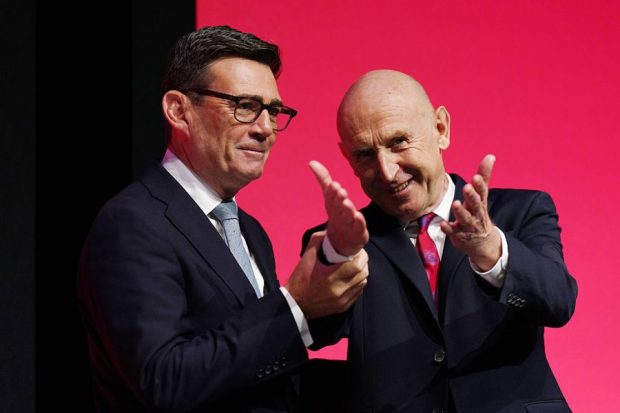
Andy Burnham makes his first visit as Prime Minister to Germany today in an attempt to further strengthen the country’s partnership with Britain. Last year, Keir Starmer and German Chancellor Friedrich Merz signed the Kensington Treaty, laying out a plan for a closer working relationship across defence, trade, transport and migration. Nine months earlier, the Trinity House Agreement created a framework for closer military and defence-industrial cooperation. Merz and Burnham will exchange the ratification documents of the Kensington Treaty as part of the PM’s trip.
While Burnham entered Downing Street in July with the promise of a distinct domestic focus, he has since made diplomatic efforts abroad by meeting the likes of Donald Trump and Emmanuel Macron.
When Burnham arrives in Berlin, however, the reality facing the two heads of government couldn’t be more different. The Labour leader began his time in No. 10 in the wake of a stretch of electoral losses, internal disputes and low approval ratings for his party. Fortunately for Burnham, however, he has, so far, enjoyed relative sympathy from the public compared to his predecessor. Meanwhile, Merz stands on increasingly shaky ground. His Christian Democratic Union (CDU) party not only lost seats in recent state elections but is on the downslide in nationwide polls. For the first time in its history, the CDU wasn’t able to clear the 5 per cent hurdle at a state election, scoring just 4.9 per cent in Mecklenburg-Vorpommern in September.
Merz is slowly losing control of his party and potentially the chancellorship
On Tuesday, parts of the CDU group in the state parliament of Saxony-Anhalt likely backed the AfD politician Tobias Rausch in the election for the parliament presidency. While it was a secret ballot, Rausch received 48 votes, four more than the AfD and the BSW – which will likely support the AfD in many matters in the coming years – possess combined. It is highly unlikely that any member of the three left-wing parties gave Rausch a vote, which only leaves the CDU. Rumours are ramping up about whether some Christian Democrats, who are hostile towards the regional party leadership, have made a deal with the AfD and could even back the party’s leader Ulrich Siegmund in the December election for minister-president.
Merz reiterated recently that he remains steadfast in his position that the CDU ought not to partner with or support the AfD, but some elected representatives may have gone against that directive. Tuesday marked just one of many CDU mishaps in recent months, as Merz slowly loses control of his party and potentially the chancellorship.
The most recent national voting intention poll on Monday saw the CDU and its sister party CSU at 17.5 per cent, while the AfD was slightly above the 30 per cent mark. Merz is facing the predicament that he doesn’t know where to go to bring voters back from the AfD or other political competitors. He has already taken a stronger stance on immigration than Angela Merkel and Olaf Scholz, his two predecessors, but voters see the anti-immigration AfD as the genuine article. Any swaying to the left would seem inauthentic for a conservative and market-liberal like Merz, who vividly opposed Merkel’s centrist course for years.
Regardless of his uncertain future, Merz has to move forward and lead the German government in international affairs as best as possible. He visited Kyiv accompanied by business leaders on Sunday to promise further support for Ukraine’s defence against Russia. German and Ukrainian armaments companies signed more than a dozen documents regarding further cooperation, while the Ukrainian ministry of defence awarded Diehl and its defence division the contract for the delivery of Iris-T short-range air-to-air missiles. Merz guaranteed €350 million (£297 million) for Ukraine’s energy sector.
Obviously, spending even more taxpayer money on the war in Ukraine, no matter how important it may be from a geopolitical standpoint, is not going down well with parts of the electorate who have been told about painful social reforms in recent months.
Germany’s Christian Democrats may hope that Merz is able to score points by freshening up relations with Britain and strengthening economic ties. But as things stand, defence might be the major talking point today. Since the October 2024 agreement, the two countries have, in particular, expanded their joint work on weapons projects and military coordination, while continuing to push for European support of Ukraine.
Today’s visit might be advantageous for Burnham as he could sharpen his foreign policy profile after years in regional politics. But whether it will bring Merz any sympathy given the dire situation he is in is rather unlikely.