On Tuesday, Andy Burnham returned to the House of Commons after almost ten years in the wilderness, bringing with him ‘a clear diagnosis of what has gone wrong’ in the country.
Burnham’s claims about how the country has been governed since the 1980s do not stand up to scrutiny
According to Burnham, the problems started in the 1980s when a ‘series of wrong turns’ were made. The Prime Minister said that ‘political power was centralised, economic power privatised, the country deindustrialised, austerity followed, hollowing out councils and depriving them of the agency to act to reverse any of this’.
People who can remember Britain before the supposed wrong turns may find the recasting of the 1960s and 70s as a prelapsarian golden age surprising. People born after the Thatcher revolution have not lived through three-day weeks or corpses piling up as they went unburied due to strikes.
But leaving what happened in the 1970s to one side, Burnham’s claims about how the country has been governed since the 1980s simply do not stand up to scrutiny.
‘Political power was centralised’ – False
The 1980s were the final decade in which the four constituent parts of the United Kingdom were governed directly from Westminster. Margaret Thatcher’s negotiations with the Irish government conceded some of Westminster’s sovereignty over Northern Ireland by establishing a role for the Republic in the Northern Irish government during the Anglo-Irish agreement of 1985, something which was enhanced by power-sharing in the Good Friday Agreement in 1998. Also in the 1990s, New Labour created the Scottish and Welsh Assemblies, which were given powers over education, health and other policy areas.
This devolution of power away from Westminster over the last forty years has not only taken the form of empowering nations but also regions of the UK. Both Labour and Conservative governments have assiduously devolved power from Westminster. The Mayor of London was established by Tony Blair’s government in 2000, and the Mayor of Greater Manchester was introduced in 2017 by the Tories, creating the power base in which Burnham would be able to sit out the Corbyn years, and from which he would later mount his return to Parliament.
Even within specific policy areas the trend, broadly, has been to take power away from Westminster departments and to instead empower supposedly neutral quangos. In the National Health Service power was taken from the Department of Health and given to NHS England, and later distributed among regionally-orientated Integrated Care Systems (something that is now being reversed). Police and Crime Commissioners (soon to be abolished) were created to empower ‘local communities’. Ministerial departments have also ceded control of functions ranging from setting interest rates (the Chancellor used to have the final say; Gordon Brown gave the power to the Bank of England) to budget forecasting (the OBR), management of the roads (National Highways), inspection of schools (Ofsted) and even criminal sentencing (Sentencing Council and its predecessors).
Somehow Burnham looks at all of these developments – many of which occurred while he was in government – and concludes that the story of the last forty years is Westminster seizing control.
‘Economic power [was] privatised’ – False
‘Economic power’ does not have a clear definition, but let us assume Burnham means that the state has ceded its influence over the economy to the private sector since the 1980s. This is the opposite of the truth. In 1990, the year that Thatcher resigned, government spending was 35 per cent of GDP. In 2025/26 this rose to 44.3 per cent. And far from giving up control over economic power the state is taking ever more control by consistently raising taxes, such as the apprenticeship levy and the digital services tax, the energy profits levy and the plastic packaging tax. Government revenue was 33.8 per cent of GDP in 1990, and is forecast to rise to over 42.5 per cent by the end of this decade.
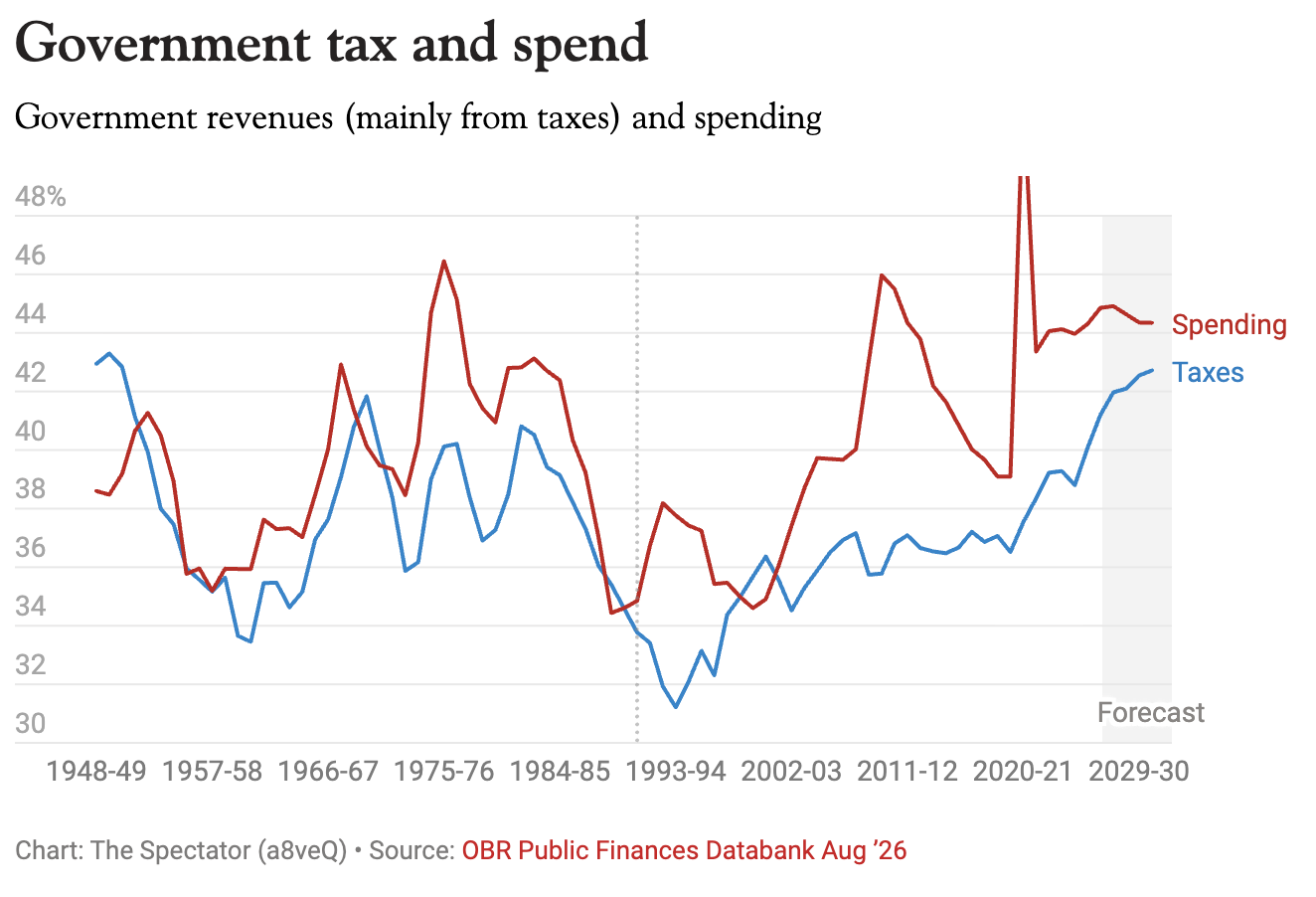
Even these tax increases have not been enough to keep pace with the expansion of the state. Public sector debt as a share of GDP has almost tripled in the last twenty years. The OBR projects that it could reach 325 per cent of GDP by 2070; in 1990 it was below 30 per cent. As well as increasing the tax burden in the long run this extended borrowing binge is making it more difficult for the private sector to access credit. The state is also interfering more with the operation of private companies and the labour market, having introduced and sharply hiked the minimum wage and, through more expansive interpretations of employment legislation it has effectively outlawed unpaid internships.
This is by no means an exhaustive list of all of the ways in which the state has expanded its control over the economy since Thatcher – that would take tens of thousands of words – but set against the semi-privatisation of a few utilities, and the marginal involvement of the private sector in the NHS, the evidence that our woes are being caused by too little since government since 1990 is very thin indeed.<//>