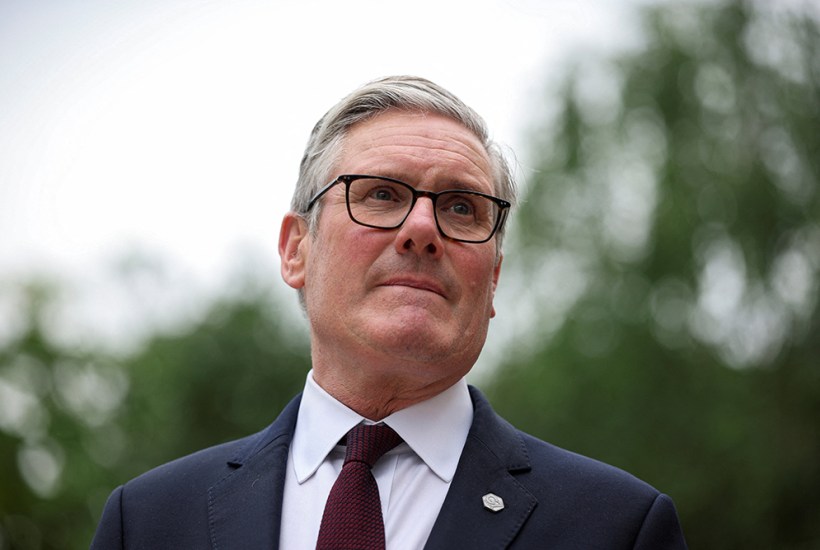
I am starting to think that Keir Starmer might have been in it for himself. In saying that, I am not trying to echo that laziest of all critiques of politicians that ‘they’re only in it for the money’. Good luck to anyone trying to make money from politics in Britain these days. Rather, I mean that the former prime minister’s decision to leave the House of Commons and trigger a by-election is not the behaviour of a patriot.
There were many people in the legal world who were nervous when the former director of public prosecutions decided to put his name forward as a Labour candidate for parliament. DPPs are meant to be politically impartial, like BBC presenters. But the fact that a DPP might turn out to be a Labour supporter was about as surprising as ‘impartial’ BBC journalists leaving the BBC and then starting very left-wing and lazy podcasts. In both cases the transition does not surprise the public but it does sow even greater suspicion of the supposed political neutrality of our institutions.
Being a representative of the people in parliament ought to be regarded as a high honour
Like so many others, Starmer was clearly after the top job or nothing. Despite the usual pabulum, it never seemed likely that he would want simply to serve his constituents and make useful interventions on legal subjects. For some reason, like so many other men of little talent, he imagined he was ‘the man’. Though who or what persuaded him of that, only Starmer, God and perhaps Mrs Starmer can know.
In any case, he was eager enough for the top job that he was willing to put aside any existing principles throughout the Jeremy Corbyn years. In that period, anyone with a soupçon of decency either left the Labour party or acted as an opponent of the leadership from the back benches. Not Starmer. He stuck with Corbyn and sat in his shadow cabinet despite his party’s leader being a man who never saw an anti-British terrorist group he didn’t have the hots for. Starmer’s lack of principle paid off, and so in due course it came to be his turn. The Labour party needed someone efficient after the Corbyn years: a safe pair of hands, someone to steady the ship – all the usual banalities.
And so he got it. By then the Conservatives had made such a hash of government that it seemed as though Starmer’s calculation had worked. He got to Downing Street, but as I have asked in these pages before, for what? There was never any vision for the country. There was no major initiative or insight. Other than him being a walking advertisement for adenoidal surgery, even Starmer ‘loyalists’ couldn’t point to anything he actually achieved. When he announced that he was stepping down as PM, the best his supporters could say was that he had left the country a ‘fairer’ and ‘stronger’ place. Statements that mean less than nothing.
Once Andy Burnham became Prime Minister, Starmer faced the same decision as all former prime ministers have: stick around and serve your country or bugger off because you can’t be bothered. We learned this week that he had chosen the latter.
An alarming number of recent prime ministers have taken this stance. David Cameron, of course, announced that he would see through whatever verdict the British people delivered in the Brexit referendum, only to go into the most terrific huff and resign not just as prime minister but also from parliament. His aim appears to have been to make money – another thing he failed at.
Tony Blair took a similar view – though when he abandoned ship he did so at a time of his own choosing and onto a mega-yacht. To be fair, Gordon Brown gave it five years before he left parliament and Theresa May stayed for another term too. Boris Johnson, of course, left parliament within a year of losing the prime spot. And Liz Truss wasn’t given enough time to consider her options before being rejected at the ballot box by her own constituents. During the last days of Rishi Sunak’s time in office, Starmer used to taunt the then prime minister that he would be swanning off to California if he lost. To his credit, Sunak remained in the House – indeed he has now outlasted Starmer.
But Sunak is an honourable exception. Perhaps it is false nostalgia, but I cannot help missing the time when politicians who once held senior office routinely stuck around afterwards to see what they could do for their country, or at least their constituents. Stanley Baldwin springs to mind, and it’s enough to make you miss Edward Heath.
I think it is correct to say that there was a time when being in parliament mattered, and when, in the event that your party lost an election or you got unceremoniously booted out by your own party, you nevertheless stuck around. It may have been because the one thing that unites almost all politicians, whatever their party, is the hope that one day the country will call, and perhaps even call a second time.
But it also seems that the mere business of being an MP has come to be viewed as a bit of a bore by politicians like Starmer. It isn’t a surprise that his only interest in politics was to lead the country for no particular purpose. But it is a terrible indictment of the individual in question, and perhaps of our politics as a whole. Being a representative of the people in parliament ought to be regarded as a high honour, with the fate of the nation sitting in your collective hands.
Either parliament today does not have the power and significance it once had, or the best people, let alone the most patriotic ones, are simply not entering politics. Venality, ambition, double-crossing and betrayal might be expected among politicians but we ought at least to be able to expect longevity and some belief in public service.
Anyhow – I wish Starmer luck in the rest of his career. Doubtless there will be some international conferences to speak at, podcasts to appear on and an unreadable volume of memoirs in due course.
Got something to add? Join the discussion and comment below.
You might disagree with half of it, but you’ll enjoy reading all of it. Try your first month for free, then just $2 a week for the remainder of your first year.