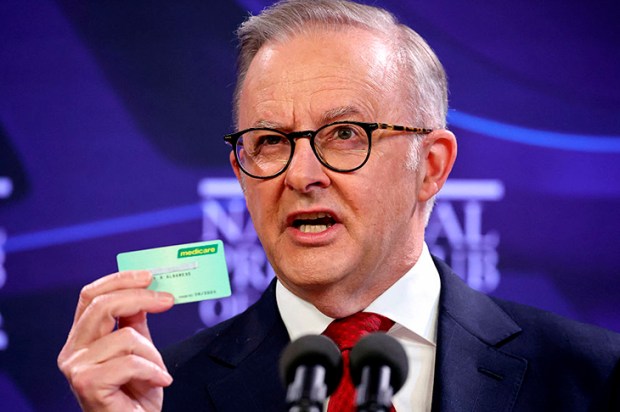
Jim Chalmers says the next election will be a referendum on superannuation. Splendid. Let us have it. For thirty-four years the political class has treated compulsory super as a settled article of faith, beyond reform. The moment Pauline Hanson suggested that struggling families might be allowed to touch some of their own money, the Treasurer accused her of wanting to ‘destroy’ the system. That reflex tells you everything. A policy that cannot survive the question ‘Why can’t I have my own wages?’ is not a policy; it is a racket.
Let me be fair to Paul Keating, because he deserves it. As treasurer he floated the dollar, deregulated a sclerotic banking system, cut tariffs and, in 1987, introduced dividend imputation, ending the double taxation of company income that still disfigures most developed countries. These were acts of genuine economic statesmanship. But great reformers are entitled to one great blunder, and Keating’s was the Superannuation Guarantee. What began in 1992 as a three-per-cent levy has been ratcheted up, election by election, to twelve per cent of every wage in the country since July last year.
Think about who pays it and when. A twelve per cent deduction falls hardest on the twenty-eight-year-old trying to scrape together a deposit, service a mortgage at six per cent and start a family. Her employer is compelled to salt away one dollar in eight of her labour income into a fund she did not choose, invested in assets she cannot see, locked away until she is sixty. Meanwhile she rents, or borrows at a rate well above anything her fund will return net of fees. Any finance student can see the absurdity: the household is forced to lend cheaply to a fund manager while borrowing dearly from a bank. The state does it to them by force.
And the family home is not merely shelter. It is the best retirement asset most Australians will ever own, free of capital gains tax. Compulsory super systematically delays home ownership in the very cohort that needs it, then congratulates itself on ‘retirement adequacy’. We have built a system that makes young people poorer today so that they may be marginally richer at seventy.
The pool now stands at roughly $4.4 trillion, half again the size of the entire economy. That scale is routinely cited as a triumph. It is the measure of how much of the nation’s wages have been confiscated and handed to intermediaries. Fees on that pool run in the order of $30 billion a year, whether markets rise or fall. A management drag of one per cent, compounded over a forty-year working life, consumes a fifth or more of the final balance. That is the largest wealth transfer from ordinary workers to the financial sector ever legislated in this country, and it was designed by a Labor government.
Nor is it an accident that the biggest winners are the union-linked industry funds. Under the ‘equal representation’ model, union officials sit on fund boards, draw directors’ fees that flow back to the union movement, and preside over funds that receive contributions by default from workers who never chose them. The Cbus affair, with its CFMEU-connected directors and a regulator forced to impose licence conditions while the corporate watchdog sued over unpaid death and disability claims, is not an aberration. It is what happens when a captive revenue stream meets weak governance.
Then there is the matter of whose money it is. The honest answer is that it is the worker’s: deferred wages, nothing more. Yet the political class increasingly speaks as though it were a sovereign wealth fund at their disposal. The Treasurer has convened the big funds to steer them into ‘national priorities’: social housing, energy transition, whatever the government finds inconvenient to fund from its own budget. Fund chiefs murmur about ‘nation-building’. Nobody asks the twenty-eight-year-old whether she would like her deposit invested in a wind farm at a concessional return.
The proposed tax on balances above $3 million exposed the same instinct. Its first design would have taxed unrealised paper gains, a principle so dangerous that it took a revolt from the crossbench and the accounting profession to force a retreat. The message had been sent: the money is only yours until Canberra decides otherwise.
Remember, too, what the edifice was supposed to achieve. Super was sold as the means of taking pressure off the age pension. Three decades on, pension outlays as a share of GDP are much where they were, and that is no accident. By exempting the family home from the assets test, government has ensured that even sizeable super balances scarcely dent pension eligibility. It has never shown the slightest willingness to collect the budget dividend that justified the scheme. Nor should anyone be fooled by Treasury’s claim that super ‘costs’ the budget tens of billions a year in concessions. That figure is a concoction. It assumes that, absent super, every dollar of saving would be taxed at the punitive rates applied to investment outside the system: tax on nominal rather than real returns, in unindexed brackets, on income that has already borne progressive tax once. Measured against the proper benchmark, a tax on consumption rather than nominal income, the ‘concession’ largely evaporates.
What should be done? The clean answer is abolition: make contributions voluntary, let workers keep the twelve per cent as wages, and let savers choose their own vehicle. New Zealand’s opt-out KiwiSaver shows the sky does not fall. If that is too much for a timid parliament, half-measures would help. Let first-home buyers draw on their balances for a deposit. Let anyone under forty direct contributions into a mortgage offset account, where the guaranteed after-tax return beats anything a fund will deliver. Cut the guarantee to six per cent and pay the difference as wages: that alone would halve the fee take, and the union sinecures with it. Award default funds by competitive tender rather than industrial award. Do not bother demanding ‘independent’ directors, as listed companies must; independence is no substitute for shrinking the pool.
Hanson has said something the major parties dared not: the money belongs to the people who earned it.
Jim Chalmers wants a referendum on that proposition. As with the Voice, he may find the answer is not the one he expects.
Got something to add? Join the discussion and comment below.
You might disagree with half of it, but you’ll enjoy reading all of it. Try your first month for free, then just $2 a week for the remainder of your first year.