Why are filmmakers so interested in nuns? They’ve been exploring the subject for more than a century, which might seem odd, given that real-life dramas in convents are mostly confined to quarrels about the washing-up. But celluloid nuns are a different matter.
As early as 1922, in the Swedish silent movie Häxen, a nun reaches for a spiked leather belt before leading her sisters in a demonic dance. That’s the beginning of one stereotype, the nun as sadomasochistic hysteric, which reached its apogee in Ken Russell’s The Devils (1971). Meanwhile, films such as Powell and Pressburger’s Black Narcissus (1947), set in a Himalayan convent, and The Nun’s Story (1959), starring Audrey Hepburn as a missionary sister struggling with her vows, dealt more subtly with the theme of repressed sexuality.
At the other end of the spectrum of stereotypes are singing nuns, famously depicted in Sister Act (1992). But its main character Sister Mary Clarence – played by The View’s resident bore Whoopi Goldberg in those far-off days when she was mildly funny – is only disguised as a nun; she’s actually a lounge singer on the run from the mob. In contrast, Debbie Reynolds’s Sister Ann in The Singing Nun (1966) is modelled on the Belgian Sister Luc Gabriel, whose hit single ‘Dominique’ outsold Elvis Presley. (Understandably there was no sequel telling the story of the singing nun after she left her convent: she died in an apparent suicide pact with her female lover.)
The plot is so full of absurdities that I lost interest and played my favourite game of spotting clerical solecisms
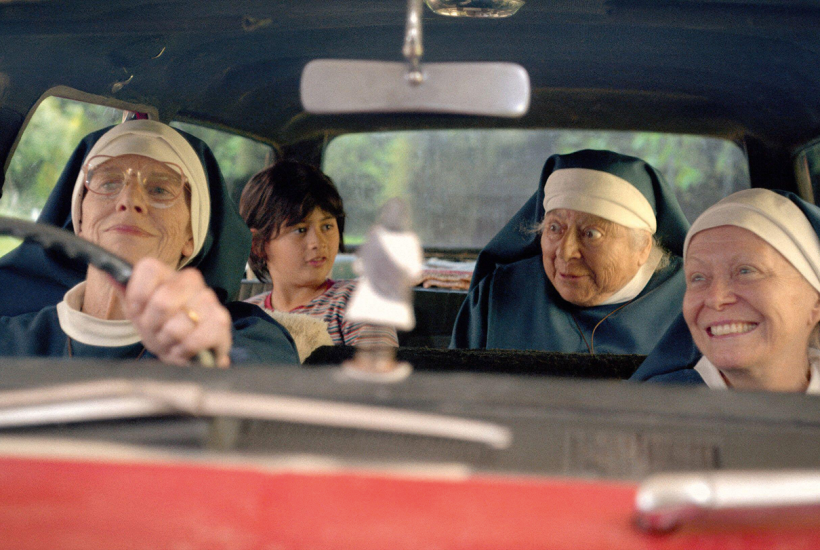
Holy Days is a comedy about three elderly nuns who embark on a road trip through New Zealand with a little boy who is helping them save their convent from demolition. It’s dimly aware of the complex genealogy of nun films. Infected by a spirit of geriatric mischief, the nuns jive to pop music, Sister Act-style. Judy Davis, who plays the Mother Superior Sister Agnes, hides her emotional fragility behind a veneer of bossiness – a genuflection to Meryl Streep in Doubt (2008), but rendered pointless by the feeble script.
The plot of Holy Days is so full of absurdities that I lost interest and played my favourite game of spotting clerical solecisms. Why were both the Catholic parish priest and his bishop sporting Anglican cassocks? Why did Sister Agnes address the bishop as ‘Your Excellency’ when the style in New Zealand is ‘Your Lordship’, and then promote him to archbishop by calling him ‘Your Grace’? And, an unrelated question, why does yet another movie set in the 1970s resort to long-haired wigs borrowed from a Debenhams mannequin?
The biggest mystery, however, is why Miriam Margolyes agreed to play the role of Sister Luke, who spends most of her time stuffing her face before her teeth fall out. Margolyes used to be an actor with virtuoso comic skills. Then she turned herself into a bargain-basement national treasure by regaling Graham Norton with anecdotes about breaking wind. In the end, Holy Days isn’t so much a road trip as an ego trip for this annoying woman. I took one look at Sister Luke and thought: I bet she farts by the end of the film. I won my bet.
Got something to add? Join the discussion and comment below.
You might disagree with half of it, but you’ll enjoy reading all of it. Try your first month for free, then just $2 a week for the remainder of your first year.