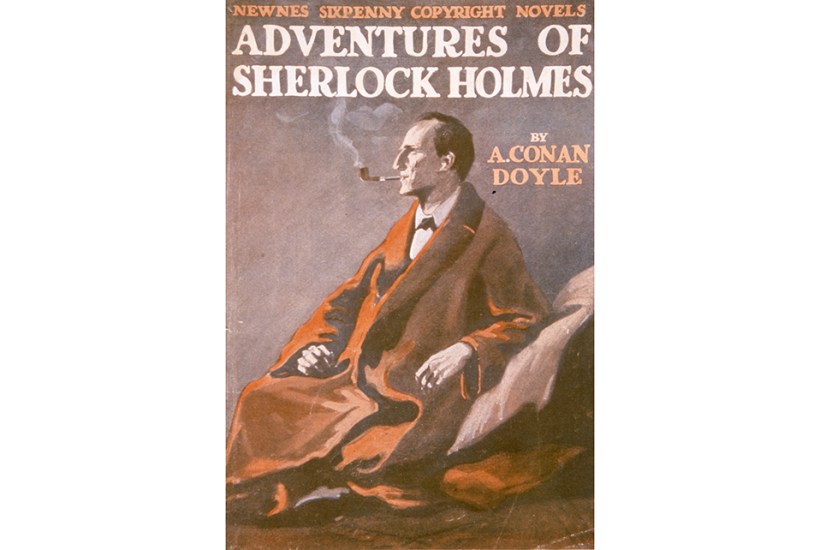
The podcast audio-drama Sherlock & Co. is an updated version of Sir Arthur Conan Doyle’s stories in which the great detective is neurodivergent and gay, Dr Watson is a millennial who preaches against ethnic stereotyping, Lestrade is a woman who speaks with a Caribbean twang, and the society gossip Langdale Pike has morphed into a drag queen. Throw in the fact that it’s produced by Gary Lineker’s Goalhanger and you might imagine that we’re talking about a woke brew designed to repel conservative Holmesians like me.
Actually, Sherlock & Co. is my favourite podcast ever. I love it almost as much as Conan Doyle’s ur-text and infinitely more than the BBC’s Sherlock, which began well but then disappeared up its smug backside. In the past three years, author Joel Emery has reinvented 50 of the stories; by the end of next year he will have updated the entire canon, something never attempted before. But what matters is that he’s managing to combine imaginative daring with fidelity to the structure, if not the details, of the originals.
In Sherlock & Co. there is an extra occupant of 221 Baker Street. Sherlock (Harry Attwell) and John (Paul Waggott) share rooms in flat B, as in the canon; flat A serves as the offices and home of the detective agency’s Spanish business manager Mariana (Marta da Silva). Their three-way banter is delicious – and flows astonishingly well, given that Waggott records everything from his home in New Zealand – but it would die on the page if I transcribed it. You have to listen. The juxtaposition of humour and horror is startling. As Holmes and Watson pad up the stairs of the mansion belonging to the snobbish blackmailer Charles Augustus Milverton, Watson surveys his gallery of photos with celebs and says: ‘Most people would hide pictures of themselves with Ghislaine Maxwell.’ Five minutes later we hear a knife being twisted clockwise in Milverton’s stomach. The series director, Adam Jarrell, is merciless with death-related special effects: you’ll wish you could unhear the cracking of a skull in ‘The Empty House’.
If I had to single out a story to illustrate Emory’s skills, it would be ‘The Abbey Grange’. In Conan Doyle’s version, a sadistic toff is found in his country house with his head smashed in. Sherlock & Co. transplants the story to an old folks’ home. The victim is a fragile octogenarian and only at the end do we discover the symmetry between the narratives of 1904 and 2025. Again, the death is horrible but the dialogue sings. Watson’s gentle teasing of the home’s deaf or demented residents is perfectly judged; Holmes, psychologically incapable of empathy, immediately loses patience.
The detective’s autism isn’t a fashionable accessory. Unlike the glancing references to homosexuality – which can’t be a big deal because Holmes never allows himself to be distracted by sex – it illuminates the classic Sherlock Holmes: his emotional coldness, weird obsessions and freakish arithmetical skills. Also, Emery refuses to treat mental health as a sacred cow. Sherlock’s gruesomely misjudged manner of breaking bad news to bereaved relatives is intended to be funny, and it is.
Not every episode is successful, but often that’s Conan Doyle’s fault. Sherlock and Co. is defeated by ‘The Mazarin Stone’, arguably the feeblest story in the canon, whose MacGuffin is Holmes pretending to be a wax dummy of himself. But successes far outnumber failures, thanks not only to Emery’s lateral thinking but also to virtuoso voice-acting. I would never have guessed that the psychotic Devon gamekeeper Barrymore in ‘The Hound of the Baskervilles’ was also the social-climbing lawyer Hector McFarlane in ‘The Norwood Builder’ – but the real surprise was the identity of the actor: the social historian Dominic Sandbrook, co-presenter of The Rest is History.
Sherlock & Co. is my favourite podcast ever. I love it almost as much as Conan Doyle’s ur-text
So far Sherlock & Co. has had 25 million downloads and its success has led to the creation of Goalhanger Drama, whose new show Bear Hunt hit the top of the UK fiction charts. There are plans for Sherlockian spin-offs featuring Lestrade and Holmes’s brother Mycroft, depicted by Emery as a narcissistic James Bond rather than Conan Doyle’s obese mandarin. But what will happen to Sherlock & Co.? Earlier this month, Dead Man’s Hand, a Holmes mystery starring the podcast regulars, was staged at the Southbank Centre; Waggott flew 11,500 miles to be there. It sold out within an hour. Emery’s script was as pointed as ever, the plot ingeniously twisted – and it was entirely original. So fans can relax. After the last of Conan Doyle’s 60 Sherlock Holmes stories is dispatched at the end of 2027, the game will still be afoot.
Got something to add? Join the discussion and comment below.
You might disagree with half of it, but you’ll enjoy reading all of it. Try your first month for free, then just $2 a week for the remainder of your first year.