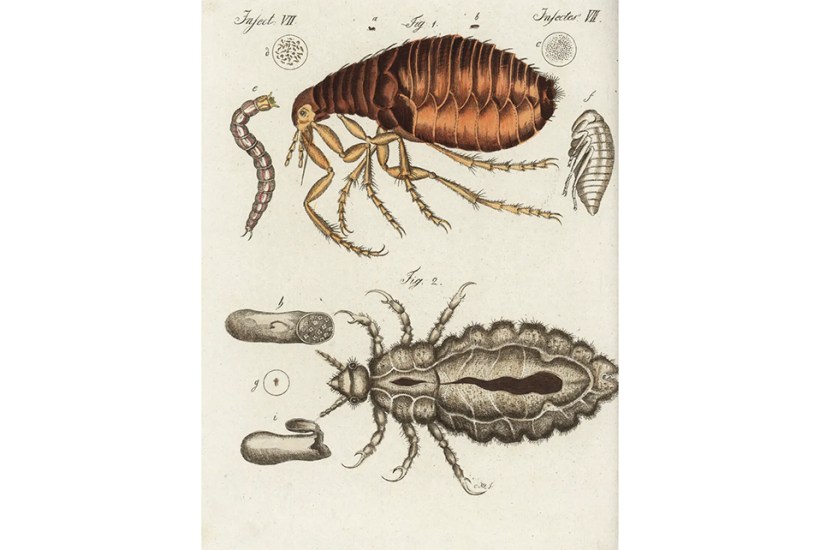
The oldest surviving sentence ever written in the first alphabet is inscribed on an ivory comb found in the ruins of the Canaanite city of Lachish in what today is Israel. Dating back around 3,700 years, it offers the owner a blessing of sorts: ‘May this tusk root out the lice of the hair and the beard.’
As Dino J. Martins points out in his marvellously entertaining tour of the netherworld of parasites, the comb (the design of which is almost indistinguishable from the plastic ones we use for the same purpose today) speaks of the depth of the human relationship with lice – creatures that have travelled with us, fed on us and multiplied with us for millions of years.
Martins is the perfect guide. An entomologist and evolutionary biologist, he is a professor at New York’s Stony Brook University and a former director of the Turkana Basin Institute and Mpala Research Centres. He is also, as Hidden Creatures makes clear, really, really into parasites. His love of his native Kenya, and Africa more generally, suffuses the book, which is filled with often ecstatic descriptions of the African landscape and the myriad forms of parasitic life that teem within it. But it is undergirded by a principle he learned from his primary school teachers: pay attention to details.
In writing about the natural world, noticing is not merely good reporting, it is an ethical act. To observe and then capture in words is to bring forth the unseen, to make the complexity of the world around us manifest. And Martins does this beautifully. The following is a description of an elephant carcass in Tsavo being devoured. There is a ‘sound: a soft, steady, rasping hum, the sound of… millions of maggot mouths… scraping and slurping’. Stripping back the hide reveals ‘a boiling cauldron of maggot stew that undulates in steamy waves. Annoyed… by the exposure to the hot, bright sunshine, the maggots squirm about and shimmer within a rainbow patina of digestive juices.’
Although the narrative occasionally groans under the cumulative weight, this delight in detail is part of what makes Hidden Creatures such a joy. As Martins careens through the mind-boggling diversity of parasites, he delivers a seemingly endless array of eye-popping facts. There are more than 10,000 species of tapeworm known to science, ‘sprinkled across a smorgasbord of hosts’ that range from fish to birds, reptiles, humans and other mammals. The tapeworms vary in size from a couple of centimetres long, that live in the bellies of shrews, to ones that can grow to 40 metres, that inhabit sperm whales and produce around 700,000 eggs a day that are released into the ocean in the whale’s excrement. (Seals are also popular hosts for tapeworms: on average the guts of Weddell seals contain 1.3 million.)
Birds are hosts to multiple species of chewing lice, which have evolved from the lice that once infested the bodies of dinosaurs. These are adapted to thrive on different parts of birds, so that those that live on their heads and necks tend to be a different shape to the ones that live on their bodies, since they do not have to survive the attentions of preening beaks. Bedbugs seem to have jumped from bats to humans before hitching a ride out of Africa with Homo erectus around 1.9 million years ago.
The mind-bending complexity of the life cycles of many parasites is similarly extraordinary. The larvae of the truly disgusting eye worm, which live in the eyelids, orbit and membranes of the eyes of various mammals (including, I’m sorry to say, humans), swim out of the eye in tears. They are then lapped up by flies; and once inside the flies, they burrow through their bodies to the testes or eggs, where they develop into a new larval stage. This then migrates to the head of the fly, so that the next time it lands on an animal to lap its tears they can swim up into its eyes and begin the cycle again.
The larvae of the truly disgusting eye worm swim out of the eye in tears
While Martins is keen to recalibrate our attitude to parasites by highlighting their diversity and adaptability, he is equally clear about their negative impacts. Parasites cause untold misery – from the horror of the guinea worm, which, after growing to a metre in length in the intestines, migrates out into the body and slowly emerges through the skin over the course of several days; to the river blindness caused by a worm, spread by blackflies, that still afflicts millions of people in parts of Africa; to mosquito-borne malaria, which has killed more human beings than any other disease in history.
As the spread of the house flea, which was carried to Europe from South America on Spanish and Portuguese ships, or sleeping sickness, which expanded across Africa on the coat-tails of the slave trade and colonial wars of conquest, make clear, commerce and colonisation have helped disperse many of these parasites and diseases. And, unsurprisingly, in many instances the prevalence of preventable diseases caused by parasites maps onto the legacies of inequity left by colonialism.
Today it is environmental change that is driving the spread of parasites. As the planet heats up, mosquito-borne diseases such as malaria, Ross River fever, the Usutu virus and dengue fever are reaching new areas. Nonetheless, for Martins the question of whether we can, or even should, try to eliminate parasites is complex. Although eradicating diseases alleviates misery, it also throws up new challenges. Studies suggest that a lack of exposure to microbes and parasites in childhood increases our susceptibility to allergic and autoimmune diseases. And the more we learn about the microbiome that surrounds and permeates our bodies, the more it seems our health depends upon immersion ina diverse ecosystem. Seen through this lens, the seemingly inexhaustible diversity of parasites is not a threat but rather a reminder of the deep, resonant interconnectedness of the world around us, which we ignore at our peril.
Got something to add? Join the discussion and comment below.
You might disagree with half of it, but you’ll enjoy reading all of it. Try your first month for free, then just $2 a week for the remainder of your first year.