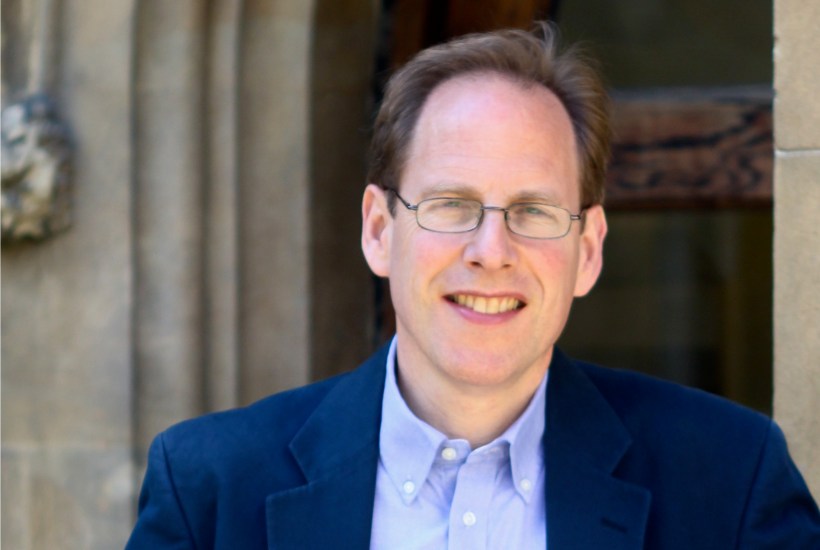
In an academic world where scholars regret seeing their cherished theories vanish into the knacker’s yard, Sir Simon Baron-Cohen is unusual in wishing people would retire one of his best-known coinages.
He may have his work cut out in trying to push back against the popularity of the term he coined in a culture now awash in woozy autistic patter
Baron-Cohen, one of Britain’s best-known autism experts, says he now regrets the language of his ‘extreme male brain’ theory of autism. He now thinks it may have caused as much bother as good in influencing how people talk about the condition.
This is not because of the underlying science, but because the specific words themselves have proved ‘open to misunderstanding’. The phrase he came up with is now ‘too broad to be useful’, he tells The Spectator.
The soft-spoken clinical psychologist’s change of heart arrives just as the research centre he founded in 1997 is being handed a record-setting new dollop of money.
Cambridge University this week announced a £26 million gift from a US philanthropist to establish the K. Lisa Yang Centre for Autism Research, along with a dedicated autism hub at a children’s hospital in Cambridge. Baron-Cohen will help oversee both ventures. Much of the new money is earmarked for looking at why autistic people have generally poorer health and shorter lives.
Baron-Cohen first set out his famous theory in his 2003 book, The Essential Difference: Men, Women and the Extreme Male Brain, drawing largely on journal work he had published the previous year. In it, he postulated that the capacity for empathy is the critical dividing line between men and women, and between those who are autistic and those who are not.
In this account, autism could be thought of as a guy thing: an expression of what he termed the ‘extreme male brain’. Baron-Cohen has previously hypothesised that this might be exacerbated in the womb by a super-dose of foetal testosterone. It is now widely accepted that autism has a genetic basis, which Baron-Cohen’s centre has attempted to pin down, as well as investigating the hazier role prenatal steroid hormones may play in, for example, the fact some autists find it agonisingly difficult to sustain eye-contact.
Unlike much of the conversation around autism since it was first described by the American child psychiatrist Leo Kanner in 1943, Baron-Cohen’s idea travelled far beyond academia, crossing the Atlantic and seeping into the popular culture. It even surfaced more recently in discussions about trans people. Popular awareness of autism has surged over the same period, buoyed by figures suggesting its prevalence is far wider than was once supposed.
In Kanner’s time, this ‘extreme aloneness since the beginning of life’ – characterised by repetitive, frequently weird behaviours and iron-walled social detachment, including in some cases profound communication difficulties – was thought to affect fewer than one in every thousand children. The latest numbers suggest more than one in 50.
Even 20 years ago, however, Baron-Cohen’s theory had its detractors. Martha R. Herbert, a neurologist at Harvard Medical School, said at the time she did not think it explained everything, or possibly not anything much at all. Although she was willing to entertain the idea that a testosterone-soaked male brain was a factor in causing autism, she said the scientific argument had yet to be made for it being a prime cause. The late G. Robert DeLong, a professor of paediatrics at Duke University, considered the thesis ‘somewhat facile’. But ‘it’s provocative,’ DeLong cheerfully conceded.
Baron-Cohen is no stranger to provocation. His then-startling ‘mindblindness’ thesis, first put forward in the 1980s, also attracted attention for suggesting that autistic people have a reduced ability to attribute thoughts and intentions to themselves and others.
Now though he’s the one issuing qualified caveats. ‘Language changes not just in psychology but in society,’ he explains, rattling off a list of other terms that were once standard medical nomenclature, such as imbecile, moron and idiot.
‘Language changes, but the concepts those words were based on, such as IQ testing, are still valid today. Even when I was publishing in the 1980s and 1990s, we would say, “We’ve got the autism group and then we’ve got the comparison group. We called the comparison group “normal”. But we would never use that word now.’
Even still-voguish words such as neurodivergent make him uncomfortable. ‘Who is this so-called “neurotypical” person?’ he asks, with a slight frown.
He may have his work cut out in trying to push back against the popularity of the term he coined in a culture now awash in woozy autistic patter. It is almost a cliché in 2026 to speak of someone being ‘on the spectrum’ for no better reason than that he, or rather less commonly she, is a bit nerdy. The concept has also surfaced in the culture wars, where the idea of being in the ‘wrong’ body – and brain – continues to receive plenty of airtime.
‘I am not sure when it started,’ he says of the sudden intersection between the sociosexual and the malady on which his work has focused for the past 40 years.
‘Maybe it was around 2010 or 2012, when something that used to be thought of as quite rare – transsexualism – suddenly seemed much more visible, with children saying, “Please don’t use those pronouns because I don’t identify with the gender I was assigned at birth.”’ Still, he notes that recent studies have suggested autistic people are six times more likely to identify as non-binary. ‘That was not really known when I wrote the book in 2003. And it is a big question: why do we see that overlap between autistic people and the likelihood of being trans or gender non-binary?’
Simon Baron-Cohen looks forward to applying his not-so-extreme male brain to that unresolved puzzle, too. But he’ll be pulling his linguistic punches from now on.