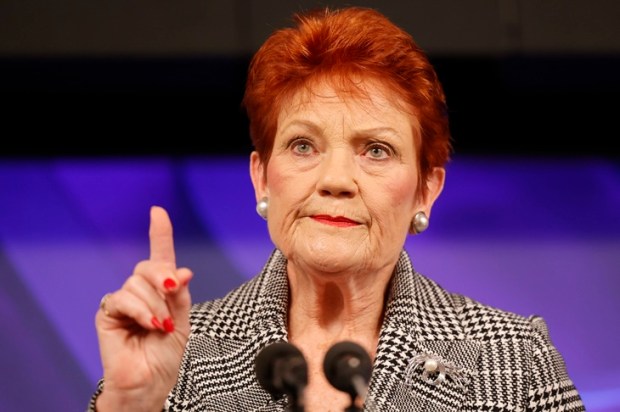
Never did I expect to see the cultural consensus of our time enforced so completely until I watched even members of the Liberal Party – the party that claims to stand for free speech, robust debate, and freedom of thought – join the cacophony against Pauline Hanson’s call for a recognisable Australian ‘monoculture’.
The reaction was near-uniform across much of the political and media spectrum: to suggest a nation might need a dominant cultural identity, or to criticise aspects of multiculturalism, is apparently to be branded a racist, a bigot, or a fascist. Paul Hogan, aka Crocodile Dundee, even referred to Pauline Hanson as a ‘pelican’.
This is what cultural hegemony looks like. A worldview completely dominated by a proscribed narrative. A narrative that has become so embedded in universities, media, peak bodies, and segments of the political class that the response is almost uniform, that is cultural hegemony. It shapes what counts as ‘common sense’. And common sense, as we know, does not necessarily mean good sense. It simply means a set of assumptions have become so dominant they feel like the natural order of things.
Antonio Gramsci, the Marxist thinker, would be proud. He developed the theory of cultural hegemony as a tool for the communists to challenge and overthrow the existing capitalist and Western power structure. And it seems they have done just that. Today, post-modern ideas about relativism and multiculturalism have become so dominant that they are now the prevailing ‘common sense’ – the very thing Gramsci described. So much so that even to question it is treated as illegitimate.
This is where Australia finds itself. In just the last three years, Australia has absorbed 1.27 million people through net overseas migration, with a record 536,000 arriving in 2022-23 alone. At this scale, one would expect serious public debate about whether newcomers are joining and being absorbed into a recognisable Australian culture. But instead, the older notion that migrants came to Australia to join a national culture grounded in democratic values, the rule of law, religious freedom, economic opportunity, and a basic commitment to Australia has simply vanished from legitimate discussion.
For decades, key institutions promoted postmodern cultural relativism: no absolute truths and no culture legitimately superior to another. In theory, multiculturalism celebrated this quasi-equality. In practice, migrants were still expected to integrate into a broadly Anglo-Saxon Protestant Western inheritance. As Tony Abbott puts it, Australia has ‘an Indigenous heritage, a British foundation, and an immigrant character’ and the great thing about the millions who have come here is that ‘they have come to join us’.
That older model has now been replaced by outright cultural inversion. The historic Australian (and broader Western) culture is framed as the problem – something to be shunned, diluted, or held at arm’s length. Other cultures arrive with a presumption of moral superiority or immunity from scrutiny. Australian norms bad, migrant cultures good by default. The popular ‘progressive’ slogan, ‘Will trade racists for migrants!’ plastered on stickers, T-shirts, mugs and artwork, says it all.
Pauline Hanson’s recent comments on the need for an Australian ‘monoculture’ made the inversion dynamic abundantly clear. Whether you agreed or not, the response was not engagement or counter-argument. It was immediate ritual condemnation. The very suggestion that some cultural practices might not be good for Australian society was treated as racism, bigotry, living in the past, outrageous, divisive, irresponsible – need I go on. That is how cultural hegemony operates: it does not merely disagree; it declares the question itself illegitimate. Even senior figures across the political spectrum, while rejecting extreme ideologies, still framed any serious critique of multiculturalism as too extreme. As if Australian culture were not legitimate to defend.
This is the same mindset that leads the media to routinely reframe serious questions about crime patterns or cultural attitudes in certain migrant communities as mere ‘complex social issues’ or individual cases not illustrative of a broader pattern. Cultural hegemony encourages this softening. It doesn’t need to win an argument. It simply has to become the common sense that quashes debate before it starts.
Even in education and public broadcasting, the inversion is openly promoted. A recent segment on the ABC program Stuff the British Stole invited high school students to redesign the Australian flag without the Union Jack to make it ‘more inclusive’ and ‘multicultural’. This is the exact inversion: British inheritance is removed without question and replaced with something deemed morally superior. The preceding Western culture is falsely treated as embarrassing and to be apologised for because it is insensitive and lacking compassion for people of differing backgrounds.
This is the victory of the Left’s cultural hegemony. It isn’t that everyone agrees – it is that to disagree makes you sound irrational and intolerant. It is why the debate about monoculture and Pauline Hanson is immediately cast as irrelevant and inferior. And once a society reaches the point where defending its own core culture is treated as extremism, hegemony has done its job.