Politicians love banning things. Even if the threats they worry about don’t actually exist.
In February 2019, amid Conservative defections and the slow death of Theresa May’s Brexit deal, Conservative MP Bill Wiggin decided that the most pressing task for parliament was banning the consumption of dog meat. Not meat for dogs, but meat made out of dogs. And no, you are right, you don’t get it at the deli counter at Waitrose. Or indeed anywhere in the UK.
Wiggin was honest enough to admit there was no actual evidence that dog meat was being eaten in the UK. And he acknowledged that it was already illegal to sell dog meat for human consumption. But that, he told the House, shouldn’t stop us from ‘setting an example to the world’.
The same logic must have been running through this government’s mind when, last week, during a leadership crisis, it decided that the best way to regain the public’s favour was to publish a draft bill to ban what it calls ‘conversion practices’.
Ostensibly this is a compassionate measure to counter persecution. No one who is gay should be subjected to cruel attempts to neutralise or change who they are attracted to. Who could object? There’s just one problem: no one has been able to find any actual systematic evidence of gay people being compelled to disavow their sexuality. Gay conversion therapy is no more of a problem in this country than the sale of tinned labrador.
Gay conversion therapy was a problem in the past, but that was well before the recent advances in equality. In 1918, Austrian endocrinologist Eugen Steinach claimed testicle transplantation could eliminate homosexual impulses. In 1952, Alan Turing was convicted of ‘gross indecency’ for being gay and was chemically castrated. In the 1960s, some patients were subjected to electric shock therapy in NHS hospitals while others were treated with nausea-inducing drugs in an attempt to change their sexual orientation.
These practices were horrific. They are no longer used in medicine and, crucially, they are already illegal under current criminal law. In addition, civil legislation provides protection against other, non-medical, conversion practices.
Last year, in an extraordinary and rare case, a gay man who underwent an ‘exorcism’ to rid him of the ‘demonic possession’ of homosexuality at St Thomas, Philadelphia church in Sheffield received an out-of-court settlement. Exorcisms to banish the demons of sexual attraction are about as common these days as sightings of griffins in the wild. But even they fall foul of the law. The individual was able to bring a tort of intentional infliction of psychiatric injury against the church – demonstrating there is already a legal basis for prosecuting conversion attempts in religious settings.
So why, after the legalisation of gay marriage and the Equality Act, in a world with wide-reaching protections for gay people, have calls for a conversion therapy ban erupted over the past decade?
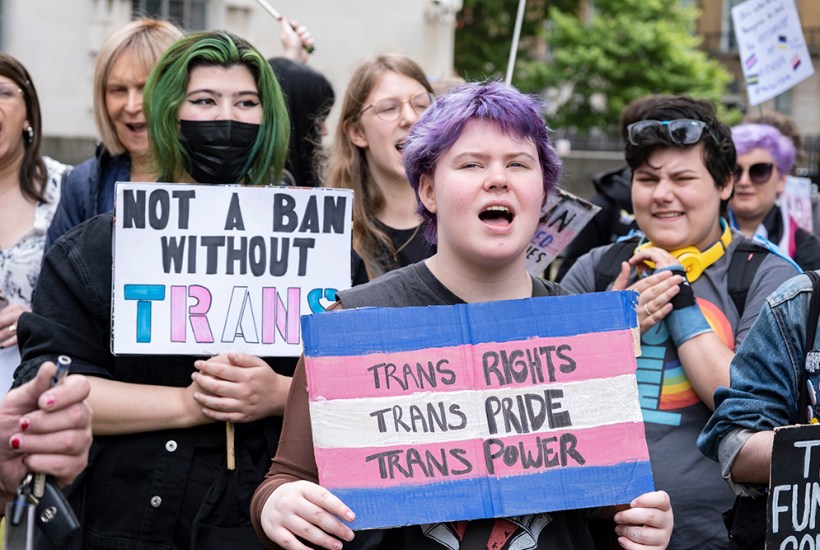
It is actually nothing to do with gay rights at all. It is another attempt by the trans lobby to hijack support for sexual equality to prevent any questioning of their desire to use medical means to surgically alter young men and women. After all, when Boris Johnson considered an original ban on gay conversion therapy practices, numerous campaigning groups including Stonewall, Mermaids and the LGBT Consortium objected because the legislation wasn’t ‘trans inclusive’. They wanted a law not to protect vulnerable gay teenagers, but a law which made it more difficult to protect vulnerable ‘gender–questioning’ teenagers from mutilation.
The ‘conversion therapy’ they want to ban is the sharing of basic facts with children who are considering life-altering medication and surgery. They want to make it more difficult to dissuade teens from taking the puberty–blocking drugs or undergoing the surgery that could render them infertile or traumatised. Campaigners are not seeking to prevent medical abuse – they are trying to make questions about the validity of transgenderism illegal. This is why so much of the ‘evidence’ that conversion therapy exists in the UK rests on the findings from a report by Galop, an LGBT anti-abuse charity, which claims that 43 per cent of trans-identifying people have been subject to conversion practices.
Except the cases in this report are overwhelmingly not conversion therapy as most would recognise it. They include a respondent who says, ‘I told my parents that I wasn’t agab [assigned gender at birth] when I was a child and they told me I was wrong and stupid’; someone who claims that a ‘family member limited internet access so [I] wasn’t able to see anything relating to my sexuality’; and a person who ‘was actively told by a friend… that I wasn’t really trans and that I was doing it for the attention’.
They want to make it more difficult to dissuade teens from taking puberty-blocking drugs
One individual says they were ‘encouraged to subscribe to a “porn addiction” online service called Fortify and met regularly with an accountability partner to see whether I was viewing pornography or masturbating’. This is not conversion therapy. Homosexuality is obviously not a mental illness. But porn addiction is recognised as a compulsive sexual behaviour disorder. Do campaigners really want to introduce a ban so all-encompassing that services treating pornography addiction are criminalised?
The government’s draft bill provides a loose and wide-ranging definition of ‘conversion practice’, as any conduct with the intention of causing the individual to have or not to have (or to believe they have or do not have) a particular sexual orientation or transgender identity. Anything that causes ‘serious alarm or distress to the individual which has a substantial adverse effect on their usual day-to-day activities’ could be an offence.
Children are not known for proportionate reactions. If a child experiences ‘serious alarm or distress’ because their parents won’t enrol them in the puberty blocker trial, is that a conversion therapy offence? What if a therapist upsets them by asking whether their autism could be contributing to their gender distress? What if an adult refuses to use their colleague’s preferred pronouns, or a wife tells her husband she does not want him to transition? Would that be an offence if it caused ‘serious alarm or distress’?
Maya Forstater’s case established that gender-critical views are protected in law. The Cass Review advised that affirmation is not always the right course of action for children experiencing gender distress. The Supreme Court judgment confirmed that ‘sex’ in the Equality Act was biological. Having lost these fights, activists have now turned to a last resort: a conversion therapy ban which will outlaw any criticism of the transgender religion.
The tragedy is that none of this will tackle the form of conversion therapy which still persists in Britain: telling same-sex attracted children they can grow into straight adults simply by ‘transitioning’.
Got something to add? Join the discussion and comment below.
You might disagree with half of it, but you’ll enjoy reading all of it. Try your first month for free, then just $2 a week for the remainder of your first year.