
There were many reasons why 2016 was a strange year. One of them was the halfhearted effort by people on both sides of the Atlantic to try to understand why voters had voted the ‘wrong’ way in the Brexit referendum and the US presidential election.
The book that was touted as an explainer for all of this was Hillbilly Elegy, a memoir by someone called J.D. Vance about his upbringing in rural Ohio. After the election of Donald Trump, Vance’s description of family breakdown, de-industrialisation, poverty and drug abuse was said to explain why so many Americans had voted for Trump.
There was much that was patronising about all this – mirrored in France by the attention paid to Didier Eribon’s Returning to Reims. The presumption in both cases seemed to be that since the people described in these books were the sort that ‘people like us’ never met then ‘we’ should at least make some effort to try to understand ‘them’.
When I read Hillbilly Elegy I was impressed by its skill, but distrustful of the weight that had already been placed on it. The book did not ‘explain’ Trumpism. In any case, at the time the author was careful to distance himself from Trump and even criticise him.
As a politician, he struggles at times to reconcile his faith with his politics. But he is frank about this
I mention all this only because the author of Hillbilly Elegy has now produced a follow-up book. In the decade between the two books he has, of course, moved from being a successful author to a senator for Ohio and now Vice-President of the United States.
After reading Communion: Finding my Way Back to Faith, one of the things that is already clear is that this book is unlikely to be treated in its own right. In recent days, its author has done the circuit of book-promotion chatshows in the US. But from The View to Bill Maher, he hasn’t really had a chance to talk about the book. He has been grilled on his relationship with Trump, ICE raids, 2028 and much more. But barely an interview has focused on the book he has just published.
If Hillbilly Elegy had too much weight put on it, Communion is at risk of having too little. Which would be a shame because it is an important, deep and moving work about some of the most important issues of any time. Like its predecessor it is a memoir, but also a meditation, specifically one on losing faith and regaining it. Vance’s account of losing his faith will be familiar to many people. Leaving home for college took him away from his community of meaning. Bad things happened to people he loved and to people he didn’t even know and he lost any faith in a benevolent god. He lost not only belonging but belief.
His description of how he found his way back to both – and realised that the two are interwoven – is artfully done. Vance explains the intellectual journey he went on to head back to faith, changing the ‘rationalist’ path on which he had been comfortably heading. The works of René Girard, C.S. Lewis and others saved him from the slough of Ayn Rand, as did a reading of the early church fathers.
This in turn led him to question the validity of the elite opinions he was surrounded by. What does it mean to lead a good life? Is it the amount of material wealth you have or the fact that you clerked for a Supreme Court Justice that matters? Or are there things that matter more?
Of course, conversion stories are rarely just a matter of intellect – they are also matters of the heart, and Vance’s is no different. Having got out of the poverty that had blighted his family, he started to recognise that he was on a treadmill of his own. After graduating from Yale and studying for the sake of having a valuable law degree, he had to start wondering again what it was all for. After falling in love with his future wife, Usha, at Yale, he started thinking about fatherhood and that most crucial question of all: ‘How should we raise the children?’ What does it mean to be a good man and a good father?
Vance is more honest than any politician has to be about the fears he felt ahead of marriage and fatherhood. Specifically, he talks about his fear that some of the problems in his own family might rear up: that some bad blood would come out through him. He is also honest about how the Christian faith addressed and healed some of those fears.
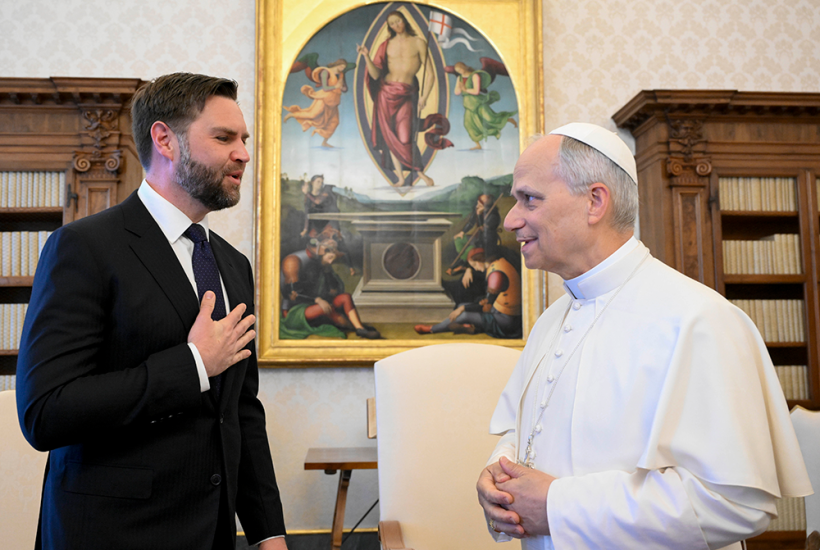
He lays out clearly why the Catholic Church was the home for him, while making more than a few nods to the inevitable reader objections, including clerical abuse scandals. Once he has become a politician, he struggles at times to reconcile his faith with his politics. He is frank about this – not least when it comes to the platitudinous things that the leaders of the churches say about migration vs the downsides that such platitudes often lead to. He even talks about his respect for Pope Francis.
I have to say that I approached Communion with some trepidation. Conversion memoirs – especially Catholic conversion memoirs – have a tendency to be simplistic or strident. In my own view there are few horrors in nature worse than a recent Catholic convert. Always best to keep away for a while and come back to them in a few years once they’ve calmed down a bit.
Perhaps because he is married to a woman who was raised by Hindu parents, or because he has never lost sight of the people and place he came from, Communion never strikes that chord. In fact, the most moving parts of the book – towards its end – reflect an old and deep form of faith that sees the bare ruined choirs (especially in Britain, it should be noted) and the fear that this generation should not be the one that allows them to collapse entirely.
I doubt many people will come to Communion with an open heart or an open mind. But they should.
Got something to add? Join the discussion and comment below.
You might disagree with half of it, but you’ll enjoy reading all of it. Try your first month for free, then just $2 a week for the remainder of your first year.