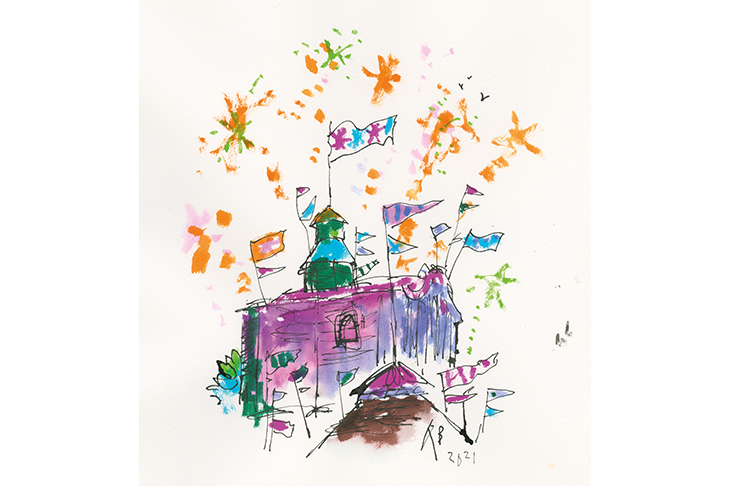
In the artistic pecking order, illustration long languished behind what were seen as the fine arts, even though it was the one art form that most of us would come across every single day. Not unrelated to the status issue, illustration came to be regarded as art for children, young children at that.
In the 19th century adult books would be routinely illustrated (Dickens’s illustrators such as Phiz were as much a part of the deal as the novels themselves), but in the 20th the field gradually narrowed. Still, up to the 1970s, even books for teenagers as a rule had pictures. Now, apart from graphic novels, they’re mostly confined to cartoons for the tiny tots.
Yet illustration remains a form that we encounter as soon as we see a book, which means that the artists have a hold on our emotions in a way that many others don’t. Off the top of our heads, most of us can reel off our favourites: Ronald Searle, Ernest Shepard, Edward Ardizzone, Arthur Rackham, Edmund Dulac, Aubrey Beardsley, Tove Jansson, Daumier… How long have you got?
Granted, Chris Beetles Gallery in St James’s gives addicts a regular fix with his annual show. And there are occasional exhibitions on particular illustrators. But as a genre, illustration has struggled for a place in the sun, though in France, it’s regarded very differently.
When I wrote about the dearth of pictures in books some years ago, Quentin Blake observed that ‘there’s a feeling it’s not quite grown up to have pictures’. Posy Simmonds, a peerless illustrator for adults, agreed: ‘There’s a sense that pictures are something you grow out of.’
All that may change now with the opening of the Quentin Blake Centre for Illustration, just round the corner from Sadler’s Wells in Clerkenwell. It’s housed in a former historic waterworks complex – lots of lovely brickwork – converted by architect Tim Ronalds at a cost of £12.5 million. Previous possibilities for the location had included Somerset House, but this site has a character of its own. The former Engine House now holds the big public library of illustration and the Boiler House is a light-filled café overlooking the gardens. London’s oldest windmill, meanwhile, is a temporary exhibition space.
The café has a big blue frieze by the great man called ‘A Bridge to the Past’, viz. a bridge being traversed by people from various periods, all characterised by the cheerfully anarchy that is Blake’s reflex mode. There are three galleries for exhibitions – which might have a contemporary illustrator, a more general exploration of the form and on the upper deck, always a display of some of Blake’s enormous archive.
To show that illustration isn’t just for the little ’uns, one of the opening exhibitions is Queer as Comics, curated by Paul Gravett, with, yep, gay comics and comic strips by homosexual artists from the past 80 years, right up to contemporary graphic novels. One that is not obviously sexual is by Tove Jansson from her little known comic strip for the London Evening News in the 1950s; others are more overt… There are the gay cowboys with slim hips by Tom of Finland, and Dave Richards’s shriekingly camp James Bond spoof from 1969, Boldfinger, the ‘randy dandy with the handy-pandy’ from 1969’s Jeremy magazine. It’s hard not to feel that the usual expectations about illustration are being subverted from the off.
Another gallery features the riotously colourful work of the Sri Lankan artist Murugiah, with psychedelic colour and surreal and explosive imagery. It’s what those of us with sheltered lives might fancy an acid trip must be like. It too challenges the notion that illustration is all about children’s classics – though they will be there too.
The Centre will usefully help extinguish the vestigial snobbishness about the applied arts
In the upper gallery – bright and sunny, with coloured walls and images hanging from the ceilings – which is devoted to Blake, the theme for the current display is ‘Performance’. So there’s not much from his collaboration with Roald Dahl, apart from some pictures from The Enormous Crocodile – again, expectations are subverted. Instead the pictures remind us that his work has been as much for adults as for the Dahl contingent; he did some illustrations for Apuleius’s Golden Ass, for example, which are pleasingly filthy.
Indeed, he started in 1951 illustrating theatre reviews for Punch, covering for Ronald Searle. There’s one here from 1959, a charming depiction of A Midsummer Night’s Dream, and a very Searle-ish drawing of Laurence Olivier in The Entertainer. Don’t miss his spiky illustrations for Macbeth (see below) with the cast depicted as birds – Lady Macbeth has a long, sinister beak – which work brilliantly. And check out his depiction of Waiting for Godot, which you would have thought was beyond illustration – I mean, two men sitting around talking with nothing happening? – but it turns out it’s a lavender wash and Blake manages to evoke so much through tone. ‘What’s interesting is that you’re not illustrating a sequence of incidents like a normal narrative,’ he once told me. ‘What you’re doing is another production, effectively.’ There are some creepy drawings for Aristophanes’s The Birds, too. Blake read English at Cambridge, sitting at the feet of Queenie and F.R. Leavis; you can tell.
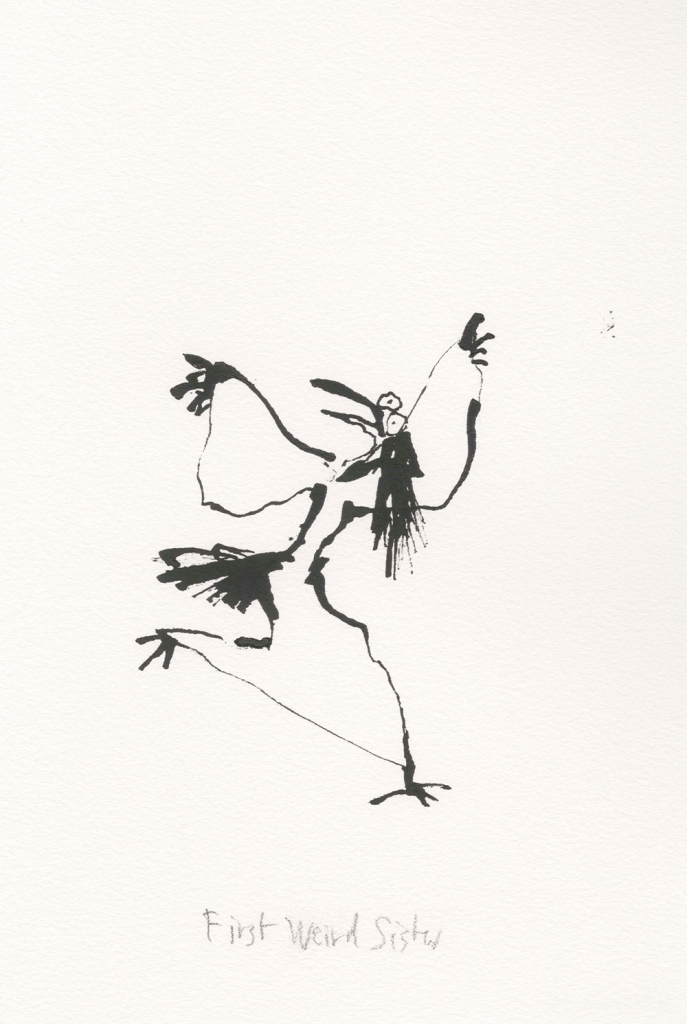 ‘First Weird Sister’, 2023, by Quentin Blake. © Quentin Blake
Among his earliest work were covers for The Spectator from 1959, and sometimes images for the books pages (his illustration for Kingsley Amis’s review of Lolita was a little girl with a big smile and pigtails). Perhaps in future exhibitions, we’ll see some of these, and his covers for Evelyn Waugh’s novels – he did them all.
The gallery is all the more needful because, like every other art form, the very foundations of illustration are threatened by AI. By one account, one in four illustrators has lost work to AI; bad illustrators, dispiritingly, are using it to do the donkey work of creating backgrounds and colouring (the term ‘hybrid creativity’ is shorthand for lazy art). There’s software such as Stable Diffusion that has access to vast databases of images and descriptive texts. It can analyse what techniques produce particular pictures – including the signature styles of various illustrators. You could probably feed it work from any illustrator – Mabel Lucie Attwell, say – and get it to produce any number of plausible chubby children in the style of the original.
Yet what real illustrators give us is an imaginative human engagement with a story or an idea. It may be possible to generate images in the style, say, of Searle, but it’s hard to imagine AI having the diabolical intelligence to think up of St Trinian’s and the humorous malice that made him give us little girls putting one of their number on a rack. I expect it won’t be long before the Centre for Illustration shows us the possibilities, and crucially, the limitations, of AI for illustration; humour will, I think, be one of those limitations.
The Centre will usefully help extinguish the vestigial snobbishness about the applied arts. (Blake, like Ardizzone, illustrated labels for drink bottles.) And it should also remind us of the importance of drawing in art schools as the irreducible basis for illustration – nowhere is bad draughtsmanship more evident than here.
Illustration is fundamentally a form of alchemy, a vital double-act between writers and artists, whereby a text plus pictures becomes greater than the sum of the parts. What would Alice have been without Tenniel, Dickens without Phiz or Cruikshank, Kenneth Grahame without Shepard? Bacon without eggs, that’s what.
Got something to add? Join the discussion and comment below.
You might disagree with half of it, but you’ll enjoy reading all of it. Try your first month for free, then just $2 a week for the remainder of your first year.