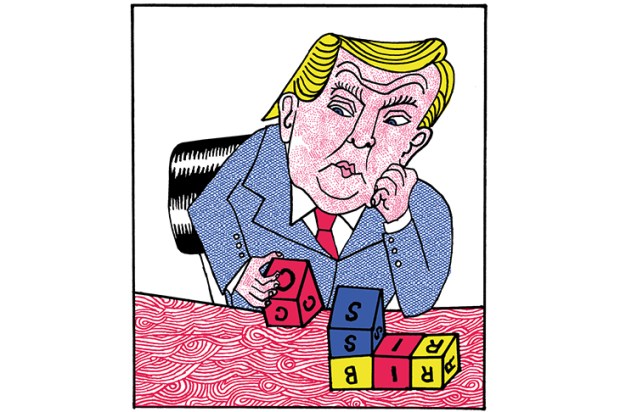
These are good times to be a scholar of the classical world. Last summer, Donald Trump issued an order that all federal architecture needed to be ‘beautiful’, noting that the Founding Fathers ‘wanted America’s public buildings to inspire the American people and encourage civic virtue’. George Washington and Thomas Jefferson had therefore ‘consciously modelled the most important buildings in Washington, D.C., on the classical architecture of ancient Athens and Rome’. It was time to go back to these principles, said Trump. From now on ‘classical architecture shall be the preferred and default architecture for Federal public buildings’ in the District of Columbia.
The Greek and Roman world still commands a special place in public consciousness, in other words, especially in the countries of the West. In his widely admired speech in Davos earlier this year, where he talked about the role of ‘middle powers’, Mark Carney talked about the fact that ‘it seems that every day we’re reminded that we live in an era of great power rivalry, that the rules-based order is fading’. It seemed a good time to quote Thucydides: ‘The strong can do what they can, and the weak must suffer what they must.’
War did not stem from competition between Athens and Sparta – but from other states causing friction
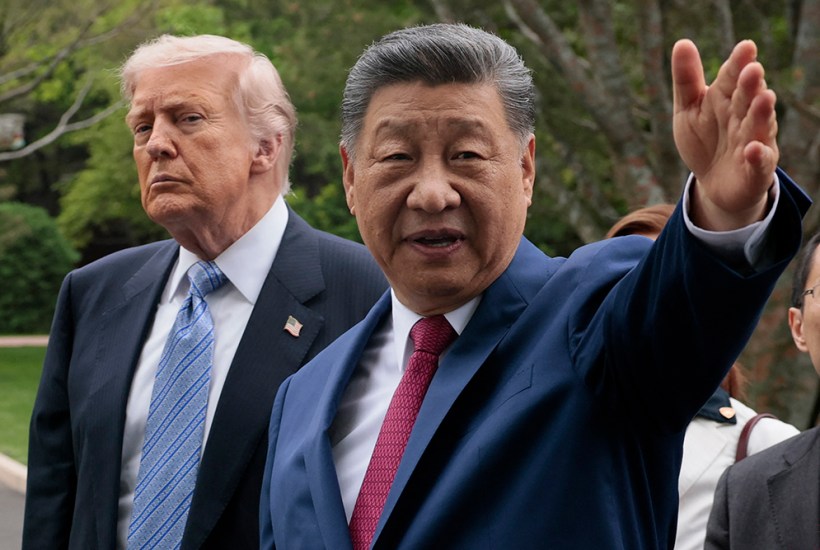
The Greek author is revered for his dedication to his art and for his good judgment. Nevertheless, it was still something of a surprise to see him cited by Xi Jinping, no less, when he met Trump in Beijing last month. ‘The world has come to a new crossroads,’ said the Chinese President. ‘Can China and the United States transcend the so-called “Thucydides Trap” and forge a new paradigm for major-power relations?’
This was a reference to the great historian’s comment near the start of his epic Peloponnesian War where he wrote that ‘it was the rise of Athens and the alarm that this instilled in Sparta that made war inevitable’ – although a more accurate rendition might be not that war was inevitable but that Sparta felt it had little choice. That has been worked up, most famously by Graham Allison at Harvard, into ‘the Thucydides Trap’, a paradigm used to explain a range of conflicts between major powers in the past when a ‘ruling power’ is challenged by a ‘rising power’.
The relationship between the US and China looks to some like a classic example – not least Xi himself, who has been impressed enough by the concept of the Thucydides Trap to invite Allison to meet him personally in Beijing to talk it through in more detail. Xi is taken with the model partly because it fits with his view – shared widely in China – that the country is rising and rapidly closing the gap with the US.
Not all are as enthused or convinced by the merits of the model of traps that inevitably snap. Scholars like Hal Brands and Michael Beckley, for example, have complained that the Thucydides Trap has become a ‘truism now invoked, ad nauseam, in explaining US-China rivalry’, and complaining that it is both far too simplistic and also over-deterministic about how the future might, or will, play out.
The main problem, though, is that the most interesting part of the story of why Athens and Sparta went to war and fought each other into the ground for the best part of 30 years is not that one was a ruling or rising power, or that they were fearful of each other. Athens and Sparta were rivals, for sure, with both wary of the other’s aims and motivations. But there was a glaring difference between their relationship and that of the US and China – namely that while the two cities were the dominant powers in what is now Greece, neither was the superpower of their day: Persia was. It was the intervention of the latter in 412 bc that settled matters decisively in Sparta’s favour.
Even more important, though, was the fact that war did not stem from the direct competition between Athens and Sparta – but resulted from the behaviour of other states that caused friction between the two. Athens and Sparta were dragged into confrontation by the ambitions and miscalculations of others. It was the agitations of the small, petty cities that lit the tinder that led to a war that cost countless lives and ended with the effective destruction of the Athenian empire. In today’s parlance, the ‘middle powers’ were the problem, not the solution.
The road to war had been building after Corcyra (modern Corfu) quarrelled with Corinth over the colony of Epidamnos. What began as a local dispute in 433 bc escalated when both sides sought allies. Corcyra appealed to Athens for support, arguing that if Corinth absorbed its fleet, the balance of power would shift dramatically. Athens agreed to form a defensive alliance with Corcyra, something which the Corinthians regarded as iniquitous.
Not long after, Corinth gave support to Potidaea, a small city that paid tribute to Athens, as a way of settling scores. This raised the temperature, since Corinth was a member of the Peloponnesian League and an ally of Sparta. It was a similar story when it came to Megara, a small town in Attica that also had close ties with Sparta. Under the direction of Pericles, Athens decided to use economic coercion, raising tariffs against the Megarians and excluding merchants from markets and ports across the Athenian empire. Then there was the attempted seizure of Plataea by the Thebans that again inflamed tensions and paved the way to war. The confrontation between Athens and Sparta was the result of multiple disputes involving comparatively minor cities that led competition to turn into open warfare.
If there is a Thucydides Trap, then, it should be less about ruling or rising powers than about the fact that these can get played off against each other. That, then, is the key risk to pay attention to when assessing relations between the US and China – namely that either or both could be dragged towards confrontation by the actions of others. History, of course, does not repeat; but it is worth keeping an eye on who might force the reshaping of the new world order, not least since the impulse may not come from Beijing or Washington but from somewhere in between.
Got something to add? Join the discussion and comment below.
You might disagree with half of it, but you’ll enjoy reading all of it. Try your first month for free, then just $2 a week for the remainder of your first year.