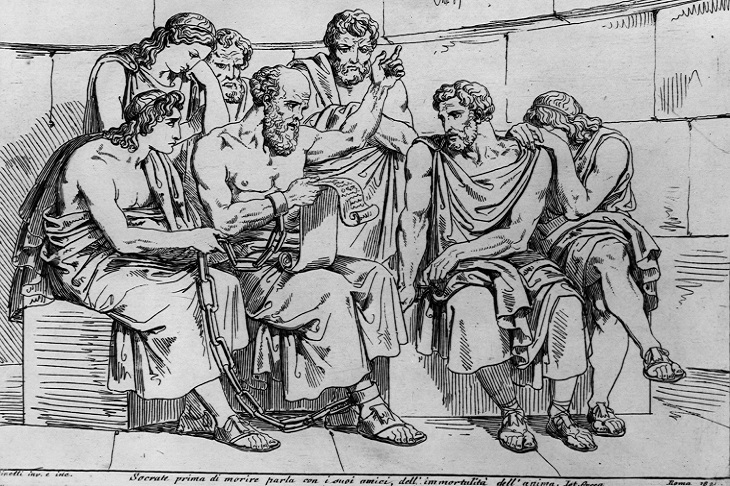
More than 2,400 years after his death, Socrates remains one of the most misunderstood figures in history.
Every few months, a quote circulates online claiming the great Athenian philosopher warned that democracy would destroy itself because ordinary people would choose comfort over truth. The story usually ends with a pointed observation: democracy then sentenced Socrates to death, proving his point.
It is a neat story.
It is also the wrong lesson.
The temptation is to see Socrates as a prophet, warning us about the dangers of popular rule. But the real lesson of his life is far more unsettling. Socrates was not executed because democracy failed. He was executed because human beings dislike being challenged.
That is a problem no political system has ever solved.
Kings dislike criticism. Bureaucrats dislike criticism. Experts dislike criticism. Democracies dislike criticism. The instinct is universal.
Socrates spent his life asking questions.
Not grand speeches. Not manifestos. Questions.
How do you know that?
Why do you believe it?
What if you’re wrong?
The questions sound simple. Yet they are among the most threatening words in any society.
Most people are comfortable defending their opinions. Far fewer are comfortable examining them. Socrates made a career of exposing contradictions, forcing people to confront the gap between what they claimed to know and what they actually knew.
Eventually, Athens tired of him. Not because he had all the answers, but because he kept asking questions.
History has repeated that pattern ever since.
We often tell ourselves that censorship is something imposed by tyrants. Sometimes it is. But societies frequently censor themselves long before governments become involved. Communities develop orthodoxies. Institutions develop taboos. Certain questions become impolite. Certain subjects become untouchable.
The pressure is not always legal. Often it is social.
The dissenter is mocked. The sceptic is dismissed. The person asking awkward questions is accused of bad motives. Before long, the argument is no longer about whether a claim is true. It is about whether it should have been raised at all.
That is when a society starts to lose confidence in itself.
Because the strength of an idea is not measured by how well it survives agreement. It is measured by how well it survives scrutiny.
This is where modern politics becomes interesting.
Across the Western world, trust in institutions is collapsing. Governments, media organisations, universities, and corporations all struggle to command the confidence they once enjoyed. The usual explanation is misinformation, polarisation, or social media.
There is truth in all those arguments.
But another possibility deserves consideration.
Perhaps people lose faith in institutions when institutions appear unwilling to question themselves.
Perhaps confidence declines when debate gives way to certainty.
Perhaps citizens become suspicious when complex issues are declared settled and legitimate questions are treated as evidence of ignorance, extremism or bad character.
The irony is that this tendency appears everywhere.
The populist convinced he has all the answers is no different from the technocrat convinced he has all the answers. The activist certain of his moral superiority is no different from the politician certain of his electoral mandate.
The danger is not democracy.
The danger is certainty.
Socrates understood this better than most.
His greatest insight was not a political theory but an intellectual one. The Oracle of Delphi supposedly declared him the wisest man in Athens. Socrates concluded that if this were true, it was only because he understood how little he actually knew.
That humility has become surprisingly rare.
Modern life rewards confidence. Social media rewards certainty. Politics rewards conviction. Yet history repeatedly demonstrates that societies advance not because people stop asking questions, but because they keep asking them.
The real lesson of Socrates is not that ordinary people should have less power. Nor is it that experts should have more.
It is that every society needs people willing to ask uncomfortable questions – and the humility to listen when they do.
Athens killed Socrates because it mistook certainty for wisdom.
More than two millennia later, that remains a temptation no civilisation has fully overcome.