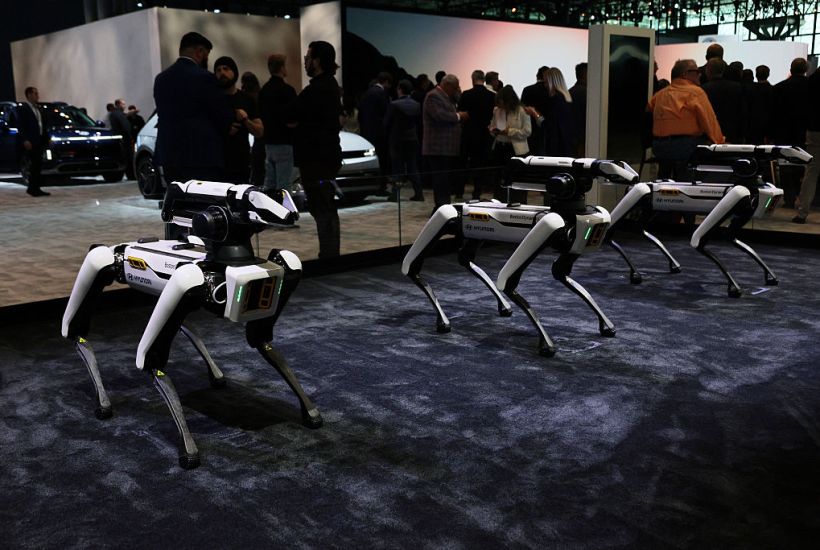
Picture this: you’re walking down the sidewalk on a bright summer’s day. A K-9 patrol vehicle parks nearby – but instead of a dog getting out of the backseat, a tactical robot emerges.
This is the future that PETA has imagined for us all, judging by a letter from the animal rights group in response to a K-9 injury in Michigan last week. Digo, a canine with the Grand Rapids Police Department, was nonfatally stabbed three times, once in the head, while working to help police apprehend a violent suspect.
In response, PETA wants robots and drones to replace the animals entirely.
“Unlike their human counterparts, K-9s do not sign up to risk their lives,” PETA manager of special projects Allison Fandl wrote in a June 2 letter to interim chief Joseph Trigg. “They are loyal and protective, but they cannot consent to be used in violent encounters they did not cause or escalate.”
Police1 reported that activists want the Grand Rapids department to replace their dogs with advanced technology, including tactical robots, drones and portable mass spectrometers.
“Police officers choose to take on the daily risks of their duties, but dogs like Digo don’t have a choice,” said PETA senior vice president Daphna Nachminovitch.
Grand Rapids Police responded to a report of a man threatening his family members with a knife. Arriving at the scene, officers were met by Eddie Deans Jr, 46, who threw a Molotov cocktail at their squad car while fleeing.
The situation escalated as Deans attempted to carjack a family at knifepoint and then enter another residence, failing and eventually running from law enforcement. Digo, the K-9, was then released towards the suspect after he attempted to charge at responding officers with a knife. Deans was fatally shot by officers and Digo suffered three nonfatal stab wounds. While he is expected to make a full recovery and return to the K-9 team if his fitness permits, it was revealed later the K-9 tactical vest prevented the injuries from being deadly. The injuries Digo sustained drew the attention of PETA, causing organizers to proclaim their radical desires for K-9s to be phased out altogether.
They say robots are coming for our jobs – who knew that time could be up for dogs as well?
Let’s examine PETA’s solution. To thoughtfully consider K-9s’ consent, police departments should take their budget and replace dogs entirely with state-of-the-art technology. To do so, the departments would likely have to deplete other areas of funds. Or, as mentioned in PETA’s letter, police should use their limited time to research and apply for grant funding to achieve this goal.
While Cockburn loves canines and wishes them no harm, it seems unrealistic to eliminate K-9s altogether. The police, after experiencing politically motivated defunding, do not have the resources and time to implement such a futuristic change. What’s more, PETA’s proposal would potentially violate two of Asimov’s “Laws of Robotics”: “a robot may not injure a human being” and “a robot must protect its own existence.”
Unless PETA buys the robots themselves, and can ensure they have the same speed, scent and cognitive capabilities as the highly-trained K-9s, Cockburn suggests we leave the robo-dogs with lethal capabilities in Black Mirror.