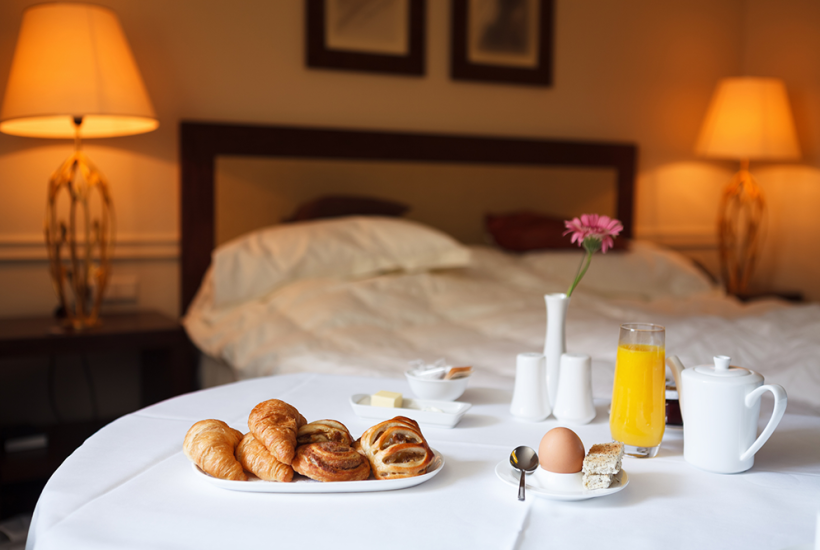
To B&B or not to B&B? That is the question. Whether it’s nobler to offer breakfast to a guest is not in question, but whether it’s possible has been my dilemma since I started my guest house.
After reading Ross Clark on The Spectator website saying that he longs for the traditional B&B, all I can say is I’ve really tried to be that landlady he describes, in pink fluffy slippers, frying bacon in a house with Artex walls.
I’ve tried to take people who roll up late at night, I’ve tried to put the second B back into the enterprise, and I’ve tried to cope with customers who, like Ross, want the option of a cooked breakfast but not a fry-up – porridge, made just the way they want it, which is different for every single customer. Yes, I’ve tried to cope with all this.
It didn’t go down too well. The first issue is the amount customers want to pay me for a bed and psychic prediction of what they want to eat in the morning.
I do not blame Airbnb for killing the traditional B&B. Because it was already long dead
This goes to the heart of why the traditional B&B really died in the first place, with people like me doing Airbnb, the only readily available comparable experience.
I blame Airbnb for a lot of things, like piling all its service fee on me from next month, rather than splitting it between me and the customer. I also blame Airbnb for not standing up to the greedy Irish tourist board now it wants a cut of the profits by charging me a yearly registration fee on top of that.
But I do not blame Airbnb for killing the traditional B&B. Because it was already long dead. And what Airbnb did was give people like me the chance to resurrect it again.
The traditional B&B was killed off by excellent budget hotels like Premier Inn and Travelodge offering near-perfect hotel conditions almost everywhere, with seemingly limitless breakfast opportunities for a price that could not possibly be competed with by people who offer, whether good-heartedly or not, slightly crumby rooms in the buildings where they live.
People like Basil and Sybil Fawlty, with all their faultiness, and people like the builder boyfriend and me with all ours – we are not service industry naturals. We can offer, in order to make a quick buck, heaps of charm and Artex, but we can’t offer the option of ‘everything’, which is what people want. And we can’t offer it for next to nothing, or £37 a night midweek as the Travelodge can, or £60 at the Premier Inn in the branches I’ve stayed in, such as the one in Cobham, which I use when I visit the UK and which is so brilliant it defies logic.
They deal in bulk, you see. Here at Kitey Towers, West Cork, we have a couple of rooms – theme of faded grandeur with modern plumbing – and we want to expand if we can. But that’s only if people manage their expectations. We drive the price down, but we can’t get it low enough, and we know this because people won’t book unless it’s below the €100 a night mark – about £80-90 a night for two, with breakfast.
‘With breakfast’ has become my least favourite phrase in the English language. Breakfast is the end of the world.
You see, I buy all the breakfast items I need for most options, and then a customer arrives and wants coconut-milk porridge or muesli with no nuts or gluten-free bread.
I tried for a while to be this well-prepared, but we slipped into deficit with all the rotting non-dairy yoghurt in the fridge and all the stupid kinds of non-milk, and it would have bankrupted us.
I’ve tried asking people to choose breakfast when they book their room but they don’t want to. They want a hotel experience with a folksy, informal feel.
At the Premier Inn, you have to click the breakfast option when you book and you can’t change your mind, no matter how much you beg the lady at reception. I personally found I had to bribe the lady in the breakfast room with a large cash tip.
But people do what they’re told in big hotels. They wouldn’t dream of turning up and arguing, because they’d get turned out on the street.
Our customers arrive with the abominable confidence of thinking we must be grateful to have them and then start making demands as soon as their feet hit our doormat.
They take possession of their €100 a night room at 9 p.m., preparing to enjoy their two very long hot showers and demand what they want to eat the next morning when the village shop has closed.
Or they wait until the next morning, and when I serve their eggs they don’t care what I say in protest to ‘What, no hot sauce?’ because they’ve decided that a) I am lucky to have them, and b) all the romance of this experience is in the informality.
‘I’ll just pop down to the village to get you that, or drive an hour to Cork city – no, I insist!’ is what I’m meant to say to the American who asks for hot sauce, or the Irish musician who asks for coconut milk, because that is what a lady in pink slippers would do.
In a last-ditch bid to make our place work, I’ve resorted to the dreaded breakfast bar
They want to go home and say to their friends: ‘We stayed in this big old place owned by a writer and she drove miles to get chipotle for our eggs!’
The traditional B&B is dead because of the brilliance of the budget hotel with its Hypnos beds and vast cooked breakfast spreads – and it’s dead because of the abominable confidence of the modern consumer and their infernally capricious demands.
Airbnb, arguably, is the only forum offering the little people the chance to compete at all. But just one person who doesn’t like an Artex ceiling, or the way you’ve made their porridge, drops you into a black hole from which you may never return. The tyranny of Tripadvisor… this too has killed the traditional pink-slippered bacon-frier.
Everything has to be perfect now. In a last-ditch bid to make our place work, I’ve resorted to the dreaded breakfast bar.
The BB has always said a cold buffet is how it has to be done, and with a heavy heart I admit he was right.
I wanted to be the lady in pink slippers frying bacon under an Artex ceiling. I tried. But it cannot be done.
Got something to add? Join the discussion and comment below.
You might disagree with half of it, but you’ll enjoy reading all of it. Try your first month for free, then just $2 a week for the remainder of your first year.